



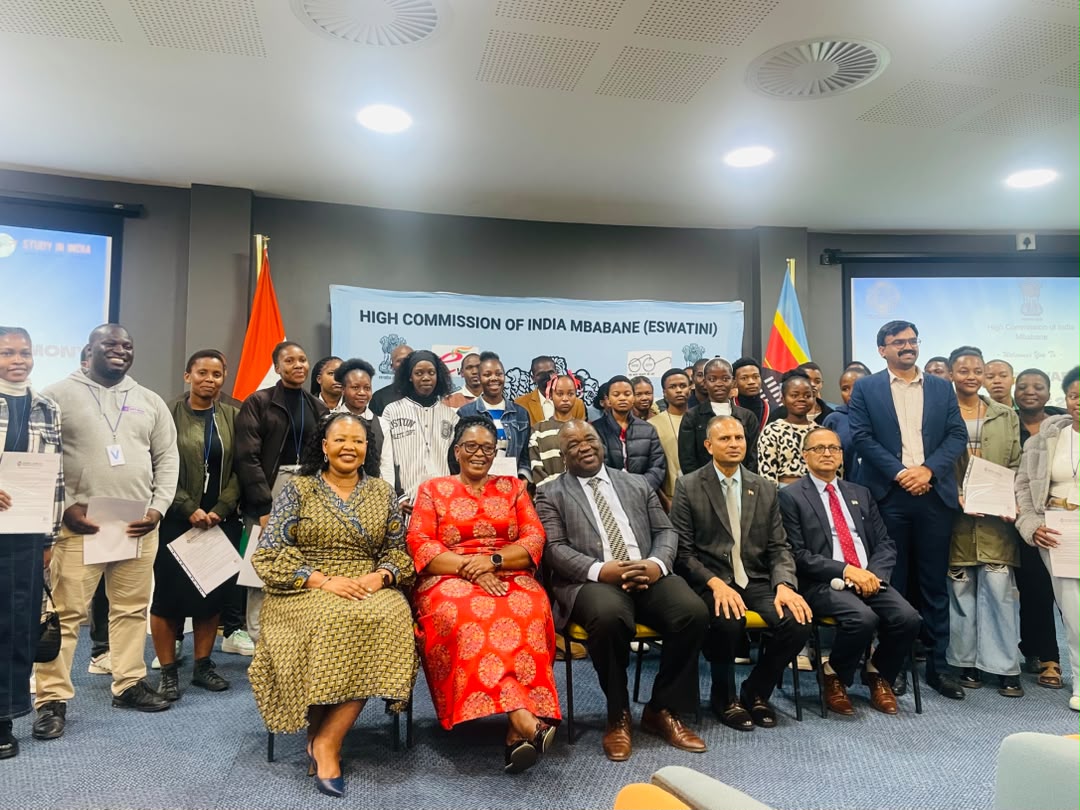
MBABANE- The Government of India has reaffirmed its commitment to supporting Eswatini’s human capital development through the award of Indian Council for Cultural Relations (ICCR) scholarships to outstanding Emaswati students, describing education as the cornerstone of national development and a powerful bridge between the two nations.
Speaking during the ICCR Scholarship Awards Ceremony held on Friday, India’s High Commissioner to Eswatini, His Excellency N. Ram Prasad, congratulated the successful scholarship recipients and encouraged them to use the opportunity to acquire knowledge and skills that will contribute to Eswatini’s long-term development.
Addressing the gathering, which was attended by Deputy Prime Minister Thulisile Dladla, Minister for Foreign Affairs and International Cooperation Senator Pholile Shakantu, government officials, educators, parents and scholarship recipients, the High Commissioner said the scholarships represented far more than financial assistance.
“It is a great honour for me to stand before you today on behalf of the Government of India to celebrate a moment that matters deeply to both Eswatini and India, which is the award of ICCR scholarships to the next generation of Eswatini leaders and professionals,” he said.


Prasad described education as a transformative force that not only changes individual lives but also strengthens communities, institutions and national economies.


“Education transforms lives. It opens doors that once seemed closed, expands horizons, and gives young people the tools to turn aspiration into achievement. But education is more than personal advancement. It is a public good that builds stronger communities, more resilient institutions and more inclusive economies,” he said.
He noted that the longstanding friendship between India and Eswatini is built on mutual respect, shared values and a common belief in unlocking human potential. According to Prasad, the ICCR scholarships reflect India’s continued investment in people, whom he described as the greatest resource any nation can possess.
He said the scholarships also serve as bridges that strengthen cultural understanding between the two countries while creating lifelong networks of cooperation.
Linking the programme to Eswatini’s national development agenda, Prasad said the education acquired in India would help advance His Majesty King Mswati III’s Nkwe vision of prosperity, social well-being and sustainable development.
“Whether the goal is to strengthen public health systems, sharpen skills in trade and technology, modernise agriculture or enrich the cultural life of the nation, the learning you receive in India will be a foundation for progress back home in Eswatini,” he said.
The High Commissioner revealed that interest in the scholarships continues to grow significantly, with 426 applications received this year for a limited number of awards—more than 10 applications competing for every available scholarship.
He explained that all applications were assessed by a three-member committee and that recipients were selected strictly on merit.
“So the scholarship awardees for this year can take pride in having competed against the best in Eswatini and succeeded,” he said.
Encouraging the recipients to make the most of their studies, Prasad urged them to embrace every learning opportunity while in India by developing not only technical expertise but also critical thinking, ethical leadership and cross-cultural collaboration.
He further encouraged them to immerse themselves in India’s rich diversity, entrepreneurial culture, scientific advancement and artistic heritage before returning home to apply their knowledge for the benefit of Eswatini.
“The scholarship is also about service to the nation. The real value of your education will be measured by how you apply it to improve lives in Eswatini,” he said.
Prasad challenged the students to return as innovators, entrepreneurs, educators, public servants and cultural ambassadors capable of driving national progress while mentoring future generations.
He also acknowledged the role played by parents, educators and government institutions in supporting the students, urging stakeholders to continue creating opportunities that would allow graduates to contribute meaningfully through employment, entrepreneurship and public service.
The High Commissioner reaffirmed India’s commitment to expanding cooperation with Eswatini beyond scholarships through faculty exchanges, vocational training, technology partnerships and cultural programmes designed to support the country’s development priorities. Concluding his address, Prasad described education as “the most powerful instrument” for changing the world and encouraged the scholarship recipients to use their knowledge to build institutions founded on integrity and create a future where every child in Eswatini has the opportunity to fulfil their potential


Discussion about this post