



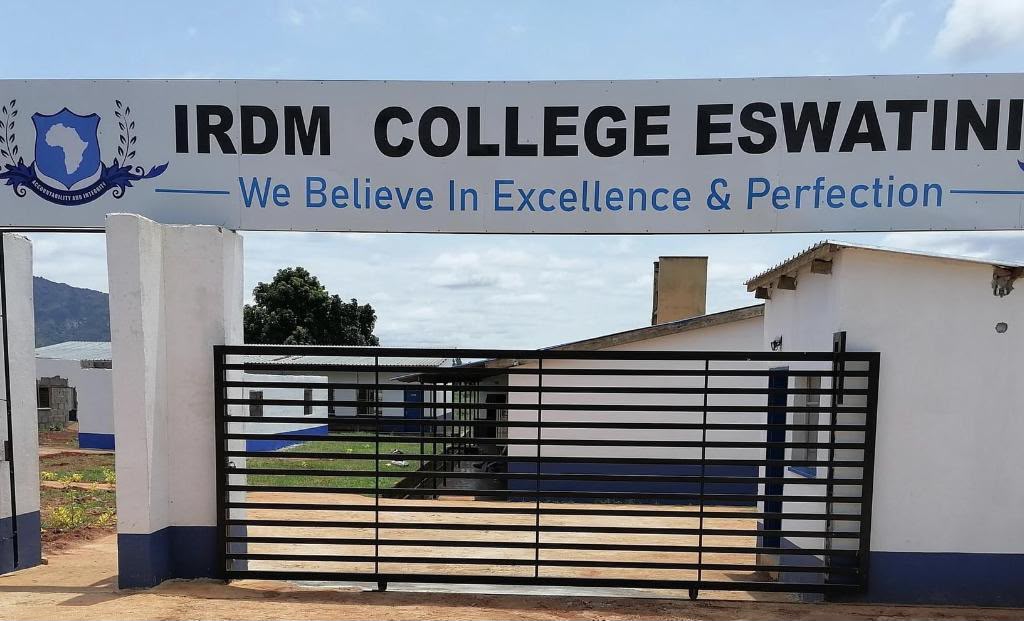
Mahlanya– IRDM College has ended its academic affiliation model with Copperstone University and is transitioning to a partnership arrangement that places locally developed programmes at the centre of its academic offering, with six new diploma and certificate programmes now awaiting approval from the Eswatini Higher Education Council (ESHEC).
The institution said the transition is in response to ESHEC’s localisation policy, which requires higher education institutions to align their programmes with Eswatini’s economic, social and labour market needs.
IRDM College Founder and Director, Dr Oliver Museka, said the move reflects changes in the country’s higher education landscape while maintaining the institution’s relationship with Copperstone University.
“Our relationship with Copperstone University has been valuable and remains so, but the regulatory environment and our national responsibility have evolved. We are now positioned to lead localisation in Eswatini’s higher education sector by developing programmes that speak to our economy, our employers and our students’ futures,” he said.


Dr Museka assured students and parents that those enrolled under the existing Memorandum of Understanding signed with Copperstone University in February 2020 would complete their studies without interruption.
He said all students registered under the current arrangement are protected and will finish their programmes under the existing agreement, adding that the institution considers this commitment non-negotiable.


At the centre of the transition are six new programmes submitted to ESHEC for registration. They include a Diploma in Retail Management, Diploma in Forensic Investigation and Security Management, Diploma in Forensic Auditing and Accounting, Diploma in Psychosocial Counselling (Localised), Diploma in Customer Experience Management and a Foundation Certificate in Business.
According to the college, the programmes were developed in consultation with employers, non-governmental organisations and government stakeholders to address skills required in Eswatini’s labour market.
The institution currently offers three ESHEC-registered diploma programmes in Business Studies, Security Management and Psychosocial Counselling, as well as three approved short courses offered to individual learners and corporate clients.
IRDM College said ESHEC’s localisation policy encourages institutions to move away from relying solely on imported academic curricula and instead offer programmes that respond to local employment needs. It cited sectors such as security, forensic services, counselling, retail and business as areas where specialised skills are in demand.
Dr Museka said the institution views the transition as an opportunity to expand programmes that are relevant to Eswatini.
“We are not being pushed into this. We are choosing to champion it because our founder’s vision has always been rooted here in Eswatini, for Eswatini,” he said.
The college, established in 2013, said it has awarded more than 100 scholarships to emaSwati over the past 12 years.
Dr Museka dismissed speculation that the transition would affect the institution’s operations, saying IRDM College remains fully operational.
“We are not closing. We demonstrated this in 2024 when we offered students a 50 per cent scholarship in response to economic hardship. As the founder, I remain personally invested in every student who chooses IRDM,” he said.
Under the new model, IRDM College will award ESHEC-registered diplomas while Copperstone University will continue providing academic input through the partnership. The institution said quality assurance will be overseen by ESHEC together with feedback from industry partners, replacing the previous model under which academic validation was primarily undertaken through Copperstone University.
IRDM College has also invited students, parents, employers and government officials to visit its campus to inspect documentation relating to the transition and the measures put in place to protect currently enrolled students.


Discussion about this post