



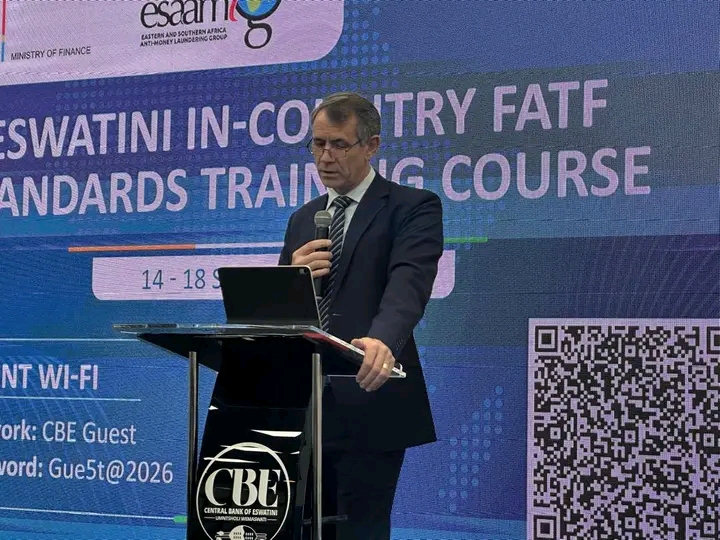
Ezulwini – Eswatini’s progress in meeting international anti-money laundering standards could strengthen investor confidence and improve the country’s financial sector standing, Finance Minister Neal Rijkenberg has said.
The country is now rated Compliant or Largely Compliant on 32 of the 40 Financial Action Task Force (FATF) Recommendations, following reforms implemented after Eswatini’s Mutual Evaluation Report in 2022.
Rijkenberg said the progress was important for the business environment as strong controls against money laundering and terrorist financing help protect the financial system from abuse while supporting confidence among investors and financial institutions.
He was speaking on Monday when he officially opened the Eastern and Southern Africa Anti-Money Laundering Group (ESAAMLG) In-Country FATF Standards Training Programme at the Central Bank of Eswatini head office.


The minister said Eswatini had since undergone re-ratings on 18 FATF Recommendations, reflecting improvements in its anti-money laundering, counter-financing of terrorism and proliferation financing framework.
He said one of the major reforms was the enactment of the Anti-Money Laundering, Counter Financing of Terrorism and Proliferation Financing (Miscellaneous Amendments) Act, 2024.


According to Rijkenberg, the legislation strengthened the country’s legal and regulatory framework and addressed several shortcomings identified during the 2022 evaluation.
He said improved compliance was not only a regulatory achievement but also important for the wider economy.
“The FATF standards provide an internationally recognised framework for protecting financial systems and economies against illicit financial activities,” he said.
Rijkenberg said effective implementation of the standards would help promote financial sector stability, strengthen investor confidence and reduce the risk of criminal elements abusing Eswatini’s financial system.
For businesses operating in the country, stronger AML/CFT controls also mean greater emphasis on measures such as customer due diligence, reporting suspicious transactions and managing financial crime risks.
However, the minister cautioned that passing laws and improving ratings would not be enough to secure lasting progress.
“While we are encouraged by these achievements, we recognise that there is still work to be done, particularly in demonstrating the effectiveness of our measures and ensuring their consistent implementation across all sectors,” he said.
He said the next challenge was therefore to demonstrate that the reforms were working in practice as Eswatini prepared for future assessments.
Rijkenberg highlighted compliance with national AML/CFT laws, prompt reporting of suspicious transactions, risk-based supervision and stronger cooperation between the Financial Intelligence Centre and law enforcement agencies as areas requiring continued attention.
He said the country’s performance should ultimately be judged by the results produced by its financial crime controls rather than the number of laws enacted.
“Our success as a country will not be measured solely by the laws we have enacted, but by our ability to demonstrate effective implementation and meaningful results in preventing and combating money laundering, terrorist financing and proliferation financing,” Rijkenberg said.
He urged participants attending the ESAAMLG training programme to translate the knowledge gained into practical measures within their institutions.
The programme is expected to strengthen understanding of FATF standards among relevant stakeholders and help institutions identify gaps in their compliance systems.


Discussion about this post