



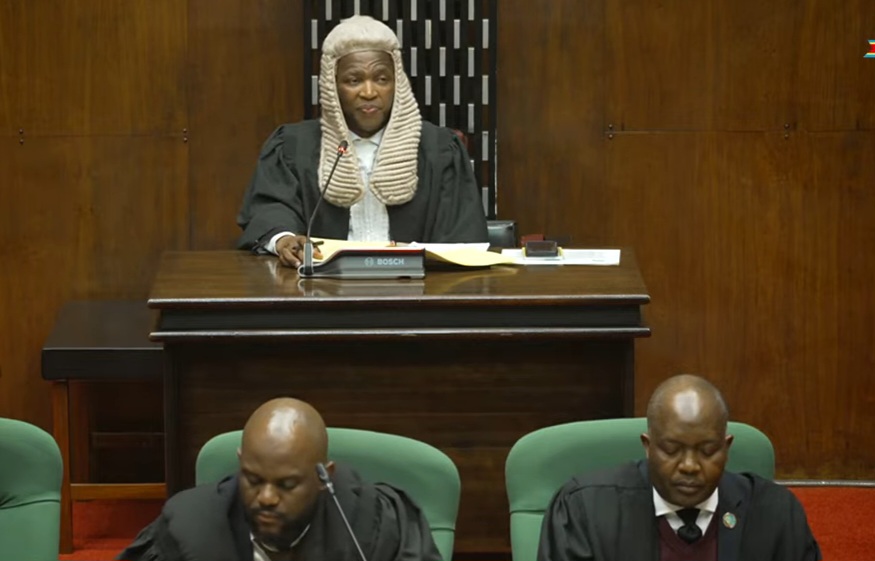
Lobamba – The long-awaited report of the Parliamentary Select Committee that investigated alleged unfair labour practices and workplace conditions at Eswatini Broadcasting and Information Services (EBIS) and Eswatini Television Authority (ESTVA) was tabled before the House of Assembly on Wednesday afternoon, marking the conclusion of an inquiry that has been in the making for nearly a year.
The report was presented to the House by Select Committee Chairperson and Somntongo Member of Parliament Sandile Nxumalo, who led the seven-member team tasked with investigating allegations raised by employees at the two State-owned broadcasters.
The select committee chair was represented by Deputy Speaker Madala Mhlanga
The committee was appointed by the House of Assembly on September 11, 2025, after Mtfongwaneni MP Nathie “Mdockies” Hlophe successfully moved for Parliament to institute an investigation into complaints of alleged unfair labour practices and poor working conditions at the two institutions.
Hlophe argued at the time that the allegations warranted parliamentary intervention to establish the facts and ensure that workers’ rights and welfare were adequately protected.
Besides Nxumalo, the committee comprised Sabelo Ndlangamandla (Matsanjeni South), Wilton Nkambule (Motshane), Sibongile Mamba (Mtsambama), Hope Shiba (Nkhaba), Bonginkosi Dube (Phondo) and Sabelo Sibandze (Nkilongo).


The tabling of the report is expected to pave the way for Members of Parliament to debate its findings and recommendations before the House determines the way forward.
The investigation attracted significant public interest after it was launched, with many emaSwati welcoming Parliament’s decision to probe the working conditions at the national broadcasters. Some members of the public called for similar investigations into other public institutions and private companies, arguing that concerns over labour practices extended beyond the media sector.
Others urged Parliament to broaden its oversight role to include public hospitals, citing concerns over working conditions for health professionals, shortages of medicines and the quality of healthcare services.
The report on EBIS and Eswatini TV was among key committee reports scheduled for tabling during the day’s sitting, alongside the report of another Select Committee established to investigate the circumstances that led to the impasse that rendered the Board of Directors of the Eswatini National Provident Fund (ENPF) dysfunctional.


Discussion about this post