



New Delhi this week becomes the meeting point of political leaders and some of the world’s most powerful technology executives as India stages the fourth AI Impact Summit under the leadership of Prime Minister Narendra Modi.
The week long gathering, attended by thousands of technology executives, government officials and AI safety experts, seeks to shape how artificial intelligence will be governed and deployed across the global south. For countries such as Eswatini, where conversations around digital transformation and innovation continue to gather pace, the outcomes of this summit could influence how AI is applied in agriculture, water management, education and public health.
Among those flying into Delhi are Sundar Pichai of Google, Sam Altman of OpenAI and Dario Amodei of Anthropic. They are joined by former British prime minister Rishi Sunak and former chancellor George Osborne, both now closely linked to AI ventures. Sunak holds roles with Microsoft and Anthropic, while Osborne is leading OpenAI’s drive to expand ChatGPT beyond its current 800 million users.
Leaders from Kenya, Senegal, Mauritius, Togo, Indonesia and Egypt are sending ministers, placing developing economies alongside corporations valued in the trillions of dollars. Many of these nations face average monthly wages below 1,000 US dollars, a reality that frames the debate over who benefits from AI and how.


Modi is expected to address the summit on Thursday, positioning India as a technology hub for south Asia and Africa. On the agenda are discussions on how artificial intelligence can transform farming systems, secure water supplies and strengthen public health infrastructure.
Yet the push for rapid AI adoption has drawn criticism from civil liberties groups in India. Campaigners last week voiced concerns that the technology could be used to expand state surveillance, discriminate against minorities and influence elections. Modi has defended his government’s approach, speaking of “harnessing artificial intelligence for human-centric progress” under the summit theme “Welfare for all, happiness for all.”
Observers describe the Delhi meeting as a contest between dominant United States technology firms and a model some call techno Gandhism, where AI is steered toward social justice and support for marginalised communities. Previous summits were held in the United Kingdom, South Korea and France, making this the first edition hosted in the global south.
António Guterres, Secretary General of the United Nations, is due to speak in Delhi. He said this week it would be “totally unacceptable that AI would be just a privilege of the most developed countries or a division only between two superpowers”.
The summit traces its roots to 2023 when Sunak launched the first gathering at Bletchley Park in the UK, focusing on cooperation to prevent catastrophic risks from advanced AI systems. Follow up meetings were held in Seoul in 2024 and Paris in 2025. At the Paris event, US vice president JD Vance said: “The AI future will not be won by hand-wringing about safety; it will be won by building.”
Safety concerns remain central in Delhi. Yoshua Bengio warned that AI capabilities are advancing faster than safeguards. “The capabilities of AI have continued to advance, and although mitigation and risk management of AI has also progressed [it has happened] not as quickly,” he said on Tuesday. “So it becomes urgent that leaders of this world understand where we could be going and it needs their attention and intervention as soon as possible.”
Nicolas Miaihle of AI Safety Connect noted that the summit unfolds against the backdrop of AI enabled warfare in Ukraine and the Middle East. “The existential risks are not going anywhere,” he said. “When Rishi Sunak started this, the race was not raging as hard. The trillions are pouring in but we are very far away from securing these models. This is profound for democracy, profound for the mental health of our kids and profound for warfare.”
The administration of former US president Donald Trump continues to resist tighter regulation of American AI firms. The White House is not expected to send a senior figure, with Sriram Krishnan, its AI policy adviser, listed as the highest ranking representative on the programme. One senior AI company source said it was unlikely there would be a major breakthrough on a global regulatory framework under the current US stance.
Google’s investments in India include a 15 billion US dollar partnership with the conglomerate of Gautam Adani to build a gigawatt scale AI data centre hub in Visakhapatnam in Andhra Pradesh, linked to global networks through subsea cables.
The company is also directing attention to education. Owen Larter of Google DeepMind said access and adoption were key priorities. “[There’s] a big focus on access and adoption, how can you make sure that the technology is available as broadly as possible,” he said. “We’re excited on the education front in India. It’s a remarkable story of an incredibly intense adoption. About 90% of teachers and students already using AI in their learning. We’ve had a big promotional programme where 2 million students have access to our pro subscription for free.”
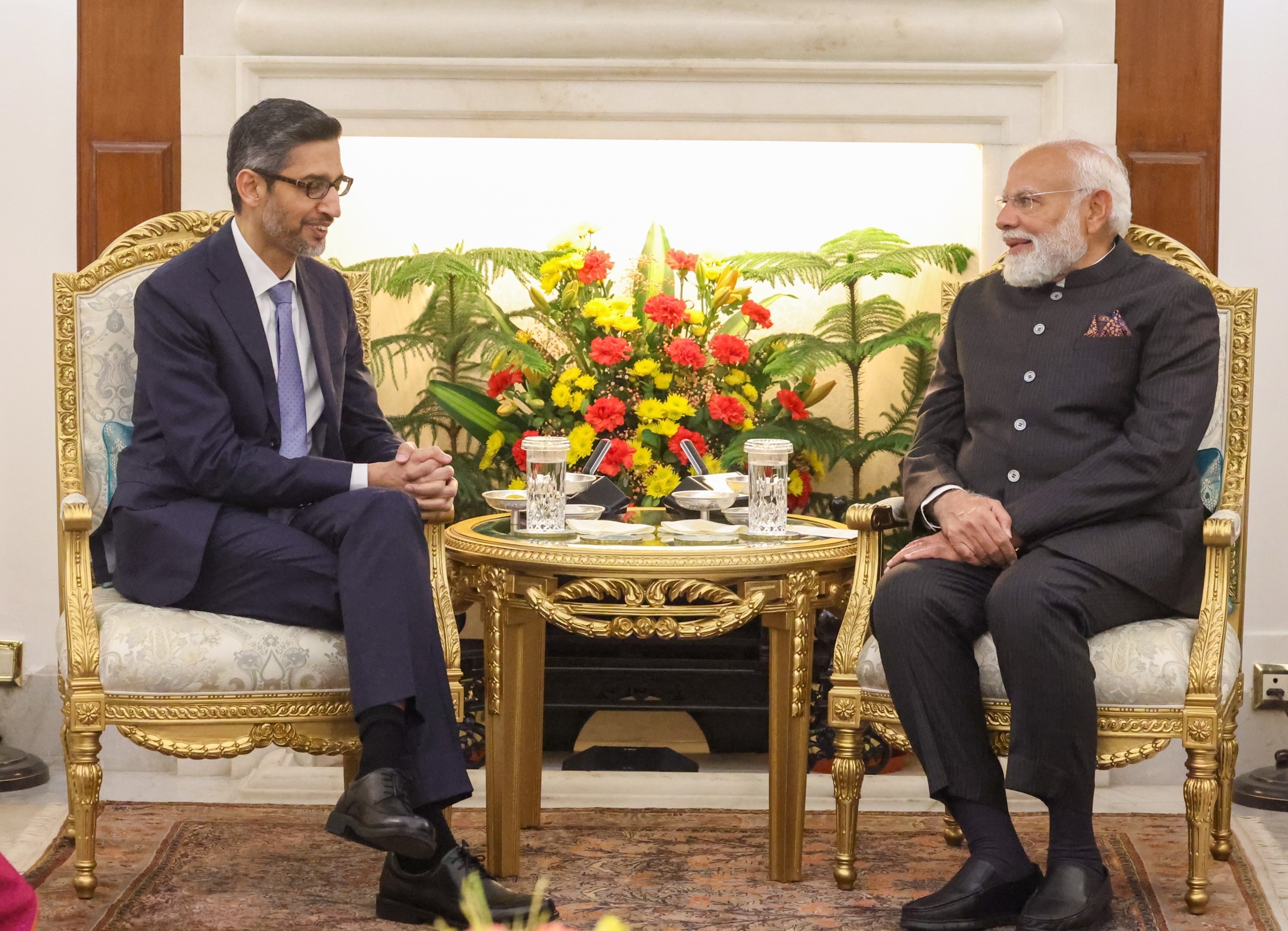
On the sidelines of the summit, Modi shared details of his engagements. He tweeted, “It was a delight to meet Mr. Sundar Pichai on the sidelines of the AI Impact Summit in Delhi. Talked about the work India is doing in AI and how Google can work with our talented students and professionals in this field”.


He also posted about talks with Spain’s leader. “Had a productive meeting with President Pedro Sánchez in Delhi. Discussed ways to boost the India Spain friendship, especially in areas such as defence, security, technology and more. Our nations are marking 2026 as the India Spain Year of Culture, Tourism and AI. This will deepen people to people linkages. Glad to see a big delegation of Universities also come to India. This too will go a long way in connecting our people.
The historic FTA with the EU will have a very positive impact on the economic partnership with Spain and provide new opportunities to the people of our nations.”


Discussion about this post