



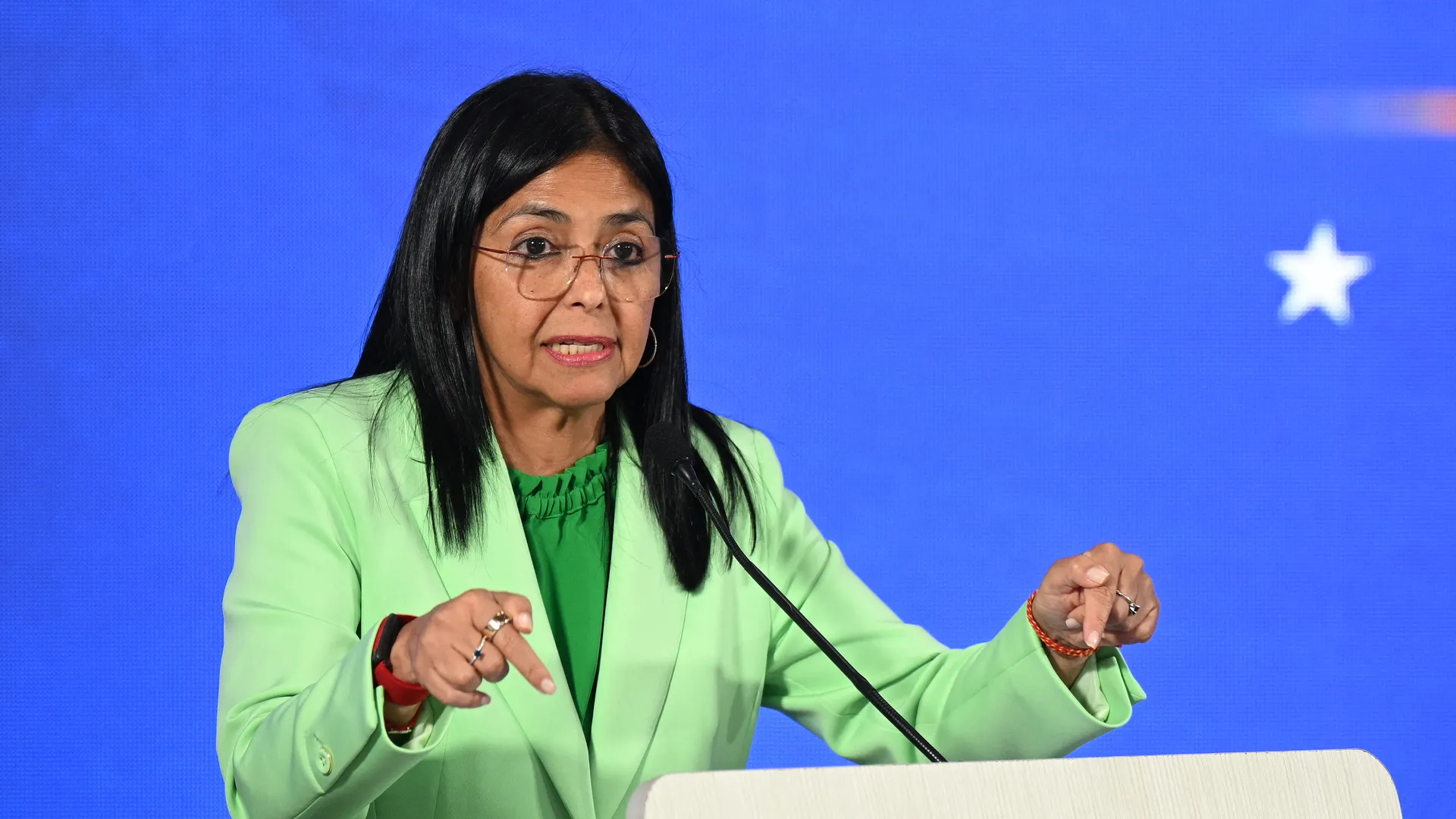
Venezuelan Vice President Delcy Rodriguez was sworn in as the interim president after the United States President Donald Trump captured Nicolas Maduro on Saturday.
Many observers would have thought that opposition leader Maria Corina Machado would step in to fill the power vacuum in light of Trump’s noted support.
However, Trump recently told reporters that Machado lacks the country’s support.
“Well, I think it would be very tough for her to be the leader. She doesn’t have the support within or the respect within the country. She’s a very nice woman, but she doesn’t have the respect,” President Trump said.

Trump, who has outspokenly supported Machado to claim the Nobel Peace Prize last year, and she partly dedicated it to him, announced that his office prefers to work with Rodriguez, 56, instead who was appointed by the Supreme Court as the acting president.
Rodriguez will officially take “the office of President of the Bolivarian Republic of Venezuela, in order to guarantee administrative continuity and the comprehensive defence of the Nation” .
Trump pledged to work with Rodríguez to make Venezuela “great again.”
But Rodriguez had hit back and publicly demanded Maduro and his wife, Cilia Flores’ proof of life from the US after he was captured in a military operation. She also issued a broadcast address requesting for confirmation of Maduro’s status and location, as well as denouncing the US activities.
“We call on the peoples of the great homeland to remain united because what was done to Venezuela can be done to anyone. That brutal use of force to bend the will of the people can be carried out against any country,” she said on the state television channel VTV.
Further criticism focuses on the yet-to-be-shared definite deadlines for settling the Venezuelan crisis by either the US or Venezuela during Maduro’s ‘forced absence’.
The Venezuelan constitution, Article 234, states that the vice president will fill the president’s temporary absence for up to 90 days. However, Noris Soto, a journalist, told DW News that this limitation is uncertain.
Rodriquez could well be acting beyond the 90 days, which the National Assembly could extend by law.
“She [Rodriquez] took power but not under the image of a complete lack of the presidency but as a temporary lack of the president. Meaning that she can stay after the 90 days that the constitution states. She can renew these powers as long as she wants… approved by the National Assembly,” Soto said.
Soto also said that the biggest fear among the people is that nothing’s going to change and “that Chavez will stay in power but now be led by Delcy Rodriguez.”
“So, this means that she could stay for those 90 days without calling for new elections. And this is very dangerous; if you see it in a way, it could mean that she could stay over a year or more in power. As long as she has the US backing,” she said.


Jesus Renzullo, a Latin American expert and research fellow at the German Institute for Global and Area Studies, said the appointment by the Venezuelan Supreme Court was a logical transition given the hints that the US government and Venezuela’s current power configuration were.
“It basically means that the US does believe that the country could go into instability if they do not maintain some of the current structure in place. It is also likely that there was some operation between the political elite in Caracas in order to take down Maduro. Basically a sacrifice to maintain power,” he said.
Renzullo also averred that the US administration will work with the Rodriguez brothers and others of Caracas’ political elite in the medium term to stabilise the country and prevent it from devolving into another catastrophe.




Discussion about this post