



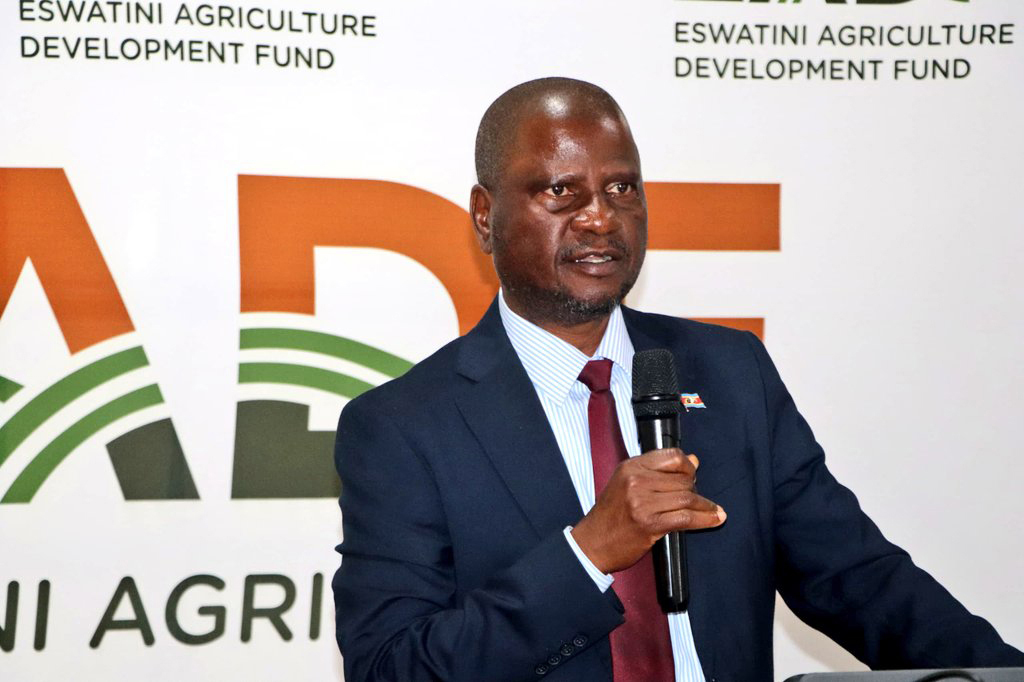
Eswatini’s Minister of Agriculture, Mandla Tshawuka, has called on farmers to boost maize production as the government ramps up efforts to achieve food sovereignty through the Hamba Ubuye programme, administered by the Eswatini Water and Agricultural Development Enterprise (EWADE).
Speaking in Ntfonjeni on Wednesday during the launch of the 2025/26 planting season, Tshawuka distributed inputs to 14 farmers from the Ntfonjeni cluster and warned that expanding local maize output was critical to avoid “exporting money and jobs” to South Africa, the country’s main source of imported staples.
Food sovereignty, he said, is a national priority, requiring more Eswatini Nation Land to be brought into cultivation. Early rains, he noted, had created favourable planting conditions, and farmers were urged to “make every hectare count.”
Government has injected E14 million into the Hamba Ubuye Revolving Fund this season, enabling EWADE to distribute inputs valued at over E18 million to 248 farmers, 192 men, 56 women and 21 youth, who are projected to plant 1,861 hectares and produce 7,444 tonnes of maize. As of Wednesday, 147 farmers across the country had already received inputs worth E11,764,875.10.

In Hhohho, 44 farmers will receive support totalling E3,310,782 to cultivate 293 hectares, with an expected yield of 1,172 tonnes. Fourteen beneficiaries from Ntfonjeni alone are projected to plant 90 hectares and harvest 360 tonnes.


Tshawuka highlighted the importance of timely delivery of seeds, fertilisers and chemicals, saying agriculture is “a race against time” where delays can compromise yields. He commended EWADE’s Commercial Maize Project team, ministry extension officers and input suppliers for ensuring prompt distribution and called on the National Maize Corporation (NMC) to provide technical support and to manage the maize market by receiving all harvests.
Since its inception in 2021, Hamba Ubuye has expanded rapidly. The first season saw 17 farmers plant 172.5 hectares and harvest 594 tonnes of maize from inputs worth E839,074, with 92% recovered. By 2022/23, 73 farmers harvested 1,362 tonnes from 545 hectares following E4,968,027 in inputs, recovered at 88%. The 2023/24 season supported 106 farmers producing 2,148 tonnes from 856 hectares with E6,493,517 in inputs, achieving an 89% recovery rate. In 2024/25, 206 farmers harvested 3,530.17 tonnes from 1,567.78 hectares, supported by E14,014,983.45 in inputs, with a 78% recovery rate.
Tshawuka said the programme was key to reducing Eswatini’s E2 billion annual food import bill, strengthening domestic value chains and retaining capital in the local economy. He challenged Ntfonjeni to reclaim its reputation as a major maize-producing cluster and contribute significantly to national grain reserves.
“Raising yields is critical if we are to reduce imports, retain capital and build an agricultural sector capable of generating jobs and export earnings,” he said, officially opening the 2025/26 maize season.


Discussion about this post