



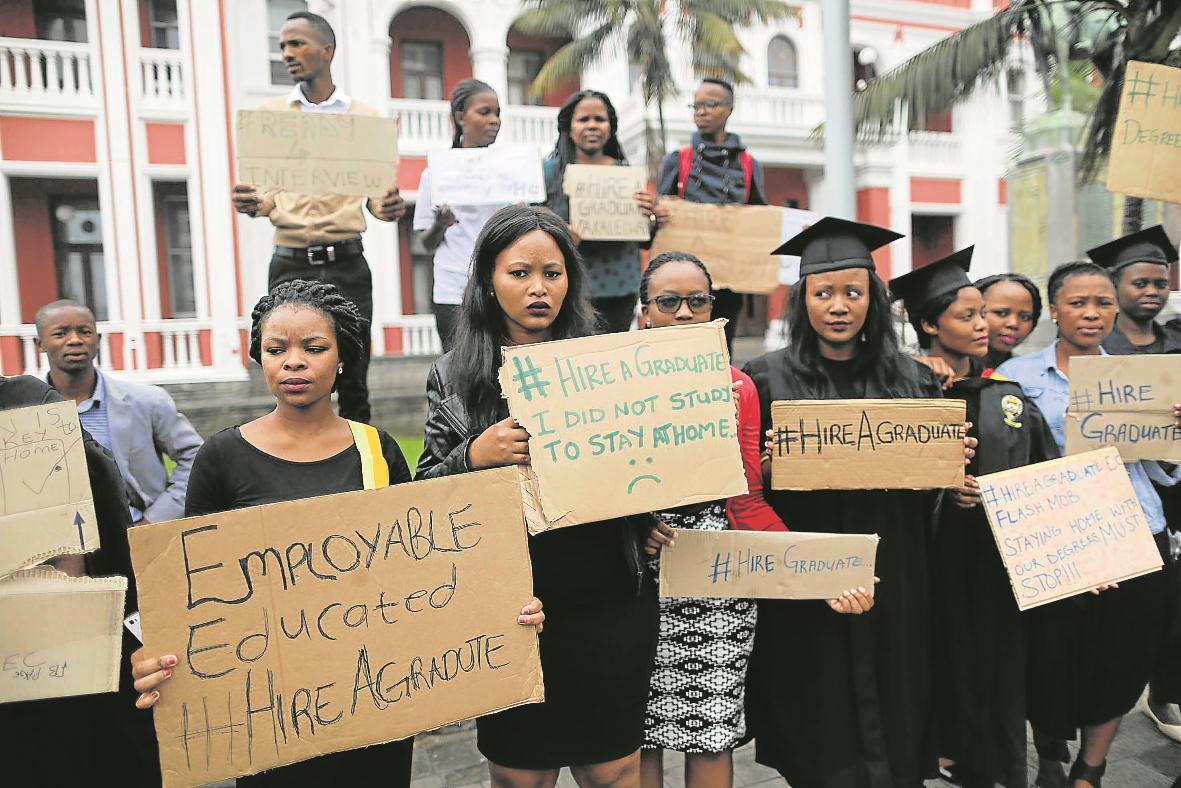
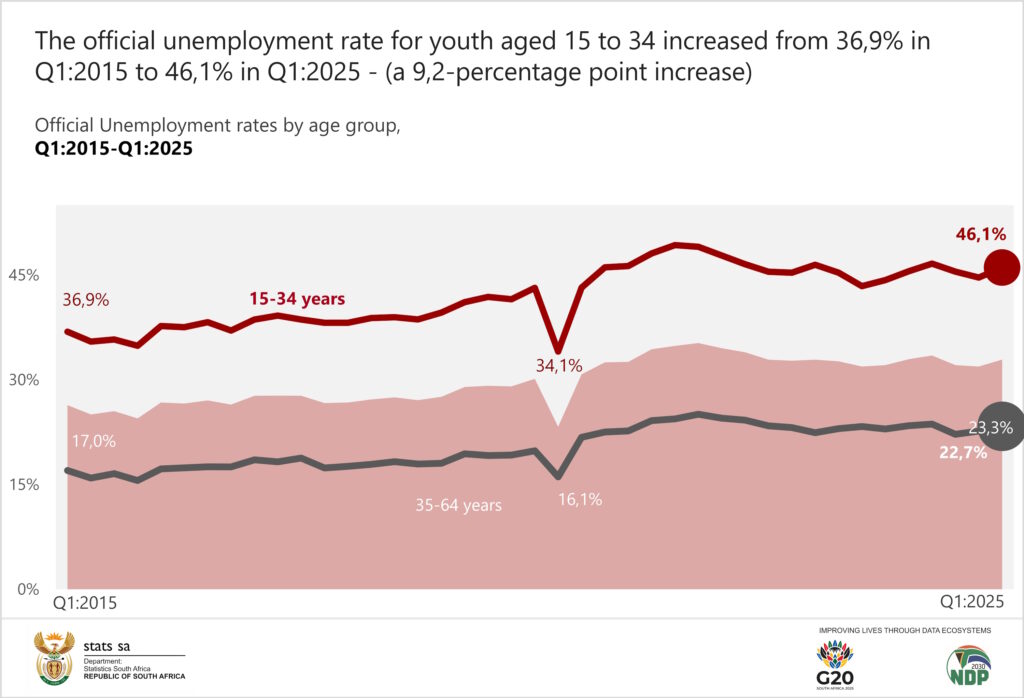
South Africa’s youth are facing an increasingly grim job market, with unemployment among those aged 15 to 34 rising sharply over the past decade. This is according to the latest Quarterly Labour Force Survey (QLFS) for the first quarter of 2025, released by Statistics South Africa.
The data shows that young people now constitute about 50.2% of the country’s working-age population—approximately 20.9 million individuals. Yet nearly half of them remain unemployed. The national youth unemployment rate has climbed from 36.9% in the first quarter of 2015 to 46.1% in the same quarter of 2025.
Teenagers and young adults in the 15–24 age group are the most affected. Ten years ago, 50.3% of them were unemployed; today that number stands at 62.4%. Among the 25–34 age group, unemployment has also worsened, rising from 31.4% to 40.4% over the decade.

Rural provinces such as the North West and Eastern Cape are reporting even more severe youth unemployment rates. In North West, only 43% of young people are participating in the labour market, and 58.8% are without jobs. The Eastern Cape follows closely, with a 54.3% youth unemployment rate and the lowest national labour force participation among youth at 39.8%.


Young women face added challenges in accessing work, training, or education. As of Q1:2025, 48.1% of women aged 15–34 are not in employment, education or training (NEET), compared to 42.2% of men. For the 15–24 age range, the NEET rate is 37.1%—slightly higher for women than men.
The situation is compounded by widespread discouragement among jobseekers. Approximately 1.9 million young South Africans aged 15–34 have stopped searching for work altogether. This figure exceeds the number of discouraged adults aged 35–64, which sits at 1.5 million.


Lack of experience remains a key barrier for job-seeking youth. Of the 4.8 million unemployed youth, 58.7% have never held a job. This catch-22—no experience, no job, and no job to gain experience—traps many in long-term unemployment and hinders skills development.
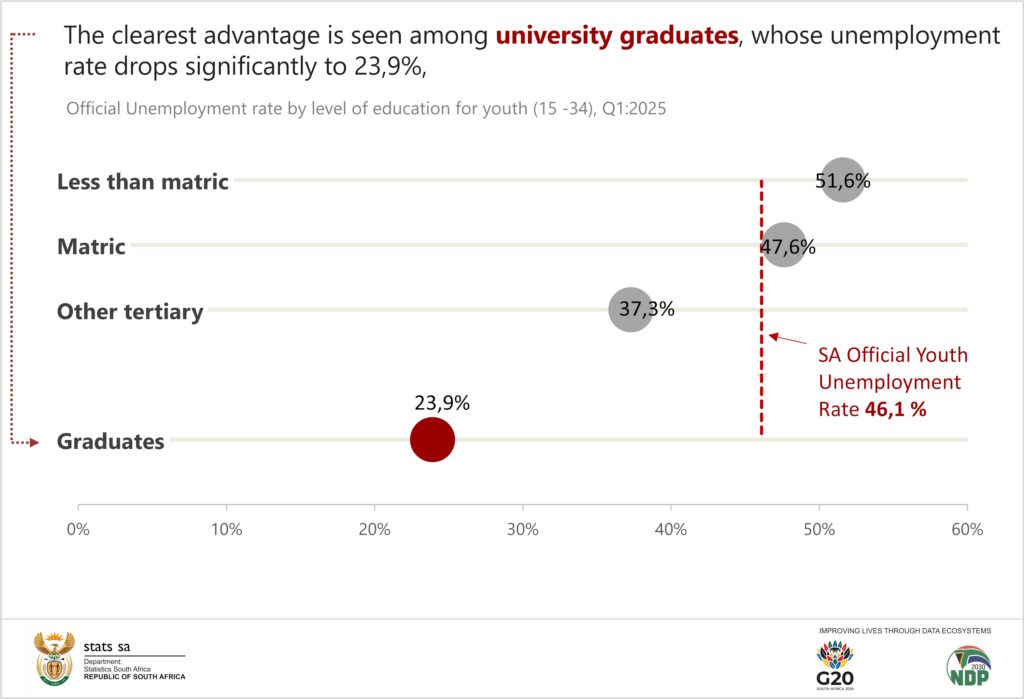
Educational attainment also determines how likely young people are to find work. The unemployment rate for youth without a matric certificate stands at 51.6%, the highest across all education levels. Those with matric fare slightly better at 47.6%. Graduates of vocational and technical training programmes report a lower unemployment rate of 37.3%, while university graduates have the lowest youth unemployment rate at 23.9%.
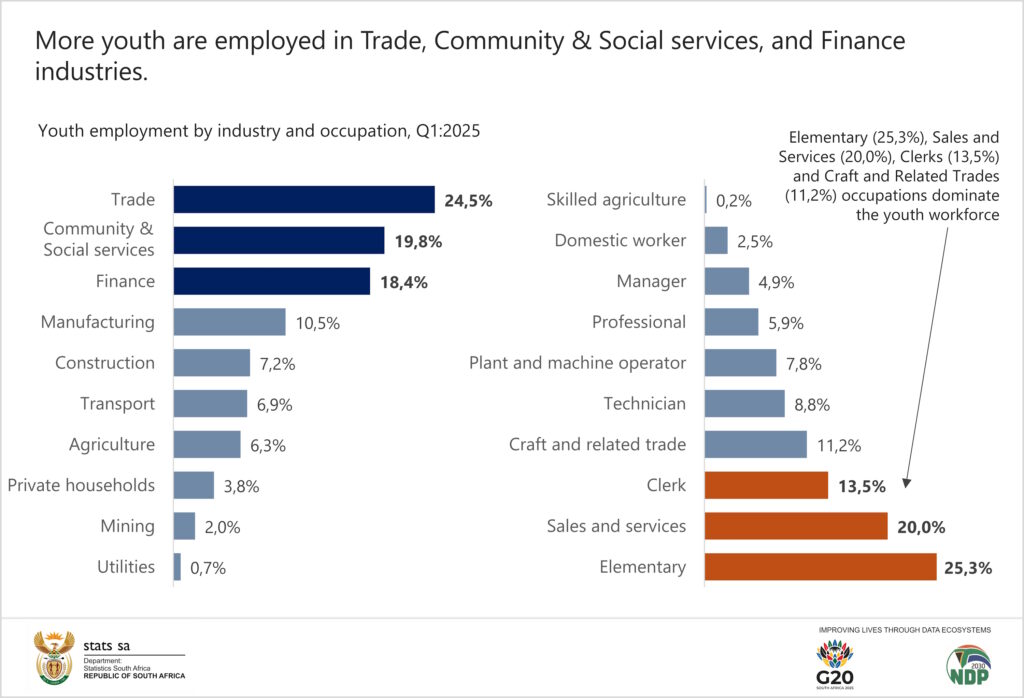
Despite these hurdles, several industries continue to provide opportunities for the country’s young workers. The Trade sector—including retail, wholesale, and hospitality—employs 24.5% of working youth. Community and Social Services follow at 19.8%, Finance at 18.4%, and Manufacturing at 10.5%.
Youth are predominantly employed in low- to semi-skilled positions, with 25.3% working in elementary occupations, 20% in sales and services, 13.5% in clerical roles, and 11.2% in trades and related jobs.


Discussion about this post