



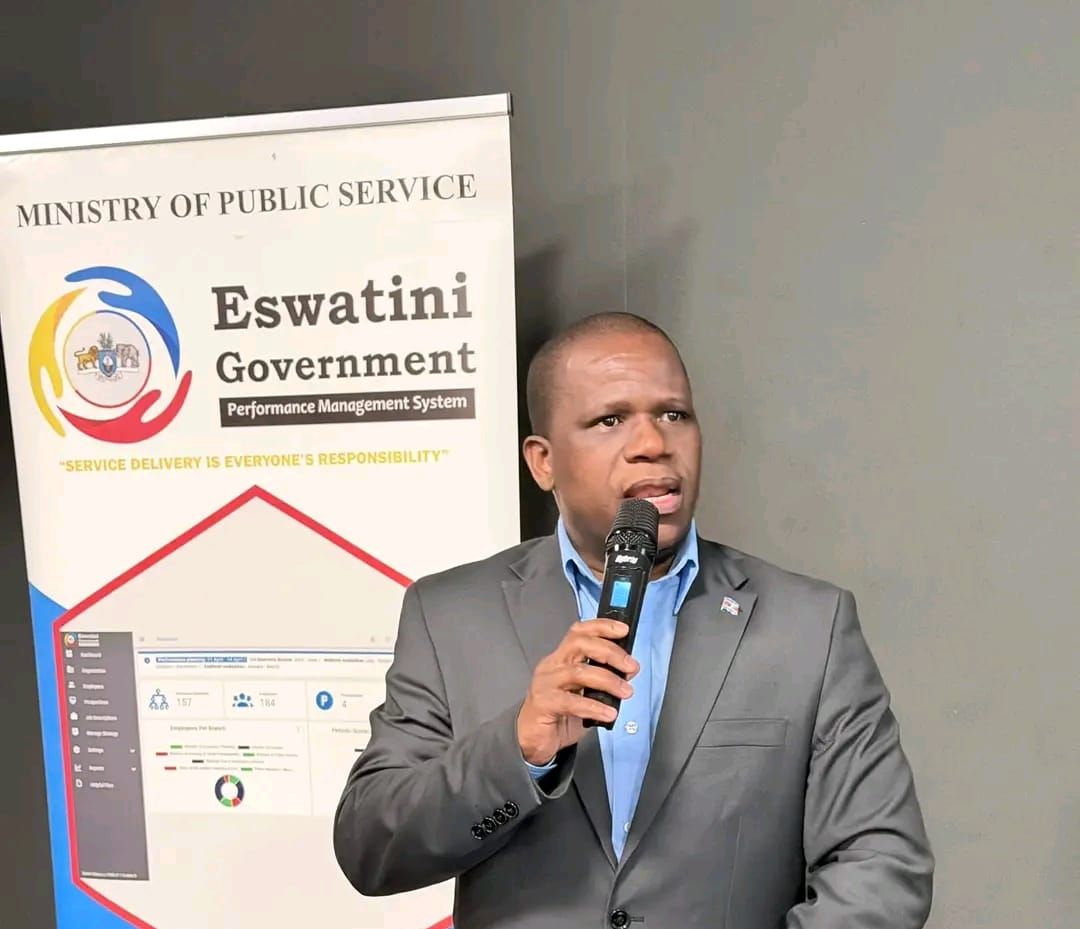
Ezulwini- The Government Negotiating Team (GNT) has moved to reassure civil servants that the Performance Management System (PMS) is not being introduced to create a culture of fear or punishment in the public service.
Principal Secretary in the Ministry of Public Service Mthunzi Shabangu said the system was instead intended to strengthen work planning, clarify roles, improve accountability and communication, and promote continuous improvement and professional development.
PS was speaking during an engagement between the GNT, through the Management Services Division within the Ministry of Public Service, and the Eswatini Principals Association (EPA) on the PMS and its linkage with the Total Rewards Strategy and Policy.
The engagement provides a platform for government and school principals to develop a common understanding of the PMS, clarify how it will be applied in schools and gather principals’ perspectives to support its effective implementation.


Shabangu emphasised that the PMS should be understood as an ongoing conversation between employees and their supervisors rather than a once-off assessment of performance.
He said the system was designed to ensure that employees understand what is expected of them, while supervisors provide continuous guidance and support and administration identifies performance challenges and development needs.
“The PMS is an ongoing conversation between employees and their supervisors,” Shabangu said.
He explained that the process involves planning together, monitoring progress, addressing challenges and ultimately working towards improved performance and service delivery.
The engagement also focused on how the PMS will work alongside the Total Rewards Strategy and Policy, which seeks to recognise performance, support employee development and contribute to talent retention.
Government said the two frameworks should work together to create a performance-oriented public service where employees are supported to improve and are appropriately recognised for their contribution.
The Ministry further highlighted that employee motivation extends beyond salary, with workers also valuing career growth, learning and development opportunities, recognition, wellbeing, meaningful work and fair rewards for their efforts and achievements.


The linkage between the PMS and the Total Rewards Strategy is therefore intended to create a cycle in which performance is planned and measured, employees receive support to develop, and achievements are recognised.
The engagement with principals is expected to help address practical issues surrounding the application of the PMS in schools and ensure that those responsible for implementing the system understand its purpose and expectations.


Discussion about this post