



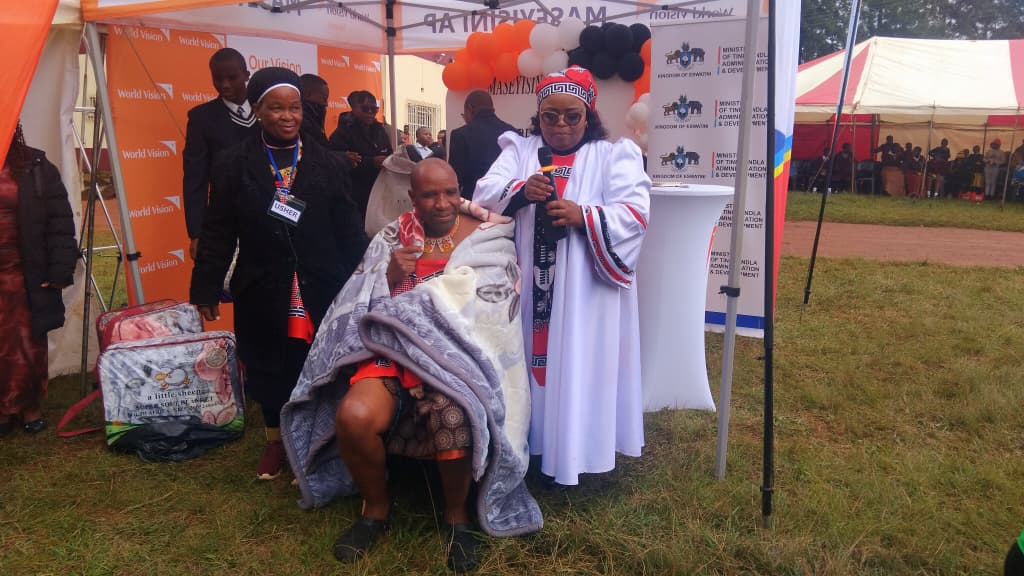
Maseyisini- Political differences have not stopped Maseyisini Member of Parliament Nokuthula Dlamini from embracing her predecessor, former MP and Cabinet Minister Mduduzi “Small Joe” Dlamini, as she publicly acknowledged his contribution to the constituency’s development.
She said, having served as MP for only three years compared to Small Joe’s 15 years, she could not claim credit for all the development achieved in Maseyisini alone.
Speaking during the official handover of the Maseyisini Area Development Programme (ADP) from World Vision Eswatini to the Ministry of Tinkhundla Administration and Development on Wednesday, Hon. Nokuthula Dlamini acknowledged the 15 years of service rendered by the former MP.
The sitting MP said development in Maseyisini should not be attributed to one person, noting that Small Joe had served the constituency for 15 years before her election.


“Emandla emuntfu akandliwa ngeke ngitsi ngimi lowente konkhe,” she said, stressing that she could not claim responsibility for everything that had been achieved in the area.
Dlamini later presented blankets to the former MP, in a gesture that reflected the cordial relationship between the two politicians despite serving in different periods as representatives of the constituency.
Her remarks also echoed His Majesty King Mswati III’s call for Agape Love, with the occasion demonstrating that political differences do not necessarily have to translate into personal hostility.
Dlamini also described World Vision Eswatini as a “mother” to vulnerable communities in Maseyisini, particularly children and child-headed families who, she said, received support at times when they had little hope.
She said the organisation provided food and clothing, paid school fees, distributed goats and fruit trees, and provided household items, among other forms of assistance.
The MP said the organisation had helped restore self-esteem among children who had lost hope, making its departure from Maseyisini an emotional moment for communities that had benefited from its interventions.
“We are heartbroken that now it is leaving Maseyisini,” she said.
World Vision Eswatini’s 18-year presence in the area has reached approximately 28,800 people across six chiefdoms — Dlovunga, Vusweni, Mbilaneni, Mzizi, Masibini and Simemeni.
One of the programme’s most significant achievements has been increased access to clean water, with more than 18,000 people now benefiting from safely managed water systems, solar-powered micro-schemes and reticulated water projects.
Through partnerships with the Eswatini Water Services Corporation (EWSC) and the Department of Water Affairs, approximately 4,000 households gained access to clean water.
A partnership with EWSC connected 2,138 households, seven schools and two health facilities through a 145-kilometre water network.
World Vision National Director Amos W. Zaindi said the programme had been built through nearly two decades of collaboration with communities, government ministries, traditional and faith leaders, volunteers and development partners.
Beyond water, the programme supported livelihoods through poultry, piggery, crop farming, feedlots and vegetable production.
More than 3,130 households participated in savings groups, while more than 1,500 farmers received training in climate-smart agriculture.
Community members also received vocational training in electrical installation, welding, sewing, upholstery and plumbing.
In health and nutrition, World Vision worked with government to strengthen community-based services, including training Rural Health Motivators in maternal, newborn and child health counselling.
Education was another key area of intervention, with all 26 schools in the programme area receiving water, sanitation and hygiene interventions.
Fourteen schools benefited from electrical and solar-powered boreholes, reaching approximately 14,000 learners.


Child Protection Committees were also established across all six chiefdoms to strengthen community systems for identifying, reporting and responding to issues affecting children.
The handover was not only marked by speeches from officials and community leaders, but also by contributions from learners who expressed their appreciation for World Vision’s work.
Learners from local schools, including Nyamane Primary School, shared poems and words of appreciation, reflecting on the organisation’s contribution to their schools and communities.
The presentations added an emotional dimension to the conclusion of World Vision’s direct programme presence in Maseyisini, as communities reflected on nearly two decades of support and prepared to continue the work under government and community structures.


Discussion about this post