



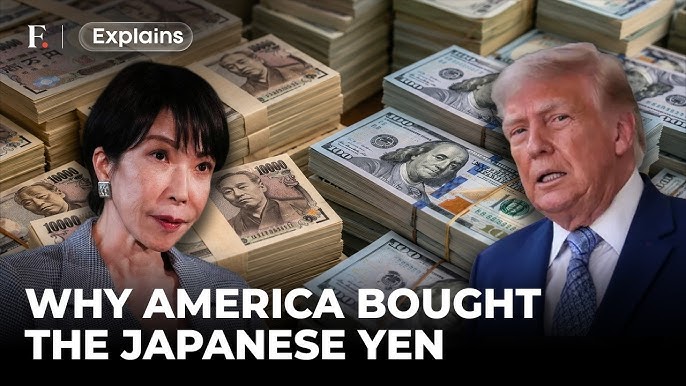
The United States bought the Japanese yen for the first time in more than a decade as “a signal of friendship,” President Donald Trump said Sunday. The rare bilateral intervention in Japan’s currency market was designed to prop up the yen from its 40-year low against the dollar.
“They have a weakening yen, and they wanted a little bit of help. And we’re always there for Japan,” Trump told reporters aboard Air Force One.
Trump’s comment confirmed the Friday joint action by the U.S. and Japan to reverse the continuing weakening of the yen, whose depreciation has been exacerbated this year by increasing energy costs due to the Iran war.
The U.S. has interests in shoring up the yen because a stronger dollar makes American exports more expensive for foreign consumers. Similarly, while a weak yen benefits Japanese exporters — and foreign tourists who go to Japan — it also increases the cost of imports like oil and gas, fueling inflation.


Japan’s Finance Minister Satsuki Katayama said in a Monday statement that the Friday action “countered excessive volatility and disorderly movements in the Japanese yen in recent months.”
The Financial Times first reported Friday that the Federal Reserve Bank of New York sold euros for yen on behalf of the Treasury Department, citing people familiar with the matter.
Trump said Sunday that supporting the yen would be “good for the world economy,” and that the U.S. would benefit financially from the move, without explaining how.
Treasury Secretary Scott Bessent said the Treasury Department “will not hesitate to participate in further joint intervention.”
“We strongly support Japan’s decisive market and monetary steps to correct the substantial undervaluation of the yen,” he said on X on Sunday.


A Reuters photograph from President Trump’s cabinet meeting at Camp David on Friday showed Bessent had written on his notepad a “to-do” list of the incoming U.S. purchase.
Taken over Bessent’s shoulder during an on-the-record portion of the meeting, the photo showed the Camp David notepad bore the underscored words “To Do” followed by “Buy Japanese Yen (JPY) $5-10 bil.”
How did the yen get here?
Despite being one of the world’s top economies, Japan has long struggled with a weak yen. Owing to a recession and chronic deflation in the 1990s, Japan had kept its interest rates as low as zero or negative in the hope of rejuvenating the economy since then through the 2010s.
Even though Japan raised its interest rates in 2024, the yen has continued to decline as rates remain lower compared to the rest of the world, with Western central banks aggressively hiking rates to fight inflation.
For a country dependent on energy and food imports like Japan, the Iran war this year also posed outsized impacts as the nation fights a rising cost of living.
Could it reverse the yen’s depreciation?
The Bank of Japan, the country’s central bank, had intervened in the markets to boost the yen in late April and in early May. While the earlier move briefly propped up the currency, it proved to be a temporary success.
Analysts are less pessimistic that the latest intervention could fundamentally alter the broader course of the yen’s weakening.
Shusuke Yamada, chief foreign exchange and interest rate strategist of Japan at Bank of America Securities, said the conventional view is that foreign exchange intervention could “only buy time.”
“However, this episode could prove more effective than previous attempts,” he said in a Friday report.


Discussion about this post