



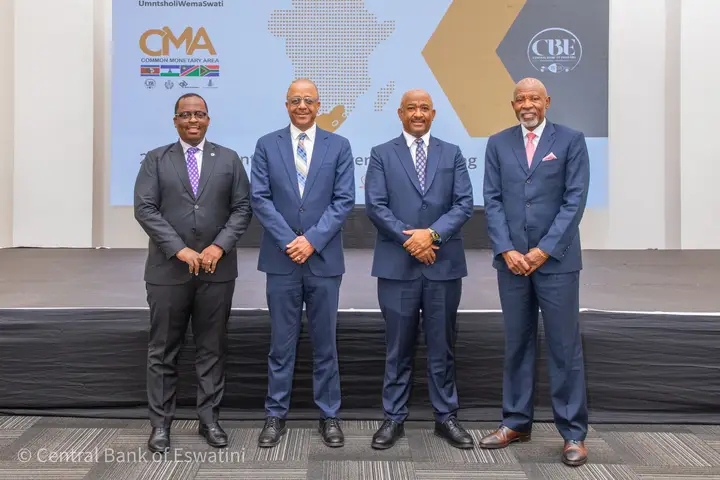
Ezulwini– The Common Monetary Area (CMA) is stepping up efforts to improve the quality of economic data across its four member states as central banks seek more accurate information to respond to global economic shocks.
Central Bank of Eswatini Governor Dr Phil Mnisi said the region was implementing a Balance of Payments Harmonisation Project that will standardise how Eswatini, South Africa, Lesotho and Namibia compile and report external sector statistics.
He said the initiative would make it easier for policymakers to track trade, investment and capital flows across the region while strengthening the quality of economic decisions.
“We are making significant progress on the regional Balance of Payments Harmonisation Project, which will improve the consistency and comparability of external sector statistics across the CMA,” Dr Mnisi said during the second day of the CMA Central Bank Governors’ Meeting in Ezulwini.


The project is expected to give governments, investors and financial institutions access to more reliable data on how money moves into and out of the four economies through exports, imports, foreign investment and other cross-border transactions.


For businesses, the improved data could provide a clearer picture of regional markets, helping companies assess investment opportunities and understand economic trends with greater confidence.
Dr Mnisi said harmonised statistics would also strengthen policy formulation by giving central banks a better understanding of external vulnerabilities affecting the region.
The initiative comes as the CMA is dealing with growing uncertainty caused by geopolitical tensions, volatile energy prices and changing global trade patterns, factors that continue to influence inflation and economic growth across Southern Africa.
He said maintaining credible economic data had become increasingly important as policymakers work to protect financial stability and preserve confidence in the region’s economies.
The Common Monetary Area comprises Eswatini, Lesotho, Namibia and South Africa, whose central banks regularly coordinate on monetary policy, financial stability and other issues affecting the regional financial system.

Discussion about this post