



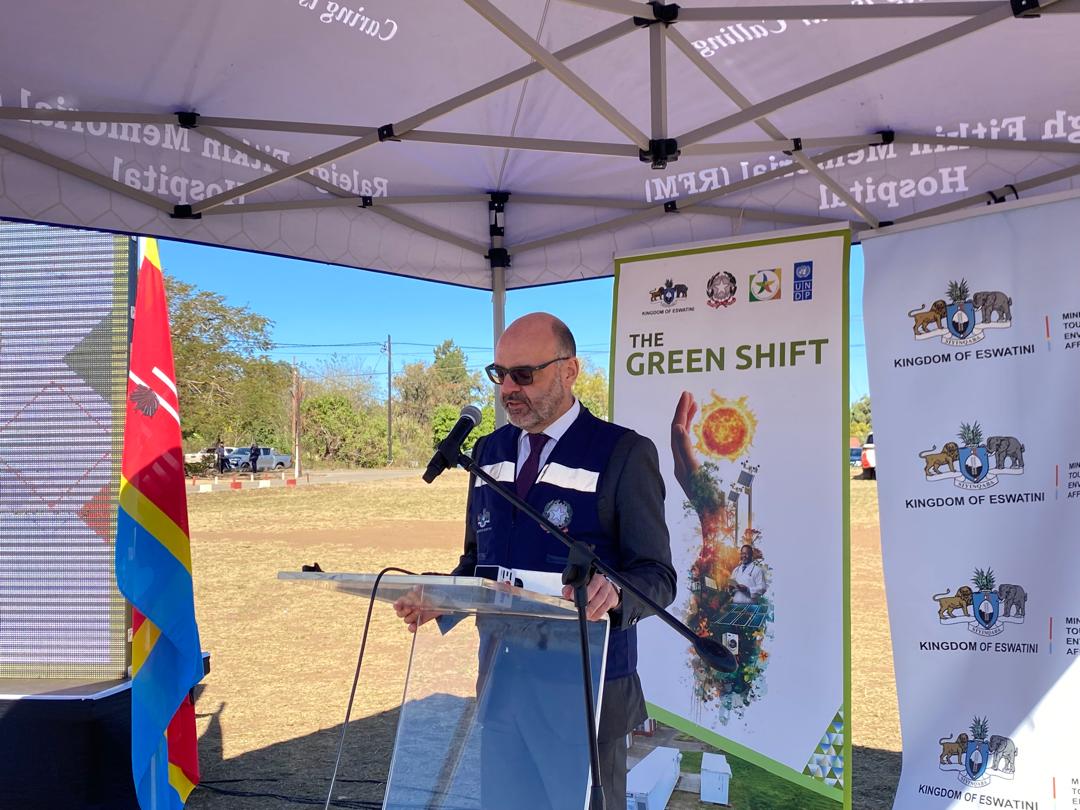
Manzini- Buoyed by the success of the Raleigh Fitkin Memorial (RFM) Hospital greening project, Italy is preparing to expand its climate and sustainable development partnership with Eswatini, with fresh cooperation already under discussion between the two governments.
The announcement was made by Italian Ambassador to the Kingdom of Eswatini, Gabriele Annis, during the official handover of the RFM Hospital Greening Demonstration Project in Manzini, where he described the initiative as proof that climate investments can strengthen public services while delivering long-term economic benefits.
Annis disclosed that the bilateral relationship, formalized through a Memorandum of Understanding signed in 2017, has entered a new phase, with both countries exploring additional projects aimed at advancing Eswatini’s renewable energy and climate resilience agenda.
“This is not the end of our journey but the beginning of a new chapter in cooperation between Italy and Eswatini,” he declared.
The ambassador portrayed the RFM project as a blueprint for future investments, noting that the hospital has been transformed from a major energy consumer into a more sustainable health facility through the installation of a one-megawatt solar photovoltaic system with battery storage, the replacement of its coal-fired boiler and the introduction of energy-efficient technologies.
He observed that the intervention has slashed the hospital’s monthly electricity bill by half while eliminating its dependence on coal, significantly reducing carbon emissions and improving the reliability of power supply.
For one of Eswatini’s busiest referral hospitals, Annis argued, those gains extend far beyond environmental targets.
Reliable electricity, he noted, means uninterrupted healthcare services, improved working conditions for medical staff and safer, more comfortable care for patients.
He further maintained that the project demonstrates that climate action is no longer solely an environmental issue but an investment in healthcare, economic efficiency and national resilience.
The ambassador urged other institutions to draw lessons from the RFM model, insisting that green infrastructure can simultaneously lower operational costs and improve service delivery.


Beyond the hospital, Annis pointed to another flagship Italian-funded intervention—the Strengthening Early Warning Systems and Climate Services Project—which has enhanced Eswatini’s ability to anticipate and respond to climate-related disasters.
The initiative delivered 10 automated weather stations, eight river flow gauging stations and upgraded climate forecasting infrastructure, strengthening the country’s disaster preparedness in the face of increasing droughts, floods and severe storms.
Commending the government of Eswatini, the United Nations Development Programme and technical partners for delivering both projects, Annis reaffirmed Italy’s commitment to supporting the country’s transition to cleaner energy and climate-resilient development.


Discussion about this post