



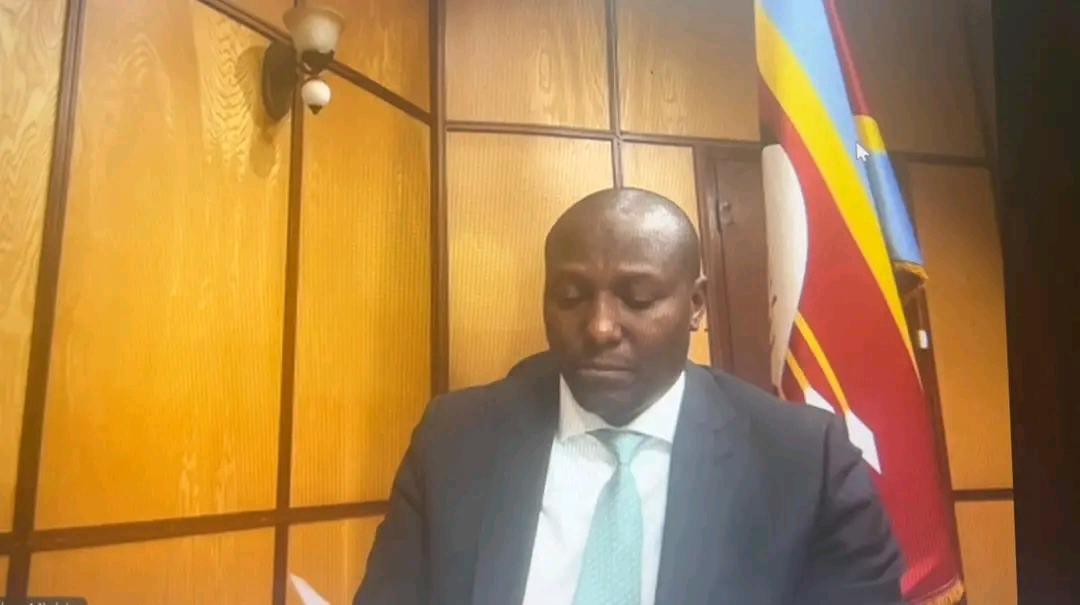
MBABANE – Prime Minister Russell Mmiso Dlamini has told the High Court that Cabinet approved the establishment of the Commission of Enquiry into the affairs of Eswatini Medical Christian University (EMCU), dismissing claims that he acted outside his legal authority.
In his answering affidavit opposing an urgent application by the university’s Council, Dlamini said although the law did not require Cabinet approval before appointing the commission, government nevertheless sought and obtained Cabinet’s endorsement “out of an abundance of caution.
“The Prime Minister is defending government’s decision to establish the commission after EMCU approached the High Court seeking to stop its operations, arguing that its appointment was unlawful. Dlamini maintained that the commission was lawfully established through Government Gazette Notice No. 204 of 2026, published on June 15, 2026.
He rejected allegations that the commission was introduced without terms of reference, saying these were clearly set out in the published Gazette.


“The commission’s terms of reference are embodied in the notice,” he stated, adding that the Government Gazette is a public document that was available well before the university launched its court application.
He argued that the university’s claim of urgency was self-created because it had been aware of the commission for several days before approaching the court. According to Dlamini, there was sufficient time for the institution to obtain the Gazette and verify the legal position.
The Prime Minister further submitted that even if the university wished to challenge the legality of the commission, it could still do so while the inquiry was underway or after it had concluded. He argued that allowing the commission to proceed would not cause irreparable harm because judicial review remedies remained available.
Dlamini also challenged the legal standing of the applicant, arguing that although the university’s Council is established under the Higher Education Act, it is not a corporate body with legal personality capable of suing or being sued in its own name.Explaining why government established the commission, Dlamini said Cabinet resolved that an inquiry was necessary after receiving numerous complaints regarding the university’s governance and management.
He attached supporting documents to his affidavit, including reports from the Vice Chancellor, correspondence from the Chairperson of the Education Council and a memorandum from the Principal Secretary in the Cabinet Office outlining governance concerns.
He said the commission was mandated to investigate allegations of maladministration and other governance issues affecting the institution, which receives substantial government funding through public subventions.
Addressing concerns that the commission duplicates investigations already being conducted by the Anti-Corruption Commission (ACC), Dlamini argued that there is no legal prohibition against multiple investigations running simultaneously.
He said commissions of enquiry can lawfully exist alongside criminal investigations, parliamentary inquiries, disciplinary proceedings and civil litigation.The Prime Minister disclosed that he was aware of the ACC investigation before the commission was established and pointed out that the commission was appointed before the ACC executed a search-and-seizure operation at the university.
He maintained that while the ACC is conducting a criminal investigation, the commission has a broader mandate to examine allegations of maladministration and governance failures.
Dlamini also dismissed allegations of bias against Commissioners Mbuso Simelane and Mangaliso Magagula. He said both were selected on the basis of their professional competence and openly disclosed during their introduction that they had previously worked with the university. He added that they would recuse themselves if any conflict of interest arose during the inquiry.


The Prime Minister further rejected assertions that he lacked authority to appoint the commission, arguing that under Eswatini’s constitutional framework he is also a minister and therefore falls within the meaning of “any Minister” under the Commissions of Enquiry Act.
He maintained that all statutory requirements were complied with and denied bypassing any ministerial role prescribed by law.Supporting government’s opposition is a confirmatory affidavit by ACC investigator Vulindlela Dlamini, who told the court that the anti-corruption body has been investigating EMCU since 2024 following numerous complaints.
He said the ACC executed a search-and-seizure warrant on June 19, 2026, and that electronic devices seized during the operation were examined by experts before being returned to the university on June 29, 2026.Government is asking the High Court to dismiss the university’s urgent application and allow the Commission of Enquiry to continue with its investigations.


Discussion about this post