



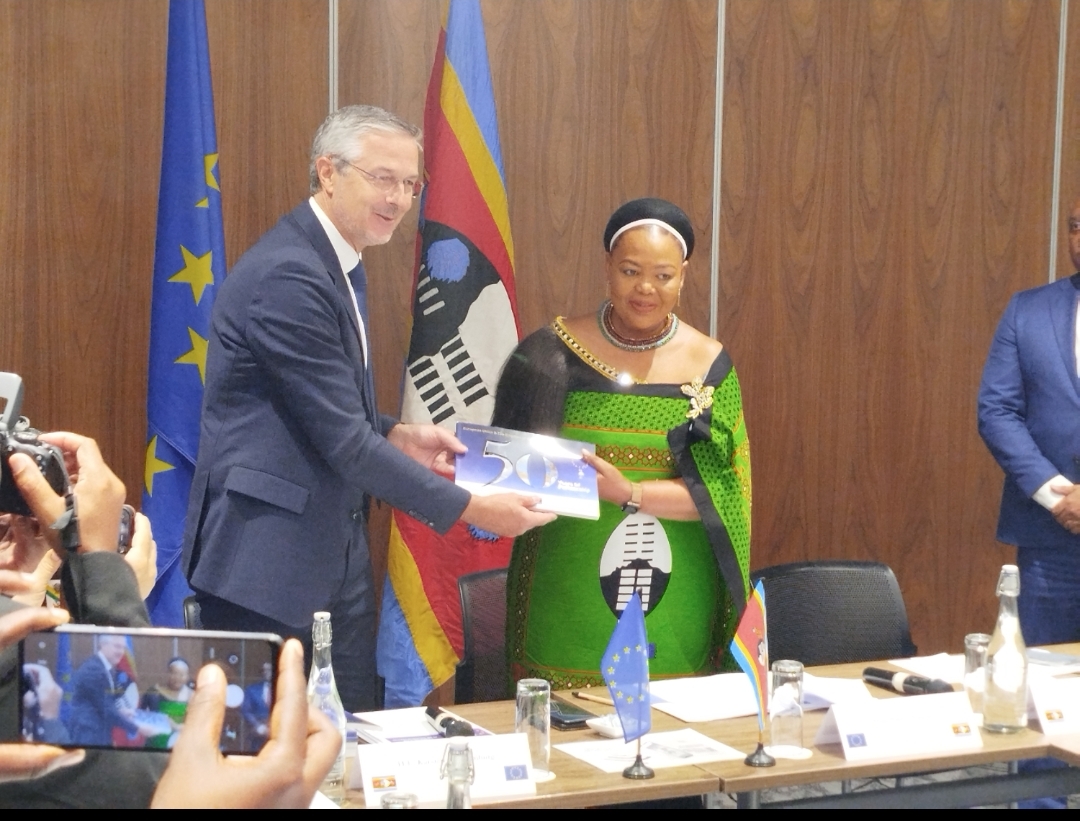
MBABANE – Minister of Foreign Affairs and International Cooperation Senator Pholile Shakantu has described the European Union (EU) as a reliable and constructive partner that has consistently supported Eswatini’s development agenda over the past five decades.
Speaking during the 3rd EU–Eswatini Partnership Dialogue held on Friday, Shakantu said the relationship between the Kingdom and the EU continued to be anchored on mutual respect, open dialogue and a shared commitment to sustainable development, peace and prosperity.
The minister made the remarks during her opening address at the dialogue co-chaired with EU Ambassador Karsten Mecklenburg.
“We highly value our 50-year-old relationship with the European Union,” Shakantu said. “Over the years, the EU has remained a reliable and constructive partner in supporting our national development agenda across key sectors, including governance, trade, health, education, agriculture, energy and youth empowerment.”


She said Eswatini remained encouraged by the continued spirit of collaboration that characterised engagements between the two parties.
The minister welcomed ambassadors and representatives from various EU member states who travelled from Pretoria and Maputo to attend the dialogue, saying their presence reflected the strength of relations between Eswatini and the bloc.
Shakantu also highlighted that the meeting came at a significant moment for the Kingdom, following celebrations marking the 40th anniversary of the reign of His Majesty King Mswati III as well as the opening of the Ezulwini Palazzo International Convention Centre.
She further noted that Eswatini was concurrently hosting the Organisation of African, Caribbean and Pacific States (OACPS) Africa-EU Parliamentary Assembly, which she said underscored the Kingdom’s growing role in international diplomacy.
According to Shakantu, the dialogue provided both parties with an opportunity to reflect on progress made together while also discussing emerging global challenges and exploring practical ways to deepen cooperation.“In a rapidly changing global environment marked by economic uncertainty, climate challenges, geopolitical tensions and evolving development priorities, partnerships such as ours are more valuable than ever,” she said.
The minister stressed that partnerships should produce tangible benefits for ordinary citizens, especially young people and vulnerable communities.“We therefore welcome continued cooperation that promotes inclusive economic growth, investment, skills development, climate resilience and innovation,” she said.
Shakantu said Eswatini remained committed to multilateralism and believed global challenges could only be addressed effectively through cooperation and solidarity among nations.She added that open and respectful dialogue remained essential in building trust, strengthening institutions and advancing common aspirations.
The minister also used the platform to raise concerns about the impact of global geopolitical tensions on ordinary citizens, saying discussions around international relations often appeared detached from the realities faced by communities on the ground.
“The discourse surrounding international relations and geopolitics frequently suffers from a disconnect between high-level strategic abstraction and the lived experiences of the populace,” she said.


Shakantu noted that while policymakers often focused on issues such as trade disputes, shifting alliances and supply chain vulnerabilities, ordinary citizens experienced the consequences through rising prices of essential commodities.
“For the people of Eswatini, this theoretical disconnect is bridged by the immediate, tangible impact of rising fuel costs,” she said.
She observed that fuel price increases experienced in recent months had placed pressure on commuters, farmers and small business owners.
“When fuel prices increase, as they have twice in two months, the effect is not merely a statistical shift in a macroeconomic report; it is an immediate contraction of purchasing power,” the minister added.
On international governance issues, Shakantu reiterated Eswatini’s support for the Ezulwini Consensus and the Sirte Declaration regarding reform of the United Nations Security Council.
She said Africa’s underrepresentation in global governance structures remained an urgent matter that needed international attention if the multilateral system was to remain credible and representative.
The minister further expressed concern about gender imbalance within the United Nations leadership, calling for the appointment of the first female UN Secretary-General.
“As the United Nations marks its 80th year of existence, eight decades and nine Secretaries-General, all men, this is not a legacy to celebrate,” she said.
“It is a gap we must urgently close.”Shakantu also reaffirmed Eswatini’s foreign policy position of maintaining friendly relations with all nations. “Eswatini’s foreign policy remains that we are committed to being a friend to all and an enemy to none,” she said.
The minister said the Kingdom remained open to dialogue with nations that approached it with respect and maintained that Eswatini preferred to be part of solutions to global challenges rather than contribute to conflict.

Discussion about this post