



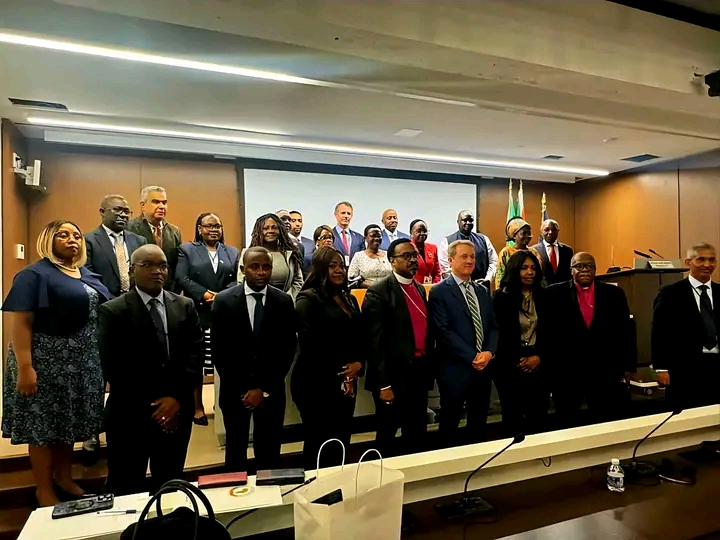
Mbabane- At a time when Africa’s development debate often circles around policy frameworks and long-term visions, Minister for Finance, Neal Rijkenberg is shifting the conversation toward something more immediate, which he described as execution.
Speaking at a high-level convening hosted by the African Union Mission to the United States, the Finance Minister positioned digital and financial inclusion not as abstract goals, but as the continent’s most practical pathway to mass employment.
Rijkenberg’s argument is grounded in a striking contradiction, while mobile phone usage continues to surge across Africa, more than half of the population remains excluded from formal financial systems. Rather than viewing this as a setback, he framed it as a rare opportunity for the continent to leapfrog outdated development models and build modern, inclusive economies from the ground up.
“Inclusion is not an end in itself; it is a catalyst for jobs,” he told delegates, underscoring how access to digital platforms and credit can enable small businesses to expand, employ, and drive wider economic transformation.


Central to his message was a call to reframe Africa’s youth bulge. Instead of being treated as a looming crisis, Rijkenberg argued that the continent’s young population should be seen as its greatest economic asset, one that can be unlocked through targeted investment in digital infrastructure and accessible financial systems.
However, the Minister’s most pointed intervention was his critique of Africa’s long-standing tendency to remain in the “idea phase.” He challenged policymakers to move beyond discussions and frameworks, urging a shift toward large-scale implementation. According to him, the real barrier to progress is no longer a lack of ideas, but a lack of coordinated execution.
This emphasis on action is already shaping policy direction in Eswatini. Rijkenberg highlighted the country’s investment in the Africa Strategic Investment Alliance, which aims to drive industrialisation and boost export capacity. By hosting the alliance’s regional headquarters, Eswatini is positioning itself as a testing ground for scalable, continent-wide solutions.


He further linked these efforts to the broader ambitions of the African Continental Free Trade Area, stressing that regional integration must be supported by interoperable financial systems and largely financed through domestic resources rather than external dependency.
The Minister also threw his weight behind the Sokokuu Integrated Ecosystem, describing it as a practical model for accelerating trade and financial inclusion across borders, provided there is sufficient political will to sustain it.

Discussion about this post