



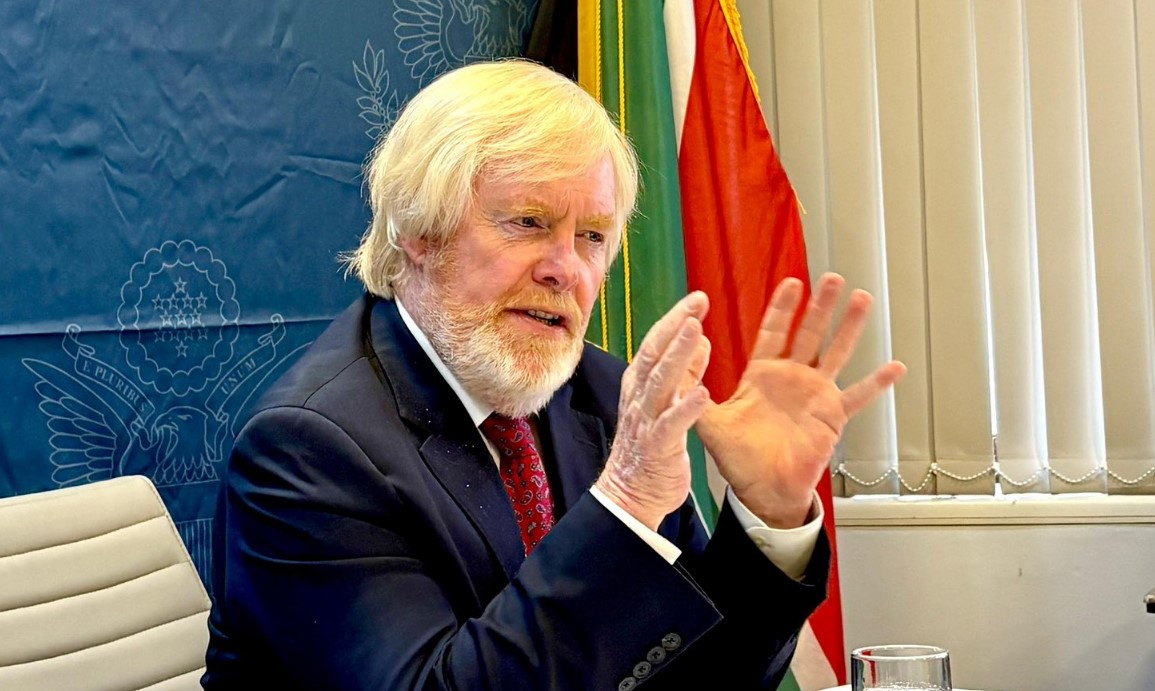
Pretoria – The United States Ambassador to South Africa, Brent Bozell, has apologised for remarks that sparked concern within government circles following a meeting with officials from the Department of International Relations and Cooperation.
The issue was discussed during a media briefing held in Pretoria on Wednesday evening where the department confirmed the apology.
Director General of the department, Zane Dangor, said officials met the ambassador after comments he made were viewed as undiplomatic.
Dangor said the envoy acknowledged that his statements created an impression that he was unwilling to work constructively with the South African government.

“He apologised and expressed regret, including for comments that appeared to undermine the judiciary,” Dangor said.
The United States diplomatic mission later issued a public apology through its social media platforms.
According to Dangor, the ambassador also acknowledged that South Africa’s past requires policies aimed at correcting historic injustice and inequality. During his recent visit to heritage sites including the Apartheid Museum and the District Six Museum, Bozell reflected on the country’s apartheid era history.
Dangor also addressed speculation surrounding negotiations between Washington and Pretoria after the United States imposed unilateral tariffs. He said government had not received any formal communication containing the reported “five demands”.
“There has been no formal communication from Washington containing the reported ‘five demands’,” Dangor said.
He added that there had also been no official request for South Africa to withdraw from the BRICS group, although the bloc sometimes draws concern within sections of the United States administration.
During the same briefing, South Africa’s Minister of International Relations and Cooperation, Ronald Lamola, said government supports open public diplomacy but reminded diplomats to observe international norms.
“While South Africa welcomes active public diplomacy and the strengthening of bilateral ties, such engagements must remain consistent with established diplomatic etiquette and international protocols,” Lamola said.
He described the United States as an important strategic partner for South Africa.
About 500 American companies operate in the country and employ more than 250 000 people while complying with local laws, including transformation policies.
Trade between South Africa and the United States stands at approximately 15 billion dollars. South African firms also maintain significant investments in the United States, particularly in the energy and chemicals industries.


Lamola said transformation measures such as Broad-Based Black Economic Empowerment remain necessary to address inequalities created during apartheid.
“B-BBEE is not reverse racism. It is a fundamental instrument designed to address the structural imbalances of South Africa’s unique history,” he said.
Lamola added that South Africa’s foreign policy continues to follow constitutional values, multilateral cooperation and the peaceful resolution of disputes.
“As a sovereign state and a significant middle power, South Africa remains steadfast in its resistance to being drawn into great-power rivalries. South Africa’s non-alignment does not entail a preference for any geopolitical bloc.
“Rather, it represents our ability to engage all international partners and take positions on a case-by- case basis, guided by international law.
“We remain steadfast in our resistance to being drawn into great-power rivalries, prioritising instead, a global governance system that is fair and inclusive,” Lamola said.


Discussion about this post