



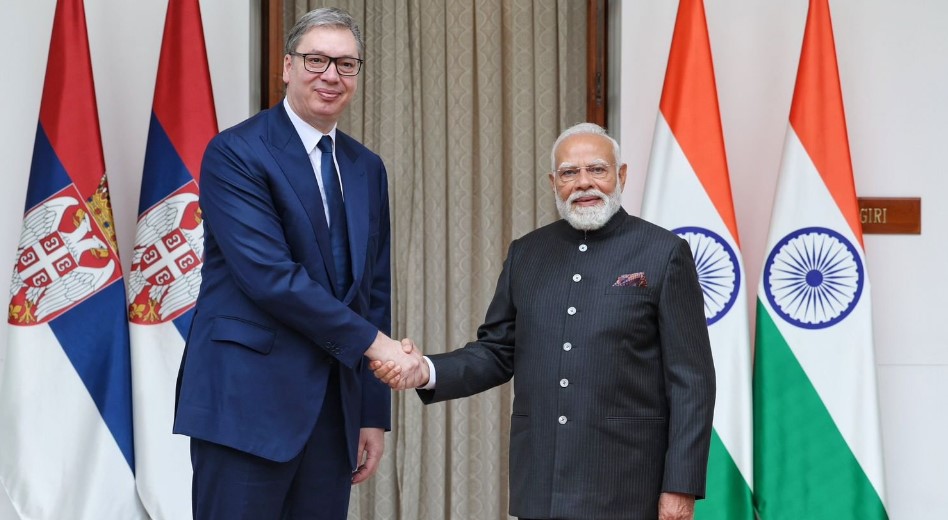
President Aleksandar Vučić has thrown his weight behind India’s growing role in artificial intelligence, describing the India AI Impact Summit in New Delhi as a gathering that places the country at the centre of the global technology conversation.
Vučić is in Delhi to participate in the summit hosted by Prime Minister Narendra Modi, where political leaders, innovators and policy makers are debating how artificial intelligence should be governed and deployed. The Serbian leader said his arrival in India was marked by “an almost irrepressible sense of exhilaration” at what he sees as a nation shaping not only its own future but that of its partners.
He traced his admiration for India back to the 1990s when he worked in London. There, he said, he learnt discipline and humility while working long hours, often alongside Indian colleagues. He recalled a Sikh manager from Punjab and the Sagar family, describing their work ethic and perseverance as formative influences at a time when, in his view, many Europeans underestimated India’s potential.
Vučić said those early impressions resurfaced at the recent World Economic Forum in Davos, where artificial intelligence featured prominently in discussions. He noted that one perspective suggested India might occupy a second tier among global AI powers, a view he rejected.

Citing India’s Minister for Information Technology Ashwini Vaishnaw, Vučić said New Delhi is prioritising practical application over headline grabbing breakthroughs. He pointed to sectors such as healthcare, agriculture, education and financial inclusion as areas where AI could have tangible impact, a model that may resonate with developing economies including Eswatini, where technology is increasingly seen as a tool to expand services and economic participation.
“The India AI Impact Summit, therefore, is more than a conference,” Vučić said. “It places India firmly at the centre of the global discourse on artificial intelligence.” He added that the objective is to explore how AI can be deployed responsibly, inclusively and at scale to address real world challenges, ensuring it is not confined to a privileged few.
As leader of what he described as one of Europe’s most promising economies, Vučić said Serbian youth stand to benefit from such an approach. He outlined the longstanding ties between Serbia and India, which marked 70 years of diplomatic relations in 2018 with commemorative stamps featuring Swami Vivekananda and Nikola Tesla.
India, he noted, has maintained support for Serbia’s territorial integrity, including its position on Kosovo following the 2008 unilateral declaration of independence.
Bilateral trade between the two countries currently stands at about 400 million US dollars and continues to grow. Indian companies operate in Serbia in sectors such as information technology, automotive components and manufacturing. Vučić said there is significant room for expansion through improved connectivity, streamlined trade processes and stronger investment partnerships in areas including pharmaceuticals and renewable energy.
He also expressed interest in deeper cultural cooperation, including the possibility of Indian film productions being shot in Serbia.


Reflecting on India’s trajectory, Vučić said the qualities of grit, equanimity and self belief that he encountered decades ago remain evident. He described Modi as a partner who demonstrates those traits through action rather than rhetoric.
“Those who still see India as a nation waiting its turn would do well to look again,” Vučić said. “India is not arriving at the future. It is helping to define it.”


Discussion about this post