



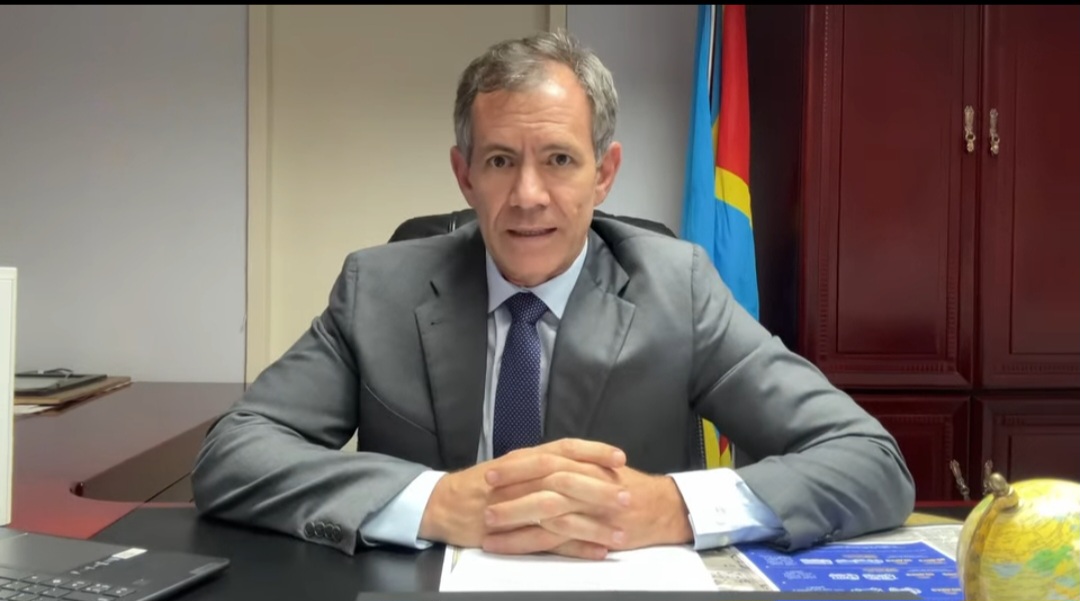
Mbabane – Finance Minister Neal Rijkenberg says Eswatini is at a critical stage of its national budget process as the government works to balance limited resources against growing demands while also tightening tax compliance and managing rising electricity costs.
Speaking during a Finance in Focus briefing on Tuesday in Mbabane, Rijkenberg said Cabinet was expected to consider the draft budget imminently, ahead of its tabling through the remaining parliamentary processes and a budget speech planned for late February.
“Good day, . Once again, we’re doing our finance in focus. Today, I’ll just talk on a few smaller issues, just that are all going on in the country. The first one the budget process. So at the moment, we are in the middle of our budget process. Hoping the cabinet will approve it tomorrow, and we’ll then take it through the rest of the process. Obviously, we’ll do our budget speech towards the end of February sometime. The date will still be announced,” he said.
Rijkenberg said government continues to face pressure due to insufficient funds to meet all national needs, making the allocation of resources a difficult exercise.

“But as normal, very difficult to allocate resources properly because we don’t have enough money for everything. We don’t have enough money to be able to fund things as much as really we would like to,” he said, adding that the focus remained on directing available funds where they were most needed while supporting economic growth.
On taxation, the minister said government was intensifying efforts to improve tax collection within the retail sector, particularly value added tax.
“At the moment, we are going to work quite hard on trying to get the correct amount of tax from the retail sector,” Rijkenberg said, noting that while some retailers complied, others did not.
“But unfortunately, we do have many that don’t pay tax very well, especially the VAT portion is what we’re focusing on,” he said.
Rijkenberg explained that in a healthy retail business, VAT payments should average about three percent of turnover, yet some companies were declaring zero VAT, raising serious concerns.


“But unfortunately, many companies it’s zero, meaning that there’s something very wrong. Either they in losses all the time or they’re building up massive stock or they are really just not paying over the VAT that they’re collecting,” he said.
He appealed to the public to support government efforts to enforce compliance, saying VAT is paid by emaSwati and should be remitted to the state.
“So it’s really not right for emaswati to be paying the VAT and then for companies or a certain sector to not remit that emaswati’s tax to the government and somehow eat it along the way,” he said.
Turning to electricity tariffs, Rijkenberg acknowledged widespread concern following recent increases, describing them as painful for households and businesses alike.
“And again, you look at these double-digit increases, it really is brutal on the household level,” he said.
The minister said the increases were largely driven by external factors, including the rising cost of imported electricity, rather than direct government decisions. He explained that while Eswatini had explored domestic power generation for years, producing electricity locally had previously been more expensive than importing it.
“That balance has now shifted,” he said, noting that government was now issuing more power purchase agreements to expand local generation capacity.
On calls for electricity subsidies, Rijkenberg cautioned against using taxpayer funds to artificially lower tariffs, arguing that utilities should operate on a user pays principle.
“The money doesn’t fall out the sky. The money comes from the taxpayer,” he said. “The principle should be a what they call a user pays principle on utilities, which means that if I, as Neil Rakenberg, use more electricity, I must pay more.”
He encouraged households to adopt energy saving measures, including reducing consumption and investing in efficient appliances, while government works on long term solutions.
Rijkenberg also warned that rising electricity prices posed a risk to businesses, which currently pay higher tariffs than domestic users, potentially leading to closures if costs become unsustainable.
He said regulators, including ESERA, were assessing the situation to strike a fair balance, while the government sought to stabilise the financial position of the Eswatini Electricity Company, whose weak balance sheet was affecting the rollout of new power projects.
“We end up in this awful cycle of not having enough money, and it means now we can’t even produce the power,” he said.
Rijkenberg said the ultimate goal was energy independence, which would shield Eswatini from volatile external prices and limit future increases to inflationary pressures.
“So Maswati, thank you very much,” he said.


Discussion about this post