



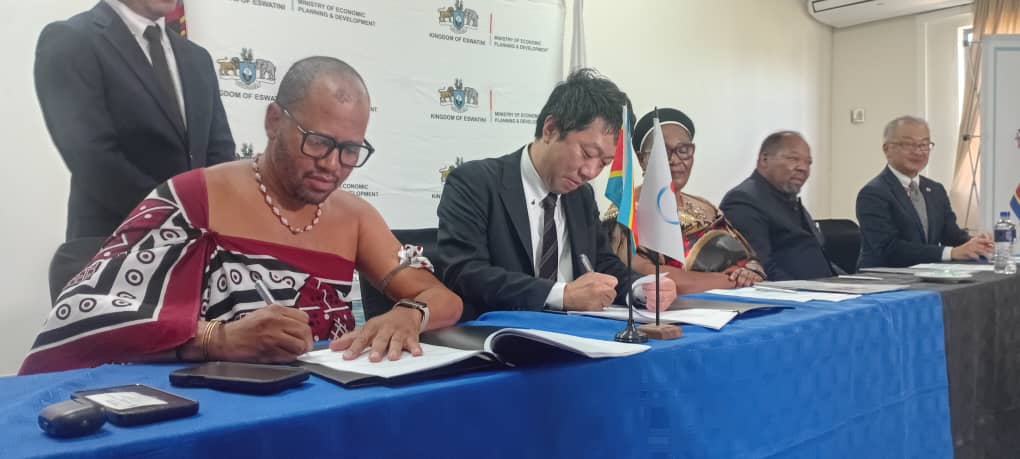
Manzini – Eswatini government through the Deputy Prime Minister’s Office has signed a landmark E11.3 million (JPY 103 million) grant agreement with the government of Japan and the Japan International Cooperation Agency (JICA), paving the way for the rollout of the Universal School Transport Project aimed at improving accessible transportation for learners with disabilities.
Speaking during the signing ceremony, the Minister of Economic Planning and Development Dr. Tambo Gina described the agreement as tangible proof of Eswatini’s cherished and strategic development partnership with Japan, adding that the event was not merely procedural but a reaffirmation of shared intent and mutual commitment to inclusive development.
“Today, we signed the Exchange of Notes and Grant Agreement for a grant of E11.3 million towards the Universal School Transport Project,” he said, noting that the support will directly help dismantle transportation barriers that have long hindered children with disabilities from fully accessing education.
He reflected on Eswatini’s longstanding cooperation with Japan, describing the Asian nation as one of Eswatini’s foremost and most reliable development partners.


Gina highlighted that the partnership spans critical sectors, from food security initiatives such as the Home-Grown School Feeding Programme, to infrastructure investments like the Inclusive Schools Project, and extensive contributions to the health sector.
“Just a few months ago, in August 2024, we were privileged to sign a monumental E176 million agreement for the Inclusive Schools Project, an initiative that underscores our mutual commitment to leaving no one behind,” he said.
“For this consistent solidarity and impactful cooperation, we extend our deepest and most sincere gratitude to the government and people of Japan.”
The new universal school transport project aligns closely with Eswatini’s national disability priorities and the broader inclusive education agenda. Gina stressed that the grant represents more than financial support.


“By providing accessible transport, we are unlocking potential and affirming the dignity of every child. This grant is a powerful statement of shared values, inclusion, equity, and human dignity,” he said.
He further acknowledged JICA’s role in strengthening long-term national capacity, saying, “Your unwavering technical support fosters sustainability. Your approach goes beyond project implementation; it builds capacity. Programmes like the ABE/SDG initiative continue to develop the advanced human capital essential for our nation’s future.”
He also commended the Deputy Prime Minister’s Office, the Ministry of Education and Training, and other implementing partners, urging them to ensure that the vehicles become moving symbols of hope and equal opportunity.
Looking ahead, he highlighted the potential for even deeper cooperation between the two nations, particularly in renewable energy, food processing, digital transformation, agribusiness, sustainable tourism, and climate-resilient infrastructure.
He noted that discussions held during TICAD 9 in Japan created momentum for transforming shared priorities into bankable development projects.
“To ensure our shared ambitions are strategically aligned, His Majesty’s Government proposes a dedicated policy dialogue in February 2026,” he announced, adding, “this dialogue would allow us to collaboratively explore new frontiers of cooperation and ensure that joint initiatives are seamlessly integrated with our National Development Plan.”


Discussion about this post