



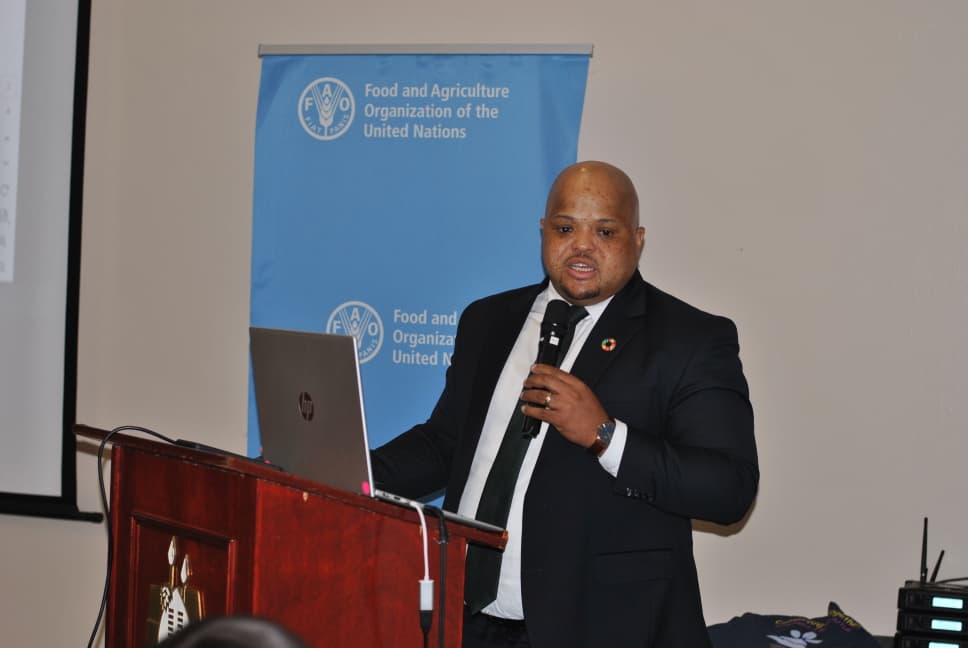
Ezulwini – Eswatini Environment Authority (EEA’s) director environment assessment Mxolisi Maphanga calls for urgent, science-driven measures to strengthen the country’s drought resilience, as the nation continues to experience rising temperatures, severe water shortages and expanding land degradation.
He delivered his remarks during a stakeholder workshop convened today to review and update the National Drought Plan (NDP), a framework central to the country’s climate-resilience strategy.
Maphanga said that drought was not an occasional shock but an entrenched national threat.
“Drought is not a distant threat; it is a recurring hazard deeply woven into our semi-arid climate,” he said, reminding stakeholders of the devastating 2015–2016 drought that affected every region of the country.
Recent climate assessments paint an even more concerning picture. Very hot days above 36°C are steadily increasing. Maphanga warned that this issue extends beyond weather patterns.
“This is not just about weather; it is about livelihoods, food security and our national development trajectory,” he said, citing the rapid spread of dongas, declining biodiversity and a surge in land degradation linked to worsening drought conditions.
Land degradation alone costs Eswatini an estimated E 1,800 million annually, about 2.9% of GDP, while national water resources remain under pressure due to rising demand and heavy dependence on water originating from outside the country’s borders.
The workshop forms part of the NDP’s review cycle, designed to keep the plan a “living instrument.” Stakeholders are focusing on three key tasks: aligning the plan with national policy, updating its action areas to reflect present challenges, and defining an investment approach to convert the NDP into costed, fundable projects.


Central to the revised direction is the development of a drought risk-financing portfolio.
Explaining the concept, Maphanga said, “Risk financing may sound abstract, but it refers to instruments that mobilise and channel resources before, during and after droughts, from domestic budget allocations to partnerships with banks, insurers and international climate funds.”
Stakeholder mapping for the review identifies a wide and diverse group of actors, including government ministries, regional development committees, parastatals such as NDMA, water and irrigation authorities, NGOs, micro-finance institutions, farmer organisations, banks, insurers, and private-sector players in forestry and beef.
The speaker underscored the importance of this breadth: “This inclusivity is essential because drought affects everyone, and solutions must be co-created.”
Maphanga reaffirmed Eswatini Environment Authority’s commitment to this collaborative approach.
“We are committed to cultivating partnerships, unlocking new funding opportunities and strengthening collaboration with both local and international partners,” he said.
The role of science and data was described as fundamental to future drought management. Improved meteorological, hydrological and socio-economic monitoring systems will allow the country to anticipate crises rather than react to them. Critical, too, is recognising how drought disproportionately affects women, youth, persons with disabilities and rural communities, ensuring these groups influence planning and decision-making processes.
As deliberations began, the speaker urged participants to be bold and practical. The objective, he said, is to produce implementable, costed actions that break down sector silos and strengthen resilience across agriculture, water, energy, health, education and finance.
Maphanga concluded by calling for national commitment to transforming drought from a recurring disaster into a controlled risk.
“The future of our environment and our nation depends on the choices we make today,” he said. “We owe it to the children of Eswatini to ensure that the rivers still flow, the soils remain fertile and our biodiversity thrives.”


Discussion about this post