



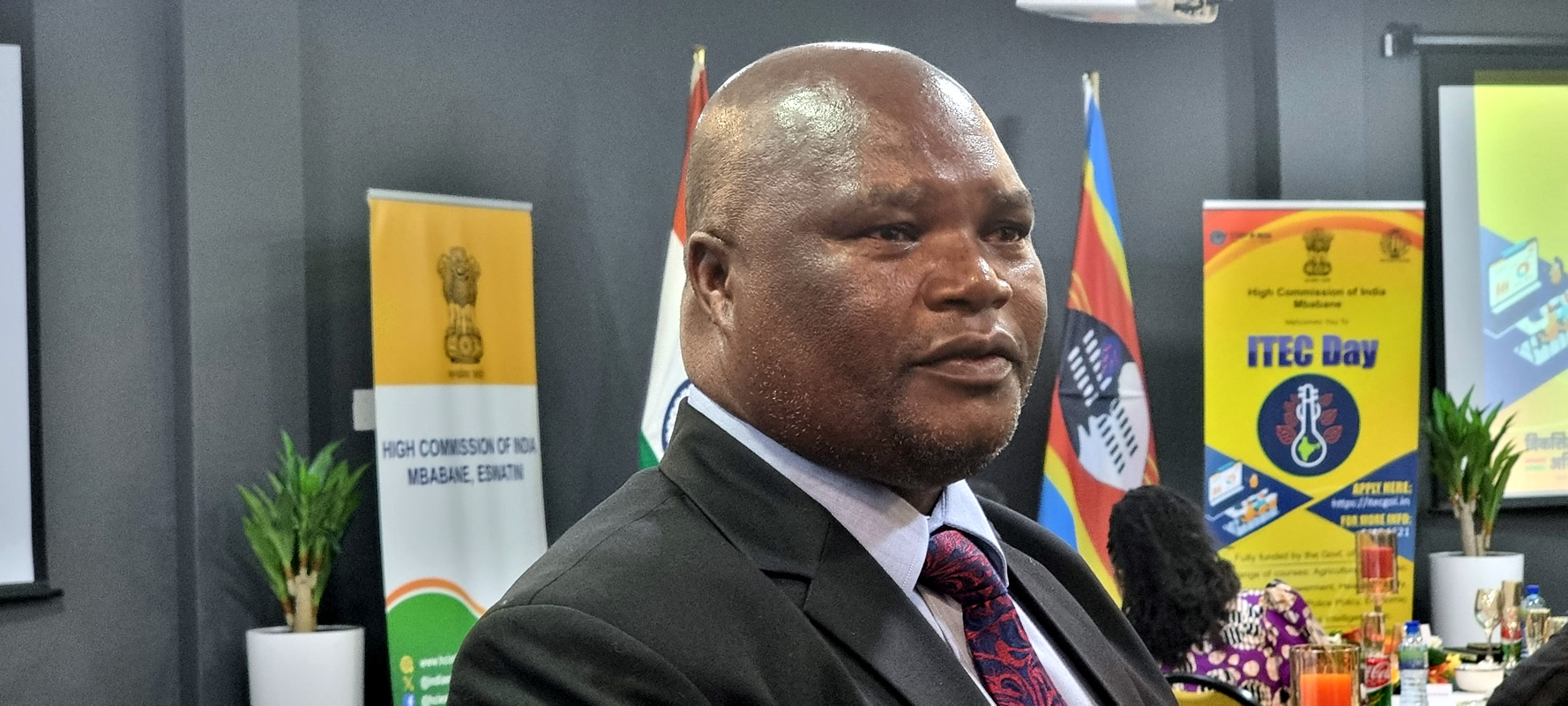
Mbabane – Eswatini Minister for Public Service Mabulala Maseko spoke at the 61st Indian Technical and Economic Cooperation (ITEC) Day celebrations held on September 19, 2025, at the High Commission of India in Mbabane. The event marked more than six decades of collaboration between India and Eswatini, celebrating the impact of the ITEC program on national development and capacity building across multiple sectors.
Addressing government officials, civil servants, media representatives, and invited guests, Maseko said, “As we celebrate the 61st ITEC Day, as Minister of Public Service, I stand before you with deep gratitude for the enduring partnership that India has extended to our nation through the Indian Technical Economic Cooperation Program ITEC. The ITEC program established on September 15th 1964 represents far more than a capacity building initiative. It embodies the spirit of South-South cooperation and demonstrates that development is demand-driven, partnership-oriented, and free from conditionalities. More than 400 have benefited from this remarkable initiative, each returning home with enhanced skills and innovative governance practices.”
He recalled that during President Ram Nath Kovind’s visit to Eswatini in April 2020, India further strengthened its commitment by doubling the annual ITEC slots from 30 to 50, acknowledging Eswatini as a valuable partner in mutual development. Maseko explained that the program addresses the Kingdom’s ongoing challenge of building institutional capacity while adapting to rapidly evolving global trends.
“Civil servants have particularly benefited from specialized training in public finance management, project management, telecommunications, and sustainable development. The defense component has been equally valuable, with several officers of the Umbutfo Eswatini Defence Force enhancing our national security capabilities,” the minister said. He also highlighted the program’s adaptability during the COVID-19 pandemic, when India launched e-ITEC programs, allowing 166 Emaswati to participate in nine online courses, six of which were designed specifically for the Kingdom.


Maseko outlined emerging areas of training, including artificial intelligence, cybersecurity, and digital transformation, as key components for positioning Eswatini to compete effectively in the global economy. He said, “The ITEC program has created more than just skilled professionals. It has built lasting partnerships. Our alumni have become ambassadors of India friendship, many rising to leadership positions across government, private sector, and civil society. These networks facilitated continued knowledge exchange and present the transformative power of South-South cooperation.”


The minister noted that ITEC aligns closely with Eswatini’s national development priorities and Vision 2022 objectives, particularly through public service capabilities and programs supporting renewable energy, environmental management, and entrepreneurship development. “Training directly contributes to our economic diversification efforts,” he said, adding that the Ministry of Public Service remains committed to ensuring that trade officials and civil servants share knowledge across institutions, creating a multiplier effect.
Looking to the future, Maseko identified digital transformation and climate-resilient development as new opportunities for partnership, combining India’s expertise with Eswatini’s innovation capacity. He expressed gratitude to India’s government, the Ministry of External Affairs, and ITEC program administrators for their dedication.
“As we commemorate the 61st anniversary, we celebrate a partnership that has transformed lives, strengthened institutions, and deepened India and Eswatini friendship. The ITEC program demonstrates that South South cooperation is a practical pathway to sustainable development benefiting all participants,” Maseko concluded.
The celebrations in Mbabane brought together officials, civil servants, and media representatives, recognizing the enduring impact of India-Eswatini collaboration on national capacity building, governance, and sustainable development.

Discussion about this post