



Mbabane – Graduates have been challenged to move beyond seeking employment and become job creators, as Government looks to entrepreneurship and skills development to strengthen Eswatini’s economy.
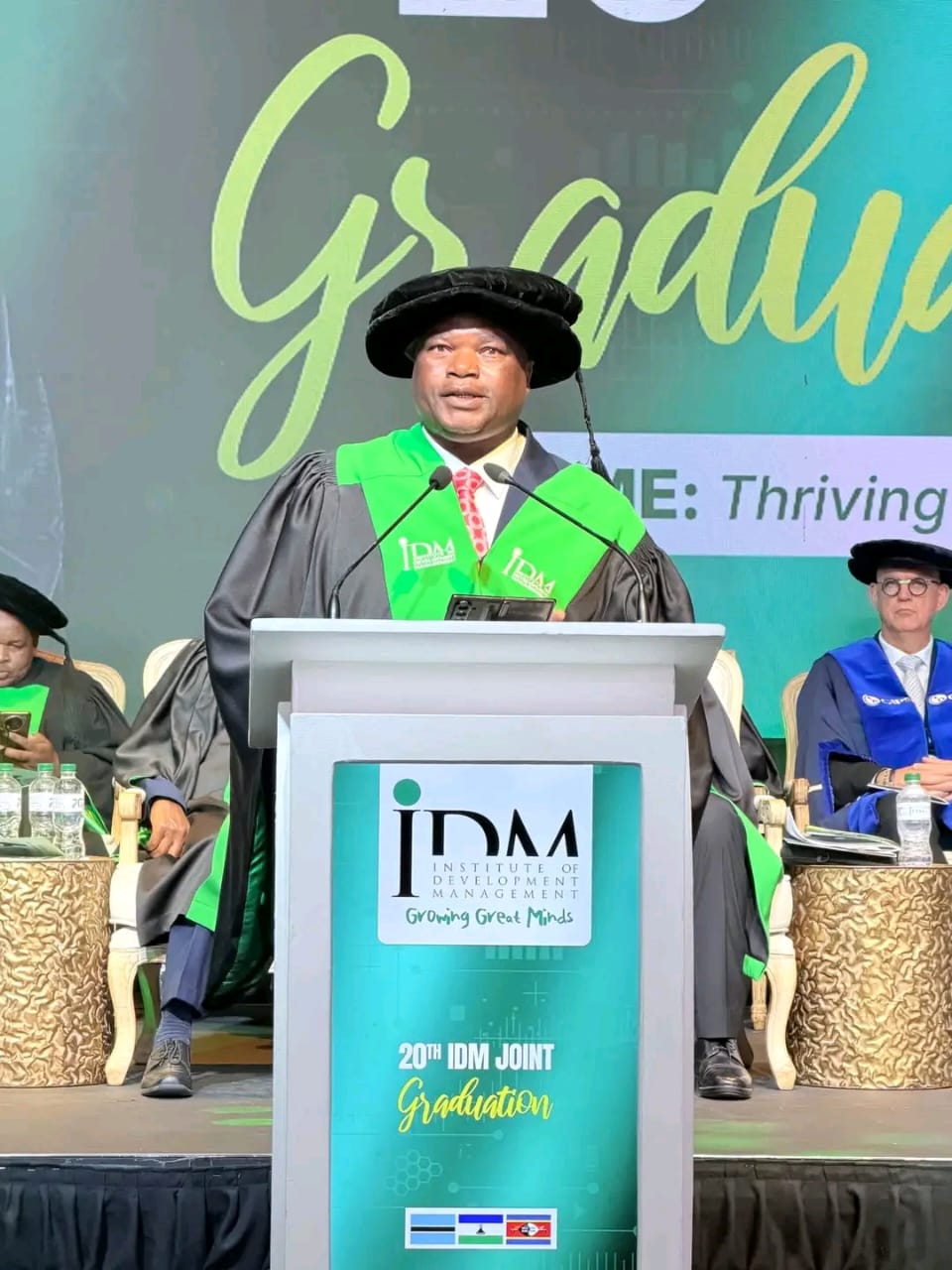
Minister of Public Service Mabulala Maseko delivered the challenge to graduates at the Institute of Development Management (IDM), urging them to use their qualifications to identify opportunities, embrace innovation and contribute meaningfully to national development.
Speaking during IDM’s 20th Joint Graduation Ceremony in Botswana, Maseko said the world graduates were entering had become increasingly competitive, requiring them to adapt to changing trends and create opportunities rather than wait for them.
“Your qualification is your foundation, and the world you are entering demands more. It is more competitive, and opportunities are changing. Align yourselves with current trends, embrace innovation, and create opportunities where others see none,” he said.


The Minister placed particular emphasis on entrepreneurship among Emaswati graduates, pointing to the Youth Enterprise Revolving Fund (YERF) and the Small Enterprises Development Company (SEDCO) as institutions that can provide aspiring entrepreneurs with coaching and financing.
He challenged graduates to bring excellence wherever they found themselves, whether in the public service, private sector or their own businesses.
The call comes as Eswatini continues to grapple with the challenge of translating educational qualifications into economic opportunities, particularly for young graduates entering an increasingly competitive employment market.
Meanwhile, Government is repositioning IDM Eswatini as a national institution expected to play a strategic role in strengthening public service capacity and developing the skills required to implement the Government Programme.
Maseko said Government’s continued financial support for the institution should be understood as an investment in the country’s human capital and not an act of charity.
He recalled that following the dissolution of the tripartite arrangement in April 2025, Eswatini had to decide whether to allow IDM’s legacy to fade or renew the institution for a new era.
“His Majesty’s Government chose renewal,” he said.
According to Maseko, the repositioning is intended to ensure that IDM develops the skills and institutional capacity needed to support the implementation of the Government Programme while advancing professionalism within the public service.
He said the ultimate objective was to have public officers who serve with competence, integrity and a commitment to delivering results.
The Minister further encouraged the graduands to uphold the institution’s reputation by creating value and serving their communities.
“Be courageous. Choose to thrive. Go beyond expectations. Create value, serve your communities, and build the future you wish to see. Wear the name of IDM with pride, for you carry its reputation with you,” he said.
A total of 213 Emaswati graduated in various programmes, with the Diploma in Human Resource Management producing the largest number of graduates at 82.
The graduands comprised 34 recipients of the CIPS Level 4 Diploma in Procurement and Supply, 31 who completed the CIPS Level 2 Diploma in Procurement and Supply Operations, 24 graduates in the Diploma in Accounting and Business Studies and 22 in the Diploma in Information Technology.
A further 19 graduated with a Bachelor of Arts in Human Resource Management, while one graduated with a Bachelor of Arts in Community Development.


Established in 1974 through the shared vision of King Sobhuza II of Eswatini, Sir Seretse Khama of Botswana and King Moshoeshoe II of Lesotho, IDM was founded on a regional commitment to education and development.
Five decades later, the institution continues to serve as a platform for skills development and regional cooperation, with Eswatini now seeking to strengthen its national role.


Discussion about this post