



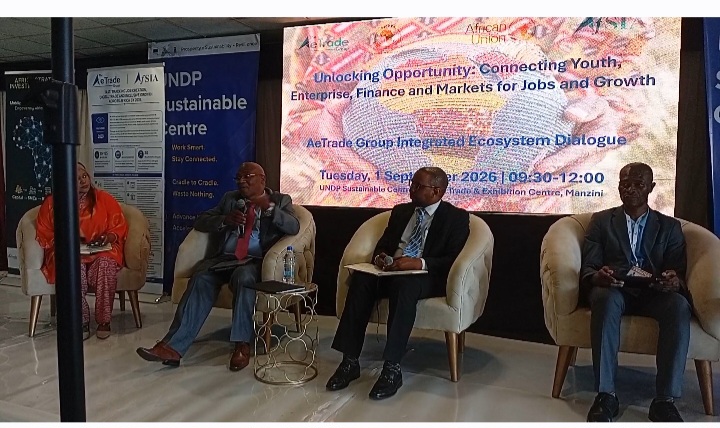
Manzini- Eswatini has been challenged to close the gap between academic innovation and commercial enterprise by creating stronger support systems to turn students’ ideas and skills into businesses and jobs.
University of Eswatini senior lecturer Dr Andile Metfula said the country could no longer afford an innovation ecosystem where young people participate in hackathons and develop promising ideas, only for those ideas to die because of a lack of mentorship, funding, data and regulatory support.
Speaking during the AeTrade Group Integrated Ecosystem Dialogue held at the Mavuso Trade and Exhibition Centre under the theme “Unlocking Opportunity: Connecting Youth, Enterprise, Finance and Markets for Jobs and Growth,” Metfula said the country needed to establish a clear pipeline from talent development to job creation.
“We take the talent, convert it to an innovation. From an innovation, I want an enterprise. From an enterprise, I want jobs. From jobs, we need sustainable growth,” he noted.


Metfula said universities should be positioned at the centre of the country’s enterprise ecosystem, where national economic challenges could be converted into research questions, prototypes and viable business models.
He argued that universities must also work more closely with the private sector, particularly in providing students with access to modern technology and equipment.
“Government cannot do this thing alone,” he said.
According to Metfula, the private sector has resources that government and universities may struggle to provide, making corporate participation critical in developing a globally competitive pool of talent.
He said the lack of proper incubation and mentorship remained one of the major weaknesses in the country’s innovation pipeline.
Metfula pointed to the FinTech Forum Eswatini as an example of how institutions could work together to address this gap. He said the forum was created after stakeholders realized that hackathons, while useful for generating ideas, did not necessarily produce sustainable businesses.
The forum brings together institutions including the University of Eswatini, Central Bank of Eswatini, Financial Services Regulatory Authority, Centre for Financial Inclusion, Eswatini Revenue Service and Royal Science and Technology Park.
Its focus, he said, is to ensure that young innovators receive support in areas such as data, regulation and other requirements needed to take their ideas to market.


Meanwhile, Youth Enterprise Revolving Fund (YERF) CEO Mandla Nkambule said the innovation conversation must also reach entrepreneurs outside the country’s main economic centres.
He questioned how the benefits of capacity building, digital finance and entrepreneurship could reach the estimated majority of the population living beyond the Manzini-Mbabane corridor.
“How do we take this conversation out of this Manzini-Mbabane corridor to my Siteki, to Lavumisa?” Nkambule examplery said.
He said partnerships with organizations on the ground would be critical in taking these opportunities to young people and SMEs across the country.
The challenge, therefore, is no longer simply to produce talented graduates, but to build an ecosystem capable of turning that talent into commercially viable enterprises.
For Eswatini, Metfula said, the ultimate measure of innovation should be whether an idea can be consumed by the market, grow into an enterprise and create sustainable employment.


Discussion about this post