



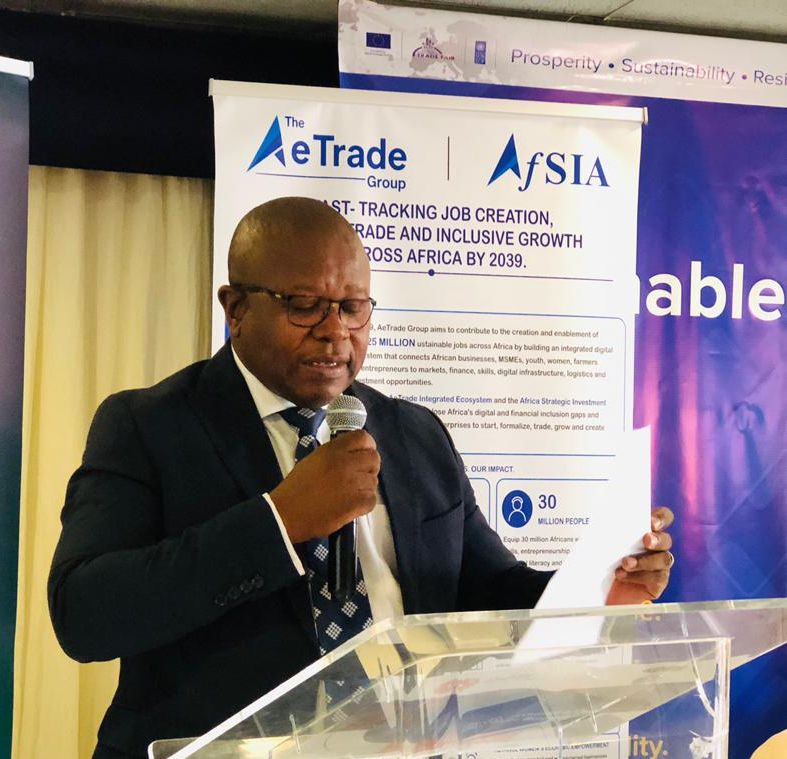
Manzini- The Minister of Commerce, Industry and Trade Mqnqoba Khumalo has said Eswatini must move beyond simply creating opportunities for small businesses and instead ensure that entrepreneurs have access to the finance, skills, technology and markets required to turn those opportunities into sustainable businesses.
Khumalo said the country’s economic transformation would depend on building a stronger ecosystem around micro, small and medium enterprises (MSMEs), which he described as central to enterprise development, economic growth and job creation.
He was speaking on Tuesday during the AeTrade Group Integrated Ecosystem Dialogue held at the Mavuso Trade and Exhibition Centre under the theme “Unlocking Opportunity: Connecting Youth, Enterprise, Finance and Markets for Jobs and Growth.”
The minister said government needed to change its approach from simply asking whether economic opportunities existed to examining how effectively emaSwati and their businesses were being connected to them.


“Registering a business is not enough,” Khumalo said, stressing the need to help businesses move from establishment to sustainability, survival to growth, and informal operations to formal participation.
He said MSMEs needed a combination of skills, finance, infrastructure, technology, standards, markets and business support to grow.
Khumalo warned that providing these interventions separately would not be enough to address the challenges facing entrepreneurs.
“Training without access to finance is insufficient. Finance without access to markets is insufficient. Market access without the ability to meet quality standards is insufficient,” he said.
According to the minister, the country also needs to strengthen production and value addition if it is to achieve sustainable economic growth.


He said Eswatini could not continue being primarily a consumer of products manufactured elsewhere, but needed to produce, process, manufacture and export higher-value goods and services.
He identified agriculture and agro-processing, manufacturing, textiles, handicrafts, tourism, services and the digital economy as areas where greater value could be created.
Khumalo also pointed to the opportunities available through regional markets and the African Continental Free Trade Area (AfCFTA), but cautioned that having access to a market did not automatically guarantee access to customers.
Local businesses, he said, must be competitive, produce consistently, meet quality standards, package their products professionally and build reliable relationships with buyers.
Digital platforms could help bridge some of these gaps by connecting local enterprises with customers, suppliers, investors and markets beyond their immediate geographical locations. Government, he said, therefore saw value in initiatives such as the AeTrade ecosystem in complementing existing national institutions.
Access to finance remains another major challenge, with Khumalo noting that many MSMEs have viable ideas and products but struggle to secure appropriate financing.
However, he said the solution was not simply to make more money available.
“What we need is financing that is appropriate to the realities of our enterprises, combined with financial literacy, proper business records, stronger credit assessment and credible market opportunities,” he said.
Khumalo further called for investment that delivers tangible economic value through increased production, job creation, skills transfer, stronger local supply chains and access to new markets.
He said the success of initiatives aimed at supporting businesses should ultimately be measured through results, including the number of businesses formalized, finance mobilised, new buyers secured and jobs created.
He challenged stakeholders to determine how many young people could move from seeking employment to creating employment.
“This is the ecosystem we need to build,” Khumalo noted.

Discussion about this post