



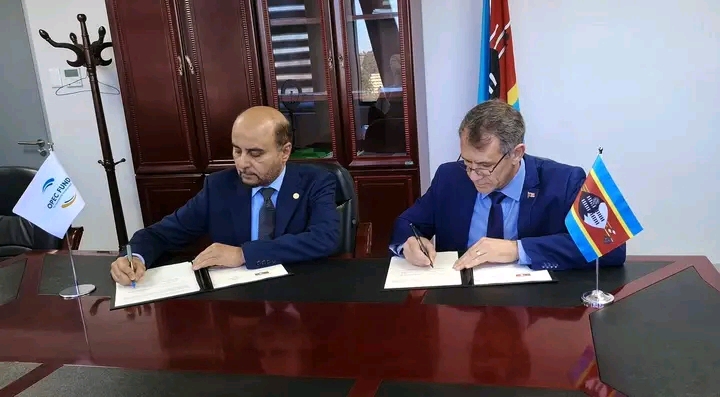
Mbabane- Eswatini has secured access to up to E 4.3 billion (US$250 million) in potential financing from the OPEC Fund for International Development over the next three years, with water, energy and health identified as priority areas for investment.
The financing window forms part of a new Country Partnership Strategy covering 2026 to 2029, signed between the Kingdom and the OPEC Fund during a high-level visit by the institution’s President, Dr Abdulhamid Alkhalifa earlier this week.
The agreement provides a framework for the Fund to finance projects aligned with the country’s development priorities, while strengthening cooperation between the two parties.
Unlike previous interventions, which have largely been project-specific, the new strategy provides a broader financing framework that could see substantial resources channelled into critical infrastructure and public services.

OPEC Fund President Alkhalifa said the strategy builds on a partnership that has developed over nearly two decades, with the latest agreement expected to deepen cooperation in areas considered critical to Eswatini’s development.
The Fund’s focus on water, energy and health comes as the country continues to invest in infrastructure and improve access to essential services, while also responding to the effects of climate change.
The partnership is also expected to support agricultural transformation, particularly through the Mkhondvo-Ngwavuma Water Augmentation Programme (MNWAP).
The OPEC Fund is already providing a E 3.2 million (US$20 million) loan towards Phase 2 of the programme, which is being co-financed with the African Development Bank and BADEA.
The financing is supporting the construction of the Mpakeni Dam, together with irrigation and on-farm infrastructure.
Once completed, the project is expected to enable irrigation of up to 30,000 hectares of farmland, with government hoping to use the expanded water infrastructure to increase agricultural production, strengthen food security and improve rural livelihoods.
The latest partnership comes against the backdrop of an established OPEC Fund presence in Eswatini.
Since commencing operations in the country in 2007, the Fund has approved eight public sector loans worth a combined E 2.3 billion (US$138 million).
The financing has supported sectors including agriculture, water and sanitation, transport, health and economic governance.
Among the major interventions are the Lower Usuthu Smallholder Irrigation Project (LUSIP), MNWAP Phase 2 and a E 810 million (US$50 million) policy-based loan approved in 2025.
The policy-based loan was co-financed with the World Bank’s International Bank for Reconstruction and Development and the African Development Bank to support structural and fiscal reforms.
The new strategy was formalized following meetings between Alkhalifa and key government leaders, including His Majesty King Mswati III, Prime Minister Russell Mmiso Dlamini and Minister of Finance Neal Rijkenberg.
Alkhalifa also met Agriculture Minister Mandla Tshawuka to discuss agricultural development and visited the OPEC Fund-supported LUSIP and MNWAP projects.


For Eswatini, the agreement creates additional scope to mobilise development financing for projects in sectors that require significant capital investment, particularly water infrastructure, energy and healthcare.
The OPEC Fund, established in 1976, has committed more than E 518 billion (US$32 billion) to development projects in over 125 countries. Its interventions have supported projects with a combined value of more than E 4.8 trillion (US$240 billion).


Discussion about this post