



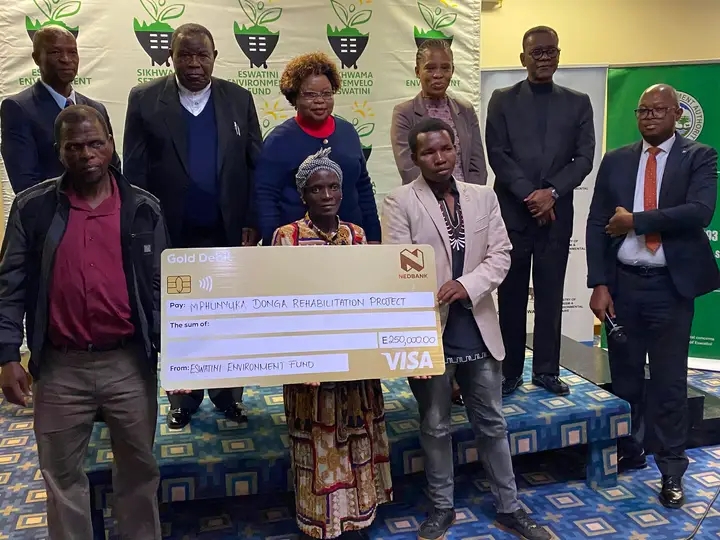
Manzini- More than 170 environmental project proposals failed to secure funding under the Eswatini Environment Fund’s 2026/27 grant cycle after only eight out of more than 186 applications met the required standard.
The successful projects shared a total of E2.3 million, with each receiving funding based on its specific financial requirements. The funded initiatives focus on sustainable water management, ecosystem and biodiversity conservation, chemicals and waste management, sustainable land management, climate change, and other environmental priorities.
Speaking during the projects award ceremony, the Eswatini Environment Fund Board Chairperson Professor Roy Vilane said the selection process was highly competitive, with many applications falling short of the required quality despite the strong interest shown by communities across the country.
He revealed that several applications were submitted after the closing date, automatically disqualifying them from consideration, while many others were unsuccessful because their proposals did not meet the Fund’s required standard.


Professor Vilane, however, welcomed the growing participation of women and young people in this year’s funding cycle, saying their increased involvement reflects a growing appreciation of environmental conservation and sustainable development among previously underrepresented groups.
The eight successful projects include wetland management initiatives at Madvohane and KaLiba Royal Kraals, Donga rehabilitation projects in the Shiselweni and Lubombo regions, a youth-led waste management initiative by Dream Home Investment, a green construction materials project at JEREMPAUL Vuvulane Food Market, a rainwater harvesting project at Mlindazwe High School, and a University of Eswatini conservation project aimed at restoring and commercialising the endangered Warburgia salutaris (Sibhaha) tree.
Collectively, the projects are expected to improve environmental management while benefiting thousands of households, learners and farmers through interventions such as wetland restoration, erosion control, waste collection, biodiversity conservation and improved access to water.
The latest funding round follows last year’s call, which attracted 205 applications, with only 11 projects ultimately receiving grants. This year’s outcome further underscores the Fund’s rigorous assessment process, where only projects demonstrating strong technical merit and community impact qualify for support.
Since its inception, the Eswatini Environment Fund has supported 90 community-based environmental projects, disbursing approximately E12 million to initiatives aimed at strengthening environmental protection, climate resilience and sustainable natural resource management across the country.
Meanwhile, Mlindazwe High School Principal Philemon J. Magagula commended the government’s continued commitment to promoting environmental stewardship, saying the Fund is empowering communities and institutions to implement practical conservation projects that will have lasting benefits for both people and the environment.


Notably, the eight successful beneficiaries will undergo a three-day capacity-building training programme. The training will equip them with skills on effective project implementation, proper utilisation of the funds, financial management, procurement procedures, and monitoring and reporting requirements to ensure accountability and the successful delivery of their projects.


Discussion about this post