



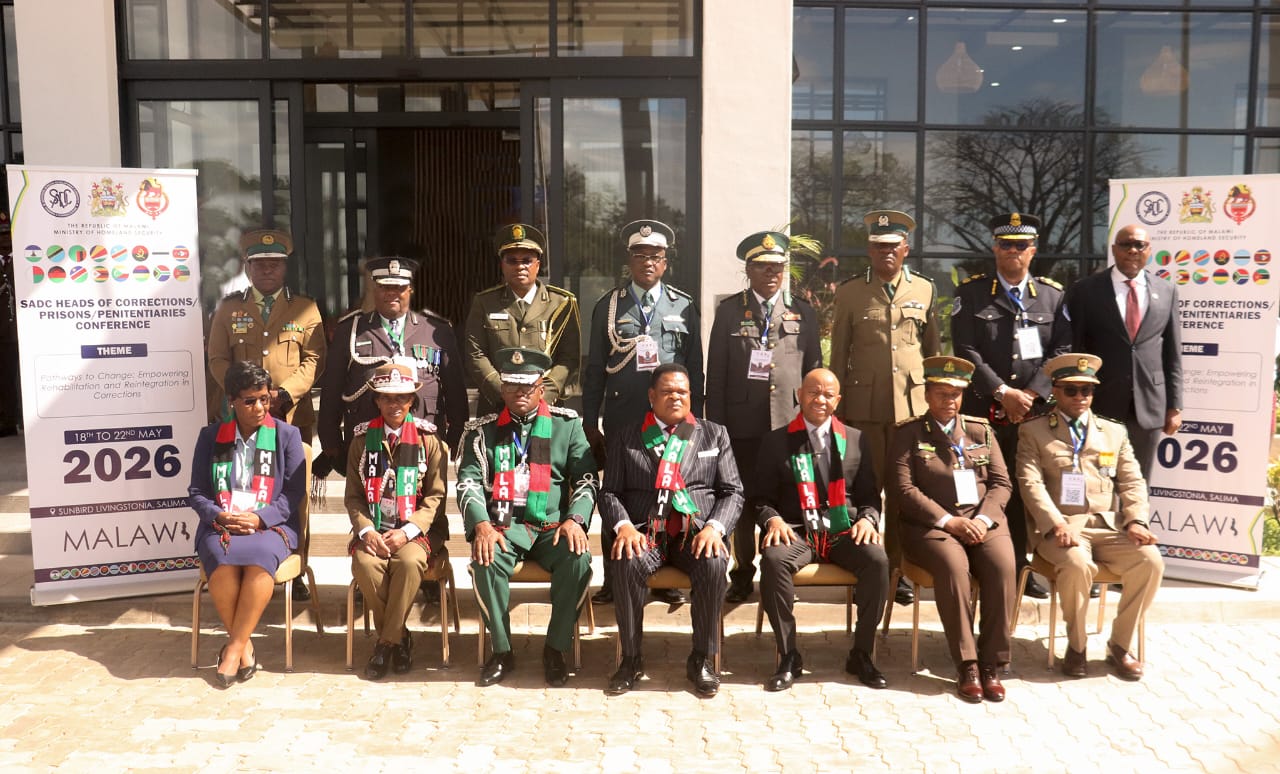
MBABANE – Southern African Development Community (SADC) member states have renewed calls for correctional institutions across the region to fully embrace the United Nations Standard Minimum Rules for the Treatment of Prisoners, commonly known as the Nelson Mandela Rules.
According to information shared by the SADC Secretariat this is part of broader efforts to reform prison systems and strengthen offender rehabilitation.
The call emerged during the SADC Heads of Corrections, Prisons and Penitentiary Services Conference held in Salima, Malawi, from May 19 to 22, 2026, where regional leaders in correctional services discussed strategies aimed at transforming prisons into centres of rehabilitation and reintegration rather than mere detention facilities.
Held under the theme “Pathways to Change: Facilitating Effective Offender Rehabilitation and Reintegration in Corrections/Prisons,” the conference brought together Commissioner Generals of correctional institutions and senior officials from across the region to exchange ideas, share best practices and confront common challenges affecting correctional systems.


Delegates emphasised the urgent need for greater investment in correctional infrastructure, psychosocial support systems, restorative justice programmes and staff capacity building in order to improve rehabilitation outcomes and support the successful reintegration of offenders into society.
In his keynote address, Malawi’s Minister of Homeland Security, Peter Mukhito, stressed that correctional systems globally were undergoing major transformation due to emerging security, social and developmental pressures. He noted that prisons were increasingly expected to move beyond their traditional custodial role and focus more on rehabilitation, reintegration and the protection of human rights.
Mukhito said correctional institutions must ensure that offenders leave prison better equipped to become productive and law-abiding citizens.
He called on SADC member states to fully integrate the principles of the Nelson Mandela Rules into correctional operations across the region, saying the framework was essential in safeguarding the dignity and fundamental rights of incarcerated persons.
“The treatment of prisoners must reflect our collective commitment to human dignity and justice,” he said, adding that correctional institutions should play a meaningful role in promoting peace, security and social stability.
The minister also highlighted persistent challenges facing correctional systems in the region, including prison overcrowding, transnational crime, violent extremism and radicalisation within correctional facilities.
He commended SADC member states for maintaining strong cooperation, dialogue and knowledge sharing on issues affecting correctional services, saying regional collaboration remained critical in responding to increasingly complex security threats.
Wandika Phiri, Commissioner General of the Malawi Prisons Service and Chairperson of the SADC Heads of Corrections, Prisons and Penitentiary Services, said rehabilitation could not be achieved through confinement alone.
She stressed the need for comprehensive institutional interventions supported by active community participation to ensure successful offender reintegration.
Phiri said correctional services across the region were increasingly expected not only to maintain secure custody of offenders, but also to provide meaningful rehabilitation programmes that reduce recidivism and contribute to public safety.
She further acknowledged ongoing efforts by correctional institutions to strengthen intelligence gathering mechanisms in order to combat violent extremism and radicalisation within prisons.
According to Phiri, correctional institutions needed to adopt innovative rehabilitation approaches capable of addressing modern correctional challenges while supporting broader national development goals.
Also addressing the conference was Prof. Kula Theletsane, Director of the SADC Organ on Politics, Defence and Security Affairs, who praised correctional institutions for their contribution towards maintaining peace and security through rehabilitation and reintegration programmes.
Theletsane encouraged member states to adopt evidence-based correctional frameworks such as the Risk-Need-Responsivity (RNR) Model, which focuses on identifying offender risks and tailoring rehabilitation interventions accordingly.
He said correctional services should strengthen initiatives such as vocational training, restorative justice programmes and offender aftercare systems in order to address the root causes of criminal behaviour.
The SADC official also underscored the importance of technological advancement and modernisation within correctional systems, saying prisons needed to evolve in response to emerging security and operational demands.
Delegates at the conference reaffirmed their collective commitment to building correctional systems that not only ensure security, but also restore dignity and create meaningful opportunities for personal transformation among offenders.
The meeting further stressed the importance of moving away from traditional colonial-era jail systems towards modern correctional models centred on rehabilitation, reintegration and community involvement.
Among the issues discussed during the conference was the review of the SADC Corrections/Prisons/Penitentiary Services Strategic Action Plan for 2021–2025.


Participants examined findings and recommendations emerging from the review process and identified priority areas requiring future intervention.
Discussions also focused on strengthening intelligence gathering within correctional institutions, improving rehabilitation and reintegration strategies, sharing global best practices and exploring innovative approaches to offender management.
At the conclusion of the conference, the Heads of Corrections and Prisons adopted a series of recommendations aimed at strengthening correctional services across the SADC region and improving the ability of institutions to respond effectively to emerging challenges.
The conference was attended by Commissioner Generals and representatives from Angola, Botswana, Eswatini, Lesotho, Malawi, Mozambique, Namibia, Seychelles, South Africa, Tanzania, Zambia and Zimbabwe, as well as officials from the Southern African Development Community Secretariat.

Discussion about this post