



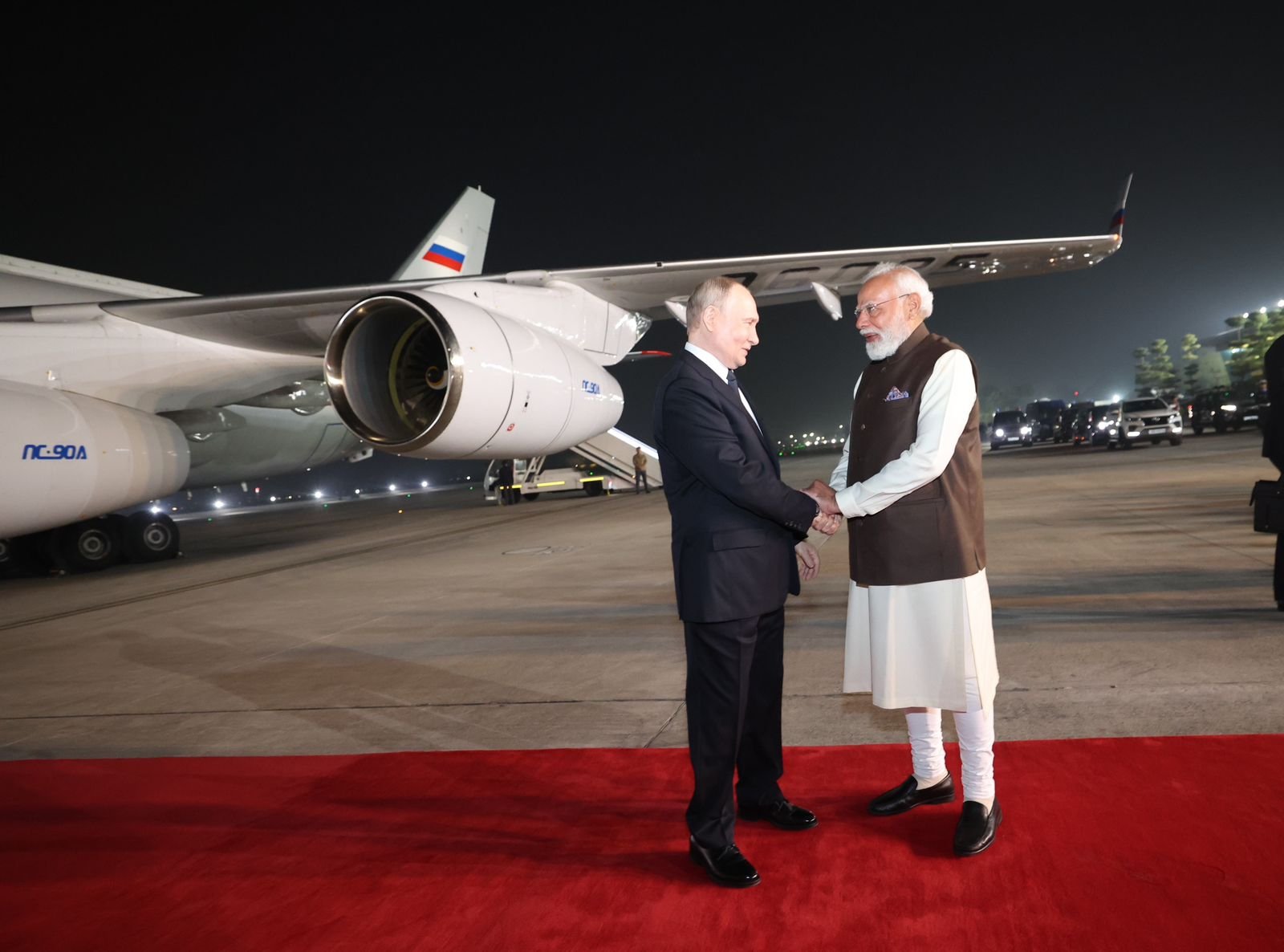
New Delhi – Russian President Vladimir Putin has arrived in New Delhi for a two-day state visit on 4 and 5 December, his first trip to India since Russia launched its full-scale invasion of Ukraine in February 2022. The visit comes during a tense moment in global politics, with India’s relationship with the United States strained and Western nations urging Prime Minister Narendra Modi to distance himself from Moscow.
Putin’s arrival is part of the 23rd Annual India Russia Summit. His schedule includes private dinners, an official banquet, bilateral meetings and interactions with business leaders. Although the Russian leader is wanted by the International Criminal Court, he faces no legal threat in India because the country is not an ICC member.
Modi publicly welcomed Putin shortly after his arrival. In a message shared on social media, he wrote: “Delighted to welcome my friend, President Putin to India. Looking forward to our interactions later this evening and tomorrow. India-Russia friendship is a time tested one that has greatly benefitted our people. Welcomed my friend, President Putin to 7, Lok Kalyan Marg.”
The geopolitical atmosphere around the visit is deeply charged. Washington has been pushing India to cut back on Russian oil purchases, arguing that India’s imports are helping finance Moscow’s war effort in Ukraine. India’s reliance on Russian crude rose from 2.5 percent before the war to around 35 percent after sanctions restricted Russia’s access to European markets. The United States responded with hefty tariffs on Indian exports, including a 50 percent tariff imposed by President Donald Trump in August. Indian refiners have since begun reducing orders to avoid possible secondary sanctions.
For Modi, receiving Putin is a signal of India’s strategic autonomy. Despite sustained pressure from Western capitals, India has maintained that dialogue remains essential in resolving the conflict in Ukraine. The visit allows Modi to demonstrate to both domestic and international audiences that India will not allow its foreign policy decisions to be shaped solely by Washington or any other power.
For Russia, India remains a vital partner. With nearly one and a half billion people and economic growth above eight percent, India offers a major market for energy, raw materials and technology. Defence cooperation remains a key pillar of the relationship. Although India has been diversifying its defence imports, Russian platforms still dominate major areas of India’s arsenal. Many of India’s 29 air force squadrons rely on Sukhoi 30 jets, and S 400 air defence systems played a crucial role during India’s limited armed clash with Pakistan in May this year.
Ahead of the summit, reports indicated that India is considering purchasing the S 500 air defence system and the Su 57 fifth generation fighter jet. Pakistan’s acquisition of China’s J 35 stealth fighters has sharpened India’s interest in accelerating its own modernisation plans. However, Russia is facing shortages of key components due to sanctions and wartime demand. Deliveries of parts of the S 400 system have already been pushed to 2026. Modi is expected to seek firmer assurances on delivery timelines and long-term maintenance.
Trade between the two nations has expanded rapidly, reaching 68.72 billion US dollars by March 2025, compared to 8.1 billion US dollars in 2020. The growth is driven mostly by discounted Russian oil, creating a large trade imbalance that favours Moscow. Indian exports remain modest, with items such as smartphones, shrimp, meat and garments contributing only limited value in the Russian market. Modi wants greater access for Indian goods, particularly in consumer sectors that could expand once the war ends and Russia gradually reconnects with the global economy.
Putin’s visit also holds symbolic importance for the Kremlin. Russia has been working to show that efforts by Western governments to isolate it have been ineffective. Putin travelled to China three months ago for talks with Xi Jinping and met Modi during the same trip, presenting an image of close cooperation among major Asian leaders who advocate a multipolar world. Russia frequently refers to its partnership with China as having no limits and labels its relationship with India as a special and privileged strategic partnership. This stands in sharp contrast to Russia’s fractured ties with Europe, which analysts such as Andrei Kolesnikov describe as unprecedented for the modern Russian state.
Modi is navigating competing demands from multiple sides. His warm past relations with Trump have not softened the US tariffs imposed on India. European partners have also increased pressure. This week, the ambassadors of Germany, France and the United Kingdom issued an unusual joint statement in an Indian newspaper criticising Russia’s conduct in Ukraine. The prime minister must manage stronger cooperation with Moscow without jeopardising India’s trade talks with Washington or weakening ties with key European partners.
India’s defence needs remain urgent. Despite moves to expand domestic production and diversify suppliers, many of India’s core defence systems still depend on Russia for parts, maintenance and upgrades. This dependence has made defence a central theme of this year’s summit.


Analysts from the Global Trade Research Initiative say the talks represent a negotiation shaped by supply chains, economic risk and long-term resilience rather than a return to Cold War-era alignments. They note that a modest outcome would secure cooperation on oil and defence, while a more ambitious agreement could alter economic and strategic dynamics across the region.

Discussion about this post