



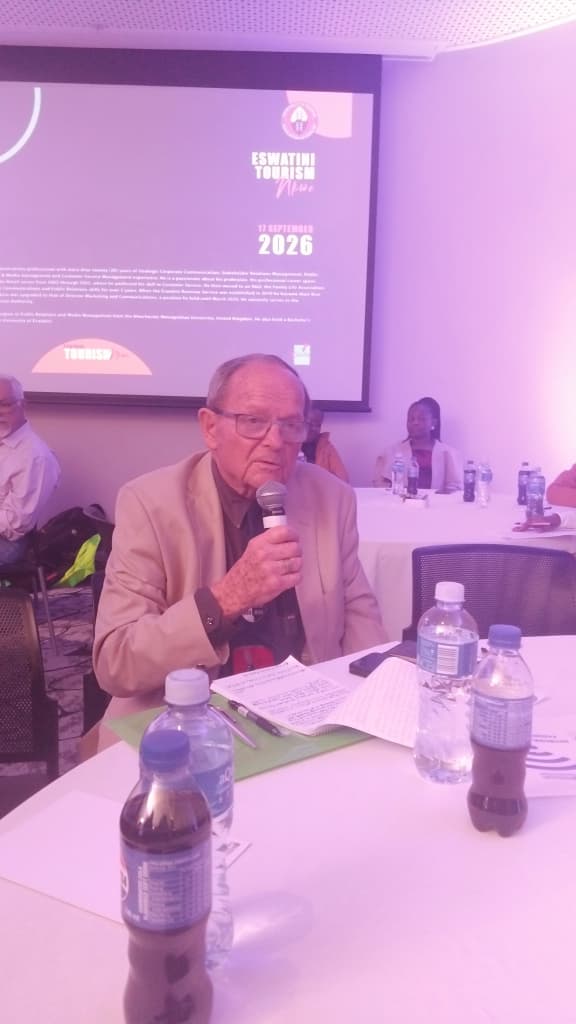
Mbabane– The reported 1.037 million international arrivals into Eswatini have come under scrutiny after a tourism operator challenged the accuracy of the figure, citing the country’s limited accommodation capacity and declining hotel occupancy.
Cuddle Puddle Director Horst Sayler questioned how the reported arrivals translated into actual visitors staying in the country, saying the statistics did not appear to correspond with the situation being experienced by tourism establishments.
Sayler said statistics from 2023 recorded only 183 accommodation facilities and 857 rooms, raising questions about where the large number of visitors reflected in the international-arrivals statistics were accommodated.
“If we put three beds in one room, then where did all the rest of our visitors, which you put in the paper and you mentioned this morning, where did they all stay?” he asked.


His challenge comes against the backdrop of figures presented by Eswatini Tourism Authority (ETA) Chief Executive Officer Vusi Norman Dlamini, who said international arrivals increased from about 964,000 in 2024 to 1.037 million in 2025.
Dlamini said the tourism sector was recovering but remained below pre-COVID-19 levels, while international arrivals had increased by about 8 per cent up to June 2026.
He attributed part of the increase to events, particularly cultural events such as Gwala, Buganu and Bushfire, while acknowledging international pressures, including rising oil prices and increased travel costs, which have affected travel from the European market.


However, Sayler said the reported figures needed to be examined against what was happening within the accommodation sector.
He said some hotels were recording occupancy levels of only 50 to 55 per cent during the Easter holiday period and claimed that some establishments did not take tourist bookings during the December and January holiday season.
“Three of our most beautiful hotels are closed now for four years. Where are the tourists? Where are they accommodated?” Sayler asked.
He said this was a significant departure from the period when tourists would secure hotel rooms months in advance for the following festive season.
Dlamini, however, clarified that international arrivals should not be equated with hotel guests.
He said people entering Eswatini for religious events, including large numbers attending Shembe gatherings, are captured in the international-arrivals statistics even when they do not stay in formal accommodation.
“If, for instance, 1,000 of them are coming into the country, then they are going to be staying in hotels. It doesn’t always necessarily mean that,” Dlamini said.
He said the issue highlighted the need for Eswatini to move beyond simply counting people entering the country and instead measure how visitors contribute to the economy.
Dlamini said the ETA was working with key partners to facilitate implementation of the Tourism Satellite Account, a United Nations-endorsed statistical framework intended to provide a clearer picture of tourism’s contribution to gross domestic product and wider economic activity.
He said the framework would help establish whether increased arrivals were translating into longer stays, higher occupancy, increased visitor spending, investment and employment.
“Tourism is cross-cutting, and it is not just about international arrivals,” Dlamini said.
The debate also comes as the tourism industry faces growing competition from unregistered accommodation.
The Hilton Managing Director said unregistered Airbnb establishments were taking business away from formal accommodation providers and could contribute to what he described as “skewed statistics”.
He said some of these establishments operated without the same obligations as registered tourism businesses, including payment of bed levies and VAT.
The Hilton MD said the industry, ETA, government and other stakeholders needed to confront the issue as the formal accommodation sector sought to rebuild its market.
Meanwhile, Dlamini said the ETA was reviewing its tourism strategy with stakeholders, with the revised strategy intended to strengthen implementation and shift the authority from an activity-driven approach towards results, outcomes and measurable impact.
The strategy is also being aligned with the National Development Agenda and Government Plan of Action.
Dlamini said digital technology and artificial intelligence would form part of the sector’s future, in line with the UN Tourism theme for Tourism Month, “Digital Agenda and Artificial Intelligence to redesign tourism.”
He said visitors were increasingly using digital platforms and AI to plan and customise trips and to virtually view destinations before travelling.
The ETA, in collaboration with the UNESCO AI Academy, is expected to host a practical generative-AI workshop for about 50 tourism industry players, including tour operators, tour guides, travel agents, accommodation establishments and digital and social media managers.
With the latest figures showing a rise in arrivals but continued concerns over hotel occupancy and accommodation capacity, the debate has shifted towards determining what the numbers represent and how much of that activity is translating into measurable economic value for Eswatini.


Discussion about this post