



Mbabane- The Smallholder Agricultural Productivity Enhancement and Marketing Project (SAPEMP) is set to move into full-scale implementation, with 2 000 farmers expected to begin production in November as the seven-year agricultural program enters a critical phase.
The Minister of Agriculture Honorable Mandla Tshawuke said the project has moved beyond the lengthy process of securing funding and organizing farmers, with 40 farmer clusters already established ahead of the first planting season. Tshawuke said the commencement of production would mark a major shift for SAPEMP, which has been in preparation for the past two years.
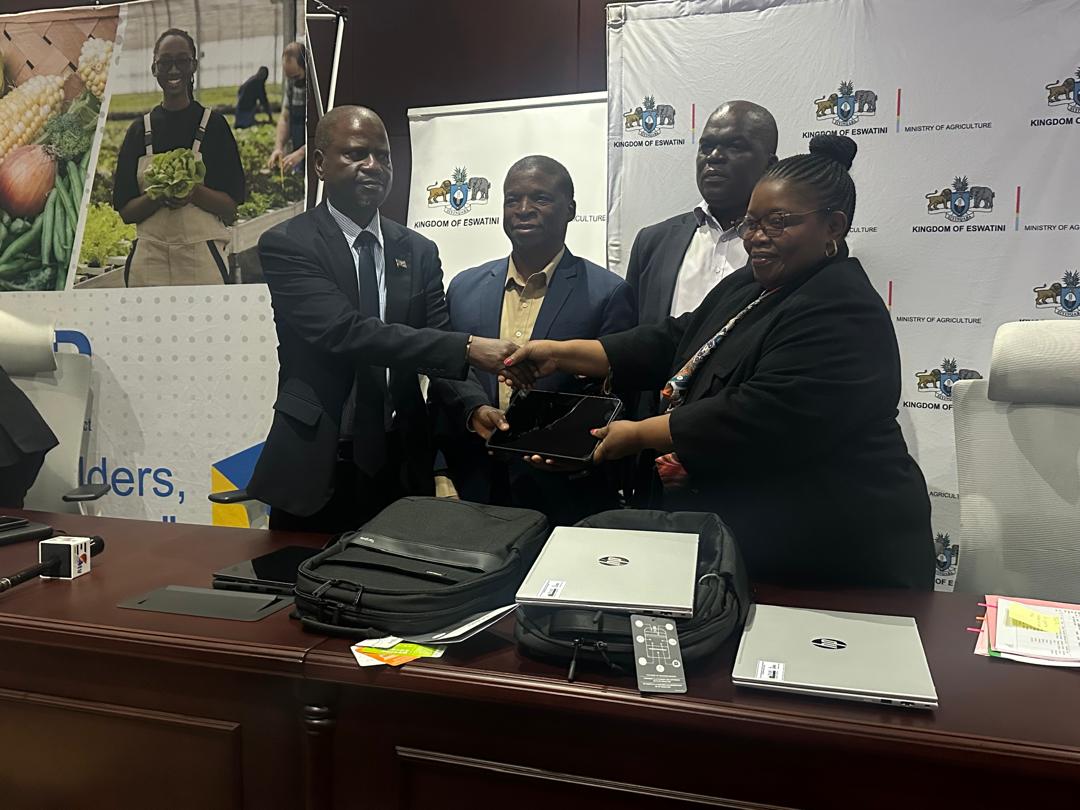
“We are now at the point whereby they are hitting the tarmac, whereby we’re actually starting the project,” said the minister during the handover of information technology equipment to SAPEMP extension officers at the ministry boardroom on Monday.
The Minister said the initial 2 000 farmers would form the starting base of the project, which is expected to eventually reach farmers across the country during its seven-year lifespan.


The first seeds are expected to be planted in November, after which extension officers will work closely with the farmers throughout the production cycle.
The project is being implemented by the Ministry of Agriculture in partnership with EWADE, with support from the International Fund for Agricultural Development (IFAD) and the Green Climate Fund (GCF).
According to the minister, the financing arrangement consists of a 40 per cent loan and 60 per cent grant. SAPEMP is intended to move smallholder farmers towards more productive and commercially oriented agriculture by improving production, strengthening market linkages and addressing some of the challenges around farmer aggregation and financing.


A major feature of the project will be the collection of data to determine whether the investment is producing tangible economic benefits for participating farmers.
The ministry has therefore equipped extension officers with 40 tablets and four laptops at a total cost of E312 000.
The four laptops, valued at E83 000, will be allocated to senior extension officers in the four regions, while the 40 tablets, costing E229 000, will be used by extension officers working directly with farmers.
The equipment is expected to enable officers to collect and transmit information from farms, including details on crops planted, farmers participating, production levels, yields, markets accessed, sales and revenue generated.
The minister said the information would be used to establish the actual impact of the project on farmers’ livelihoods.“We want to check what impact we’re actually having on the lives of people. And to do that we need data, which we then need to accumulate,” he said.
The data will also enable the ministry to establish how many farmers are benefiting from the project and whether the programme is contributing towards taking people out of poverty.
The minister said the project had taken considerable time to reach this stage because of the work involved in securing the necessary financing and preparing farmers for participation.
He said efforts had also been made to accelerate the implementation of the project, including engagement with IFAD officials. The minister said the ultimate objective was to see the project contributing to the wider agricultural economy through improved yields and employment creation.
SAPEMP is expected to promote climate-resilient production, with the broader objective of reducing the vulnerability of smallholder farmers to drought and other climate-related shocks.
The project will also seek to strengthen farmers’ participation in markets, with production expected to be linked to opportunities for increased sales and income.
With the first 2 000 farmers scheduled to enter production in November, the ministry will now have an opportunity to assess the project’s performance on the ground and determine whether its investment in smallholder agriculture can translate into higher production, stronger market participation and improved livelihoods.
The seven-year implementation period is expected to provide scope for the project to expand beyond the initial farmer base and reach communities across all four regions of the country.


Discussion about this post