



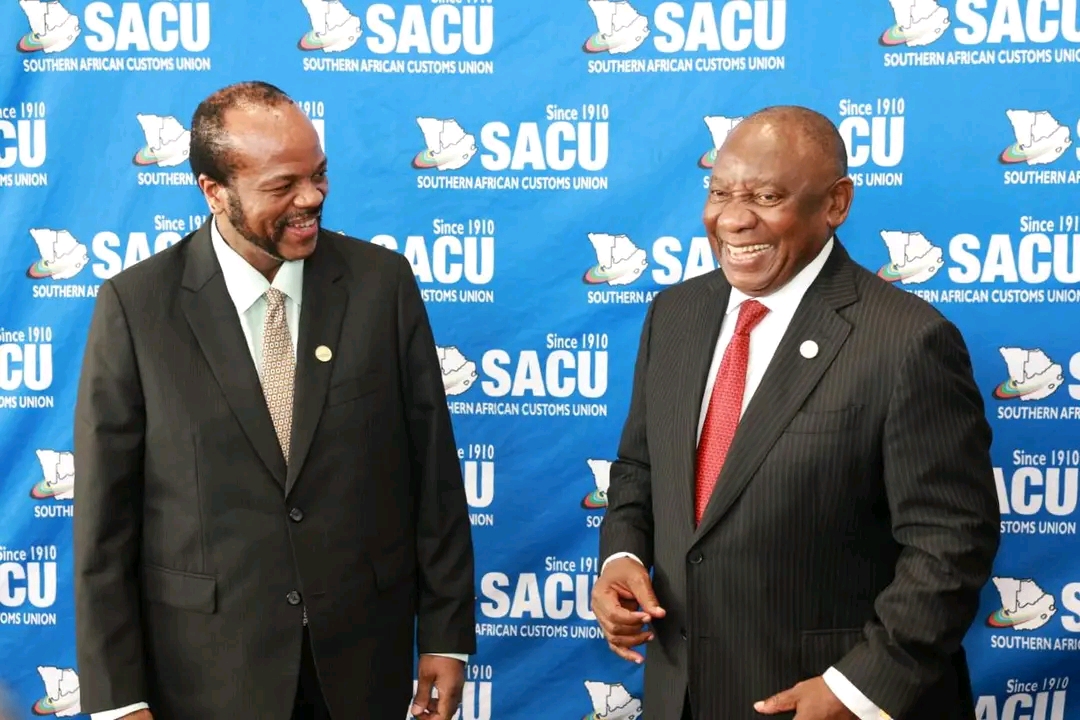
CAPE TOWN, SOUTH AFRICA – The Southern African Customs Union (SACU) will now protect member states from political spillovers that could disrupt regional trade and the shared revenue pool.
This will be done by engaging in trade negotiations as a bloc, as opposed to leaving it to a country-by-country approach.The commitment came under scrutiny at a post-9th SACU Summit press conference yesterday (Friday) when Times of Eswatini Managing Director Martin Dlamini asked South African Finance Minister Enoch Gondongwana for clarity on this resolution.
He asked whether the bloc could achieve a clear separation of business from politics and guarantee that geopolitical alliances or disputes would not undermine regional industrialisation efforts.
Minister Gondongwana said that external actors often attempt to undermine SACU’s unity rather than the union itself undermining free trade. He cited examples of the United States occasionally preferring bilateral deals with individual members such as Lesotho or South Africa which, if accepted, would fracture the customs union’s integrity.


“China similarly favours negotiations only with countries holding formal diplomatic relations with Beijing, complicating matters for members with differing alignments. As a unified bloc, we cannot allow a divide-and-conquer approach to negotiation. We will continue to negotiate collectively as a union,” the minister stated.
Addressing the intersection of trade and politics Gondongwana said, “There is no such thing as a trade negotiation completely devoid of politics.” Every nation enters negotiations guided primarily by its own national interests. As a regional bloc, our job is to define the collective political and economic interests of SACU and negotiate as a unified front. Trade and politics are inherently intertwined.”
The SACU approach aligns with Article 31 of the 2002 SACU Agreement, which requires members to engage third parties collectively.
This framework aims to prevent weaker economies from being picked off individually and to safeguard the common revenue pool that distributes tariff income across all five nations, with smaller members often receiving a disproportionate share to support their development.
For Eswatini, the China episode illustrates both the costs and protections of bloc solidarity. While the kingdom’s ties with Taiwan have cost it direct access to the world’s second-largest economy, the collective stance may give it a lifeline and ensure that South Africa and the other members cannot simply pursue separate deals that might leave Eswatini further isolated.


Analysts suggest this unified strategy could strengthen SACU’s bargaining power in future talks with major partners including China, the European Union and the United States.
However, they caution that it also requires ongoing internal cohesion, particularly as external pressures test differing diplomatic positions among member states.


Discussion about this post