



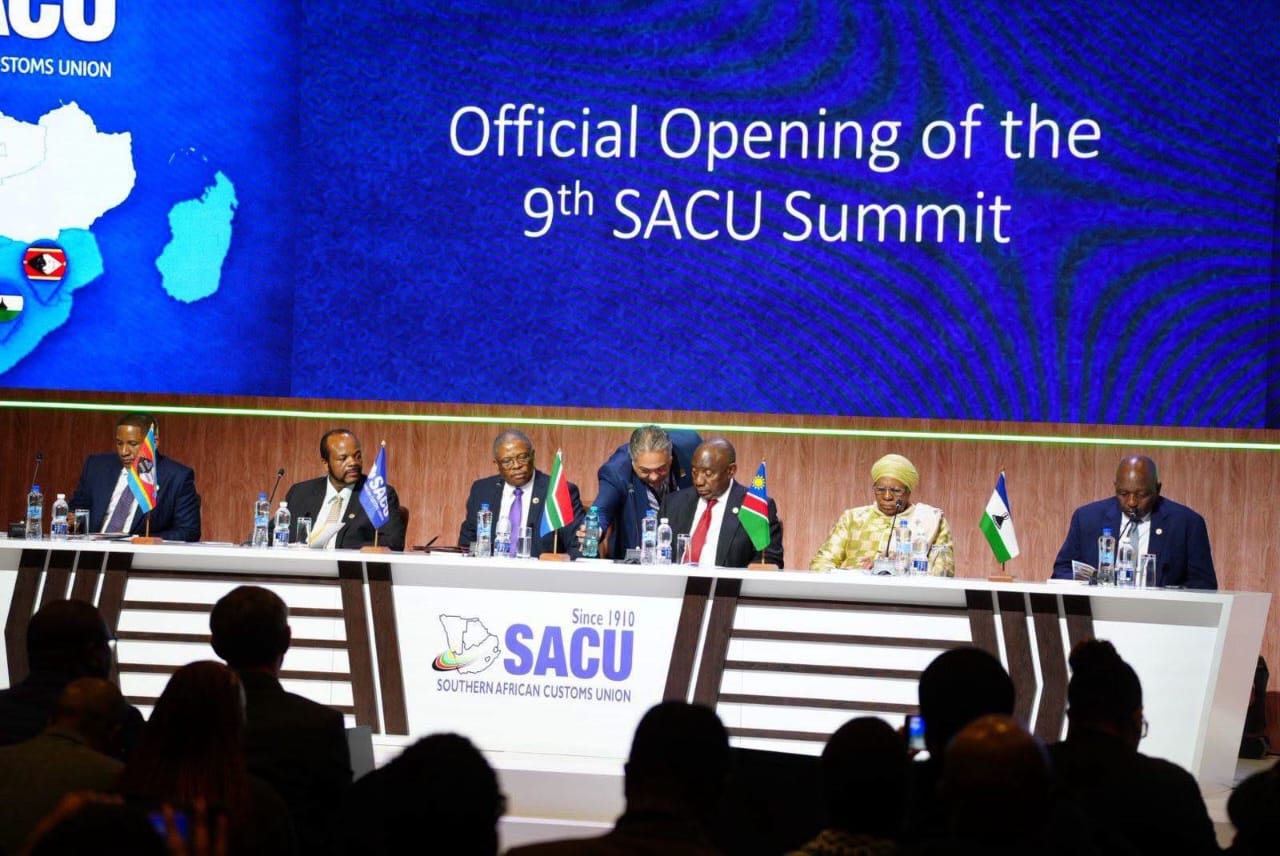
CAPE TOWN – President Cyril Ramaphosa has singled out Eswatini’s energy interconnections with South Africa and Mozambique as a shining example of the type of regional cooperation that the Southern African Customs Union (SACU) should embrace to drive industrialisation and economic resilience.
Addressing the opening of the 9th SACU Summit of Heads of State and Government in Cape Town on Friday, Ramaphosa said shared infrastructure projects such as Eswatini’s cross-border energy links demonstrate the practical value of regional integration and should serve as a blueprint for future development across Southern Africa.
The summit is being attended by His Majesty King Mswati III, alongside fellow SACU Heads of State and Government from Botswana, Lesotho, Namibia and host South Africa.
Ramaphosa said as the global economy undergoes unprecedented transformation, regional cooperation has become more important than ever before.
“Eswatini’s energy interconnections with South Africa and Mozambique demonstrate the same value,” he said while highlighting successful regional infrastructure projects that have strengthened economic cooperation among member states.
He said the region must continue investing in roads, railways, ports, energy grids, digital networks and water systems that support not only individual economies but an integrated regional economy capable of competing globally.
According to Ramaphosa, projects such as the Lesotho Highlands Water Project, the proposed Trans-Kalahari Railway linking Botswana and Namibia, and Eswatini’s energy partnerships illustrate how regional infrastructure can unlock economic opportunities for all member states.
The South African President used his address to call for the transformation of SACU from being primarily a customs and revenue-sharing arrangement into a driver of industrial development, investment and economic self-reliance.
He noted that while SACU remains the world’s oldest customs union, established in 1910, it now faces the responsibility of adapting to rapidly changing global economic conditions characterised by trade tensions, supply chain disruptions and growing uncertainty.
“It is time to move away from the traditional role of SACU as a customs arrangement and towards being the premier platform for regional economic resilience and self-reliance,” Ramaphosa said.
He warned that institutions which fail to adapt risk becoming “custodians of the past rather than architects of the future.”
Ramaphosa recalled that when SACU leaders met in Eswatini in June 2023, they resolved to develop a coordinated response to global economic shocks that had emerged after the COVID-19 pandemic. That meeting resulted in what has become known as the Re-imagined SACU Agenda.
Three years later, he said, the international trading environment remains fragile, making the implementation of that agenda even more urgent.
“In such a world, no African country, regardless of its size, can prosper alone,” he said.
“Our strength will increasingly depend on the strength of our region.”
Ramaphosa said Africa must reduce its dependence on external markets and build stronger regional value chains capable of withstanding global economic shocks.
He argued that frameworks such as the African Continental Free Trade Area (AfCFTA) and SACU provide an opportunity to deepen intra-African trade while strengthening the continent’s economic sovereignty.
Despite global challenges, Ramaphosa said SACU economies have remained resilient due to stronger regional integration, diversified export markets and effective measures to cushion against external shocks.
He said the bloc’s combined economy is projected to grow by 2.64 percent in 2026 before moderating slightly to 2.1 percent in 2027.
The President also pointed to encouraging progress in regional cooperation across several sectors.
He cited collaboration among farmers on citrus and sugar cane production as well as joint efforts between South Africa and Botswana to develop Foot and Mouth Disease vaccines.
He further welcomed the work of the SACU Task Team on Automotive and Mineral Beneficiation, which met in Maseru earlier this year to explore opportunities in battery manufacturing and cross-border automotive component production.
In outlining the strengths of each member state, Ramaphosa specifically highlighted Eswatini’s manufacturing sector as an important building block for regional industrialisation.
He said Eswatini’s manufacturing base, Lesotho’s textile industry, Namibia’s green hydrogen and uranium processing potential, Botswana’s expertise in diamond beneficiation and South Africa’s automotive and steel industries should be integrated into a regional industrial ecosystem capable of competing globally.
“Industrialisation is the only durable path from commodity dependence to an economy capable of sustaining our growing populations,” he said.
Ramaphosa also urged member states to leverage Africa’s vast mineral wealth by promoting beneficiation instead of exporting raw materials.
With Africa possessing about 30 percent of the world’s mineral reserves, he said SACU countries have an opportunity to establish regional value chains that create jobs and add value within the continent.
The President said attracting greater private investment would be crucial to financing shared infrastructure and industrial development.
He also welcomed progress towards establishing a SACU Regional Development Fund in partnership with the African Development Bank, describing it as an important step towards accelerating development across member states.


Reflecting on SACU’s history, Ramaphosa noted that the customs union was originally created during the colonial era to serve imperial interests.
However, he said today’s leaders have an opportunity to redefine its purpose.
“One hundred and sixteen years ago this Union was created to serve an empire. Today it must serve the aspirations of free African nations,” he said.
“Its original purpose was to move goods. Its future purpose must be to create opportunity.”
Ramaphosa concluded by urging member states to choose unity over fragmentation, industrialisation over dependence and shared prosperity over narrow national interests.
He expressed confidence that the current generation of African leaders could transform the world’s oldest customs union into one of the continent’s most dynamic engines of regional development.
Following his address, Ramaphosa officially declared the 9th SACU Summit of Heads of State and Government open as leaders, including His Majesty King Mswati III, began deliberations on strengthening regional integration, industrialisation and economic cooperation across the five-member customs union.


Discussion about this post