



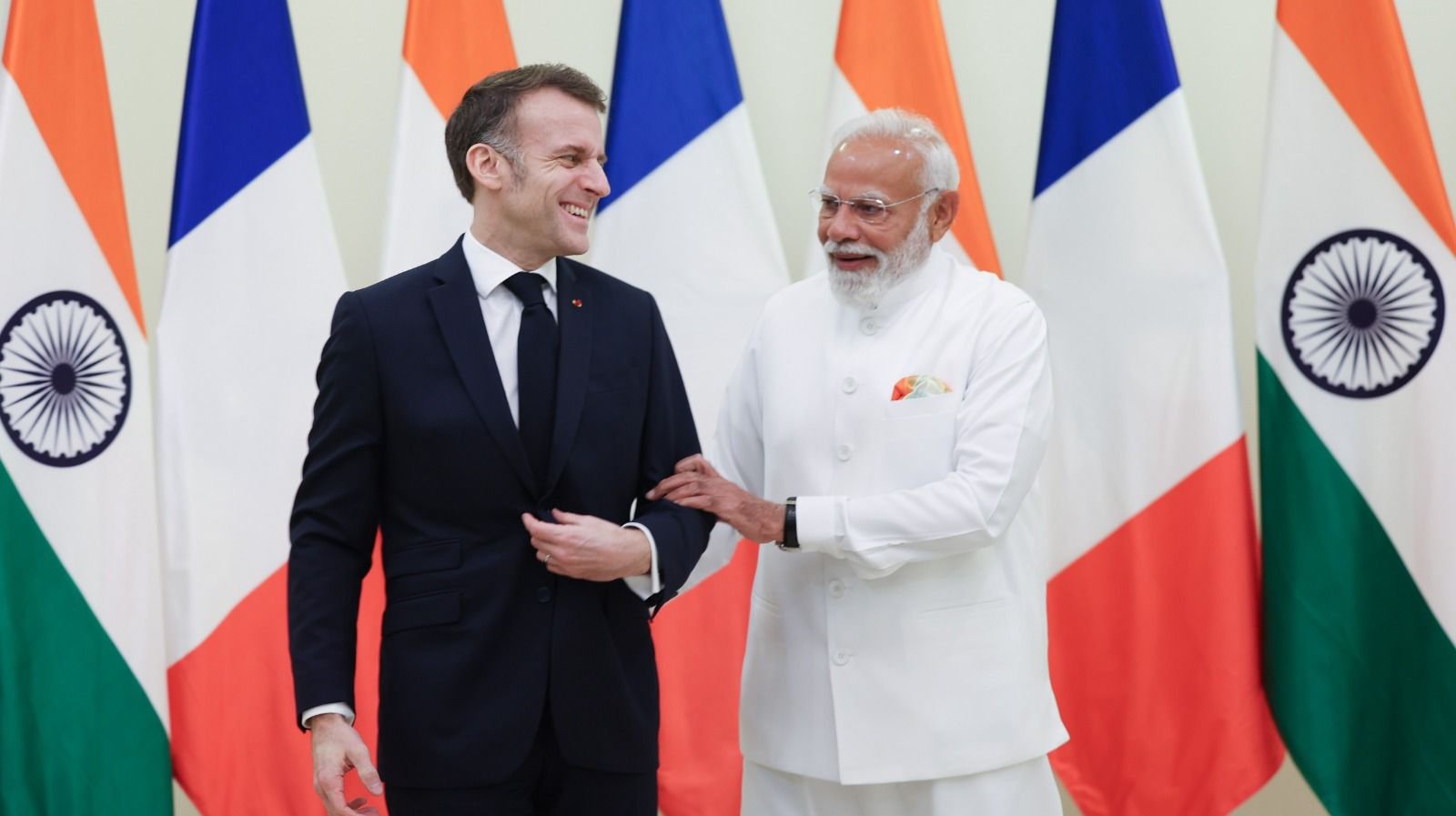
New Delhi, India – President Emmanuel Macron of France paid an official visit to India from 17 to 19 February 2026 at the invitation of Prime Minister Narendra Modi, where he also took part in the Artificial Intelligence Impact Summit 2026.
The visit, President Macron’s fourth to India, followed Prime Minister Modi’s trip to France in February 2025. The two leaders held bilateral talks and jointly launched the 2026 India France Year of Innovation in Mumbai on 17 February.
During the meetings, the leaders agreed to elevate their relationship to a Special Global Strategic Partnership, a move intended to steer cooperation in the decades ahead. The decision builds on the 25th anniversary of their Strategic Partnership marked in 2023, when both countries adopted the Horizon 2047 Roadmap to guide relations up to 2047, a year that will mark 100 years of India’s independence and diplomatic ties between the two nations, as well as 50 years of their Strategic Partnership.
An annual Foreign Ministers Comprehensive Dialogue has been established to review progress in areas such as economic security, global issues and people to people exchanges.
Defence and security featured prominently in the talks. France remains one of India’s leading defence partners, with cooperation extending to co design, co development and co production of advanced platforms. The leaders welcomed the contract for 26 Rafale Marine fighter jets and ongoing collaboration involving Safran and Indian partners, including HAL, on helicopter engines and the Indian Multi Role Helicopter. They also marked the inauguration of a Maintenance, Repair and Overhaul facility for LEAP engines and another for M 88 engines used on Rafale aircraft.
The two sides jointly inaugurated the H125 Final Assembly Line, described as a first of its kind private sector helicopter manufacturing facility in India, combining TATA Advanced Systems and Airbus. They also noted the delivery of the sixth submarine under the Scorpene programme to the Indian Navy on 15 January 2025 and pledged continued cooperation in submarines.
Military cooperation has included the Varuna, Shakti and Garuda exercises in 2025, participation in space military drills and regular port calls. A Joint Advanced Technology Development Group will be set up to explore emerging and critical technologies and address supply chain vulnerabilities.
On the economic front, trade and investment ties have grown steadily. Both countries are working on trusted and resilient supply chains, safeguarding economic security and expanding collaboration in aerospace, energy, logistics, agri food, telecoms and technology. The leaders welcomed the amendment to their bilateral tax treaty and progress on digital payments, with France becoming the first European country to offer India’s UPI system, now accepted at several flagship stores in Paris.
Cooperation in civil nuclear energy is set to deepen, including discussions on large capacity plants and emerging technologies such as Small Modular Reactors and Advanced Modular Reactors. They reviewed developments on the Jaitapur Nuclear Power Plant project and called for renewed collaboration between India’s Department of Atomic Energy and the French Alternative Energies and Atomic Energy Commission.
Climate change and environmental protection formed another key pillar of the discussions. The leaders reaffirmed commitment to the Paris Agreement and to holding global temperature increases well below 2 degrees Celsius above pre industrial levels, while pursuing efforts to limit the rise to 1.5 degrees. They pledged to support the work of the Intergovernmental Panel on Climate Change and continue joint initiatives under the International Solar Alliance and the Coalition for Disaster Resilient Infrastructure, both headquartered in New Delhi.
Global issues were also addressed. The two leaders reiterated their call for reform of the United Nations Security Council and France restated its support for India’s permanent membership. They discussed the war in Ukraine, expressing support for a comprehensive, just and lasting peace through dialogue in line with the UN Charter. Developments in Iran and the Middle East were reviewed, with both leaders backing diplomacy and the implementation of Resolution 2803 on Gaza, along with a two state solution.
President Macron invited Prime Minister Modi to attend the G7 Summit to be hosted by France in 2026 and to engage in preparatory discussions on global macroeconomic imbalances and new forms of international partnership. He also recalled the invitation to the “Africa Forward: Partnerships between Africa and France for Innovation and Growth” Summit scheduled for 11 and 12 May 2026 in Nairobi, Kenya. Prime Minister Modi welcomed the invitations and pledged constructive engagement.
For African countries such as Eswatini, where partnerships in renewable energy, digital innovation and youth skills development remain central to national priorities, the strengthened India France cooperation in areas such as energy transition, artificial intelligence, agriculture and the blue economy could present indirect opportunities through trilateral and multilateral frameworks.
The two leaders also launched the India France Year of Innovation 2026, which will feature collaborations across science and technology, cyberspace, artificial intelligence, healthcare, sustainable development, culture and research. A new India France Innovation Network will link startups, businesses and research institutions in both countries.


Educational and cultural exchanges are set to expand, with a target of welcoming 30,000 Indian students to France by 2030, up from 10,000 currently. The leaders also supported greater mobility under the Migration and Mobility Partnership Agreement and Young Professional Scheme, alongside a six month pilot visa free transit arrangement for Indian nationals through French airports.

Discussion about this post