



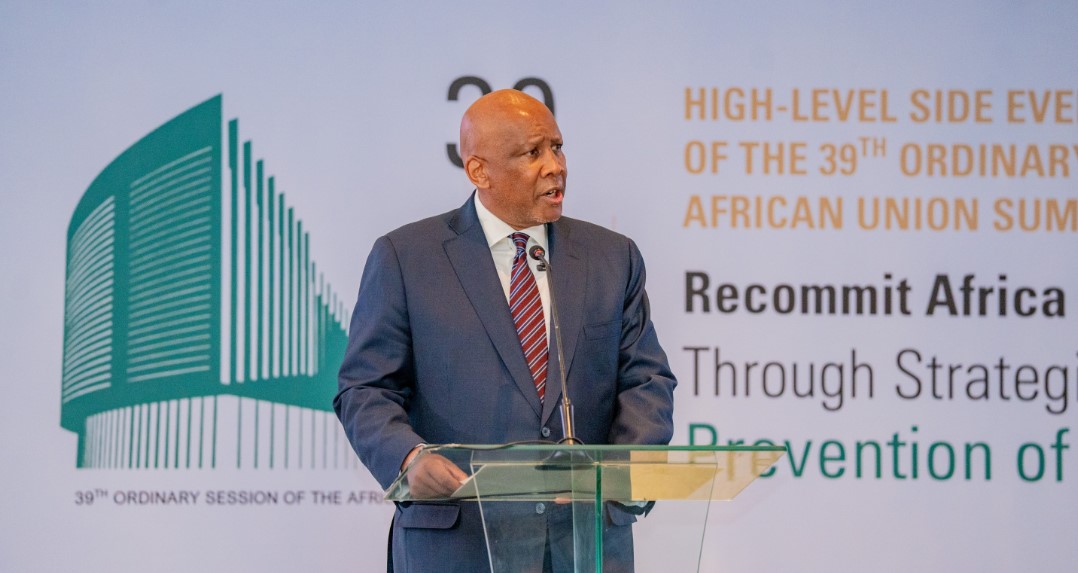
ADDIS ABABA – His Majesty King Letsie III spoke at a high-level side event on the margins of the 39th Ordinary Session of the African Union Summit, pressing African leaders to act on child survival and nutrition. The event, held on February 13, 2026, brought together deputy prime ministers, ministers, development partners and distinguished guests in Addis Ababa, Ethiopia.
Eswatini’s Minister for Foreign Affairs and International Cooperation, Pholile Shakantu, attended alongside Eswatini Ambassador to Ethiopia, His Excellency Mahlaba Mamba, and Senator Tony Sibandze.
Speaking as the African Union Champion for Nutrition, King Letsie said millions of children continue to die from preventable causes and that no nation can claim progress while its children lack the most basic chance to survive.
“Child survival is not merely a technical issue reserved for health experts. It is a political choice. It is a measure of leadership. It is the clearest signal of whether development is working for the most vulnerable members of society. When a child dies from preventable malnutrition, it reflects not a lack of knowledge, but a failure of priorities,” he said.
The King noted that nearly five million children under five die each year globally from preventable causes, with malnutrition contributing to almost half of these deaths. In Africa, he said, these deaths persist not because solutions are unavailable, but because interventions are not implemented at scale with urgency and sustained investment.
“For mothers and children, survival hinges on access to basic nutrition from pregnancy through the first five years of life. These interventions are among the most proven and cost-effective in public health. They save lives quickly and strengthen health systems. Yet child mortality on the continent is once again rising.”
King Letsie said the summit comes amid global uncertainty, including conflict, climate shocks, economic strain and reduced international assistance, which place pressure on fragile health systems. He warned that without decisive action, millions more children could die unnecessarily by the end of the decade.


“These challenges are real, but they do not excuse inaction. They demand clarity and resolve. When resources shrink and systems weaken, children and mothers are always the first to suffer. Nutrition is the earliest protection a society provides, beginning at conception, and it is too often the first area to be compromised under fiscal pressure,” he said.
The King outlined proven nutrition interventions that reduce mortality and disability, including maternal nutrition, prevention and treatment of anaemia, early and exclusive breastfeeding, complementary feeding, vitamin A supplementation, and management of acute malnutrition.
“The science is settled. The costs are known. Scaling these interventions across sub-Saharan Africa would require approximately US$3.5 billion per year — about US$13 per pregnant woman and US$17 per child under five annually. This is not an unaffordable ambition but a test of political will,” he said.
He urged African governments to treat nutrition as central to national development strategies, noting millions of children are born with low birth weight and anaemia affects a high proportion of women and children, undermining health and resilience.
The event, co-hosted by Nutrition International, the African Union Commission, the African Development Bank and World Vision, aimed to push for funded action on nutrition. The Minister of Foreign Affairs and International Relations, Honourable Lejone Mpotjoane, participated in a panel discussion.
King Letsie concluded that child survival is both a moral imperative and a responsibility of leadership.


Discussion about this post