



Mbabane – A new Afrobarometer survey has revealed that while Eswatini is steadily closing the gender gap in education and employment, girls and women continue to face discrimination, harassment and cultural restrictions that limit their opportunities for growth.
Released on 12 August 2025, the findings were compiled by Sipho S. Kunene, a research consultant with QA Strategic Information, Afrobarometer’s national partner in the kingdom. The survey paints a mixed picture: progress in access to education and professional opportunities on one hand, and persistent gender-based obstacles on the other.
Education nearly equal, but harassment remains
Survey data show that Emaswati are overwhelmingly supportive of girls’ education, with 96 percent of citizens saying families rarely or never prioritise boys over girls. The statistics also point to near-equal attainment levels between boys and girls across primary, secondary and post-secondary schooling.
Yet the reality in classrooms tells another story. Almost three in ten respondents (29 percent) said schoolgirls often face discrimination, harassment or even sexual advances from teachers. Women were more likely than men to share this view, and perceptions of harassment were stronger in cities than in rural areas.


Kunene noted that this contradiction reflects the deeper cultural and institutional issues facing the country: “While access to school is no longer the main barrier, the environment within schools is still unsafe for too many girls,” he said.
Unequal employment opportunities
Employment is another area where gender gaps persist. Among working-age adults, men are slightly more likely to hold full-time jobs than women (23 percent compared to 19 percent). Almost half of women surveyed reported being unemployed but actively searching for work.
Citizens identified three main barriers to women’s advancement in the workplace: lack of childcare, rigid work arrangements, and employer preference for men. A further concern is that one in three citizens said women are often prevented from taking jobs by their spouses or family members. This problem was reported most frequently in households experiencing severe poverty.
Despite these barriers, Eswatini’s Global Gender Gap Index ranking remains relatively strong at 47th out of 146 countries, comparable to Luxembourg and Singapore. Analysts attribute this position to near-parity in education, improved health outcomes and progressive legal reforms.
Representation in politics still low
On the political front, there is strong public backing for gender equality. Eight in ten Emaswati (82 percent) said women should have the same chance as men of being elected to office. However, women currently occupy only 22 percent of seats in Parliament, which is below the 30 percent requirement set by the Constitution.
The survey noted that women themselves were more likely than men to support equal opportunities in leadership. Support was also higher among citizens with secondary and post-secondary education compared to those with only primary schooling.
Harassment in public spaces
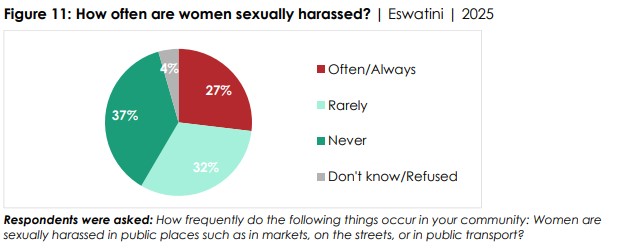
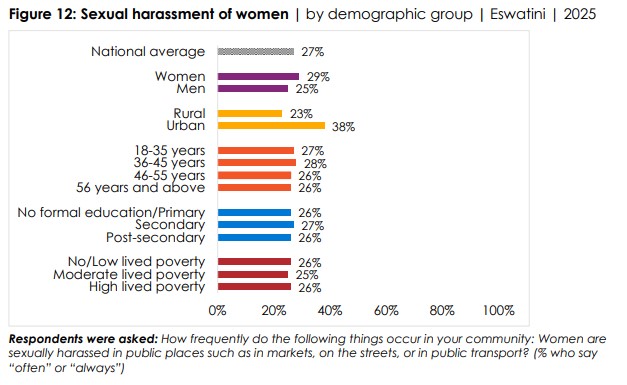
Afrobarometer’s findings also reveal that harassment extends beyond schools and workplaces into public life. More than a quarter of respondents (27 percent) said women often face sexual harassment in markets, public transport and on the streets. The perception was especially pronounced in urban areas, where 38 percent of citizens said such incidents are common.


Although three-quarters of respondents believe that women who report harassment or discrimination are likely to be taken seriously, an equal proportion expressed dissatisfaction with law enforcement. Seventy-four percent of citizens said the police and courts are not doing enough to protect women and girls.
Survey details
The Afrobarometer survey was carried out between April and May 2025, interviewing 1,200 randomly selected adults across Eswatini. With a margin of error of plus or minus three percentage points, the survey provides a reliable national snapshot of public attitudes towards gender equality.
For Kunene, the findings show both progress and unfinished work. “The kingdom has made significant gains in education and access to work, but we cannot overlook the continuing realities of harassment, cultural barriers and underrepresentation,” he said.
Afrobarometer, a non-partisan research network, has conducted surveys in Eswatini since 2013, tracking how citizens view democracy, governance and quality of life. This latest survey is part of its Round 10 series covering more than 40 African countries.

Discussion about this post