



Mbabane- The International Monetary Fund (IMF) has cut Eswatini’s economic growth forecast for 2026 to 3.7 per cent from 4.0 per cent, warning of a more challenging global environment shaped by geopolitical tensions, rising prices and unequal gains from technological investment.
The Fund has also trimmed its projection for 2027 to 3.4 per cent from 3.5 per cent, signalling weaker growth expectations for the country over the next two years.
The revised projections, contained in the IMF’s October 2026 World Economic Outlook (WEO) released on Tuesday, represent downward adjustments of 0.3 and 0.1 percentage points for 2026 and 2027, respectively, compared with its April outlook.
The downgrade comes as the global economy faces competing pressures, with investment linked to artificial intelligence supporting activity in some countries while higher energy and food costs threaten growth in others.


For Eswatini, the revised outlook comes alongside an otherwise relatively stable inflation forecast and a projected current account surplus, although these indicators do not eliminate the risks posed by a deteriorating external environment.
The IMF expects consumer price inflation in the country to ease from 3.1 per cent in 2025 to 2.9 per cent in 2026 before rising moderately to 3.2 per cent in 2027.
These projections remain below the Fund’s estimated inflation averages for Sub-Saharan Africa, where consumer prices are expected to increase by 8.6 per cent in both 2026 and 2027. Inflation among middle-income countries is projected at 4.3 per cent in 2026 and 4.5 per cent in 2027.
On the external front, Eswatini is expected to retain a current account surplus, although the margin is projected to narrow. The surplus is forecast to decline from 2.4 per cent of gross domestic product (GDP) in 2025 to 1.8 per cent in 2026 before recovering slightly to 1.9 per cent in 2027.


The current account measures a country’s transactions with the rest of the world, including trade in goods and services, income and transfers. A surplus indicates that receipts exceed payments over the period measured.
Globally, the IMF projects economic growth of 3.1 per cent in 2026 and 3.4 per cent in 2027. While the 2026 forecast remains unchanged from the April outlook, the projection for 2027 has been revised upwards.
However, the Fund cautions that these headline figures mask increasingly divergent economic performances, as the benefits of technology-related investment and favourable commodity prices are concentrated in particular economies.
Countries with stronger links to the technology investment boom are benefiting from increased demand and investment, while economies exposed to higher import costs face pressure on production expenses and household purchasing power.
The IMF also expects global headline inflation to rise to 4.7 per cent in 2026 before easing to 4.1 per cent in 2027, with higher energy and food prices contributing to the near-term increase.
The Fund warns that the economic consequences of the ongoing conflict in the Middle East could worsen if hostilities persist or escalate. Sustained increases in energy prices can raise the cost of transporting goods and producing essential commodities, feeding through to consumer prices and leaving households with less money for other spending.
For businesses, higher input and transportation costs can squeeze profit margins, while households may face reduced purchasing power as essential expenditure absorbs a greater share of their income.
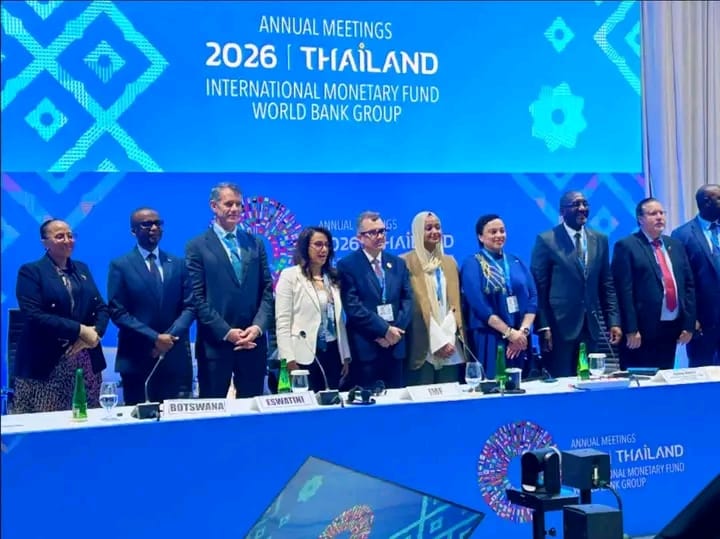
The IMF’s latest outlook was released during the IMF and World Bank Group Annual Meetings, taking place in Bangkok, Thailand, from October 12 to 18.
Eswatini is represented at the meetings by Minister of Finance Neal Rijkenberg, Central Bank of Eswatini Governor Dr Phil Mnisi, Principal Secretary in the Ministry of Finance Vusi Dlamini and other senior government officials.
The revised projections place the country’s growth prospects against a global backdrop in which resilience is being tested by geopolitical uncertainty and uneven economic gains. The extent to which these risks affect Eswatini will depend on how external price pressures and changes in global demand translate into domestic economic activity.


Discussion about this post