



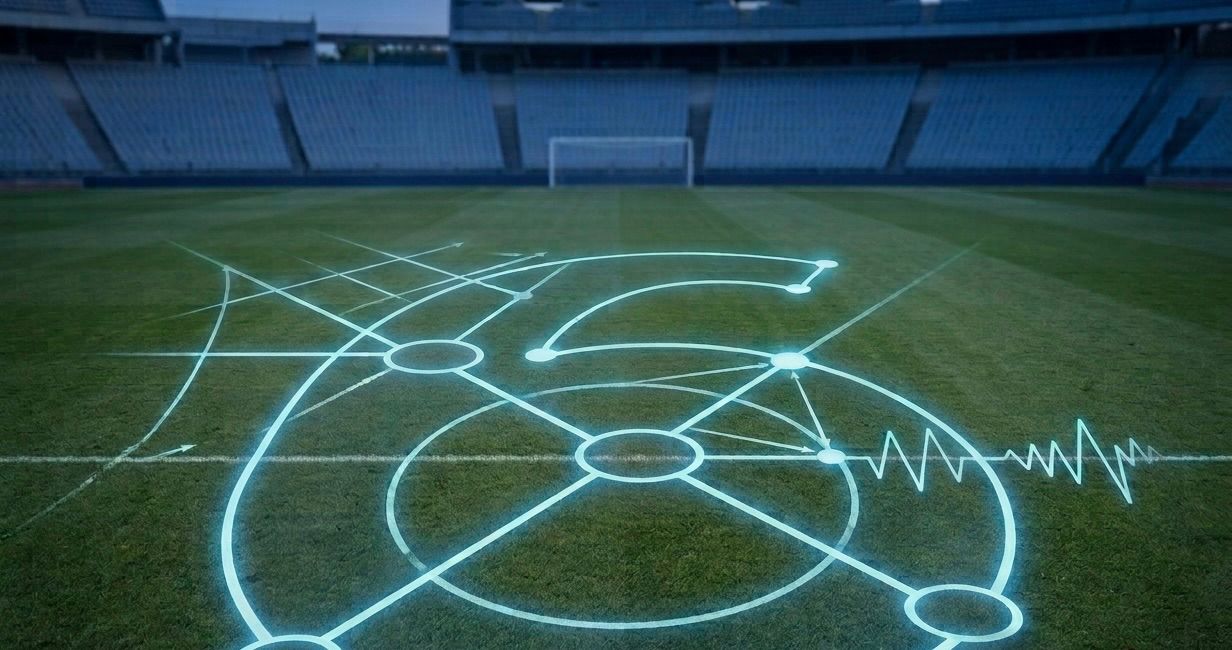
The modern game clogs the holding midfield position by assigning two players instead of one. The double pivot is ineffective. Deploying multiple occupants is not tactical safety or prowess; it is a doubt that one player can perform the duty. Cluttering the team’s engine defeats its motor.
Even superficial doubles, like inverting a fullback (as a low pivot, not a high attacker) or advancing a center halfback to create a numerical overload, crowd, inviting additional defenders. It does not matter whether a dilemma forms for the defense or whether the fullback or center halfback provides an effective ball recovery because of their proximity—the defense tracks, and you recover mistakes because you make them, being there for both.
Everyone wants space, but the knack is in accessing it. You can pinch in a fullback for a hybrid double and open a flank. The defense pursues and amasses atop the permanent holder. You worsen their circumstances, creating a target-rich environment and suffocating the very player and transition you are supporting.
You can exploit a flank through tactical simplification and the basic principles of play. If you have quality players, do not overcomplicate; if you do not, then you cannot. By removing excess pivots, you liberate one. Vacating the space releases it, allowing them to shift play toward freedom—accessing it is an ordeal when you crowd the transition.


Letting players locate freedom rather than tactically engineering it makes the entry smoother. You do not need an ornate strategy to construct a workable flank—the space does not need tons. The area that requires widening is the transition, not only for superficial doubles but also for permanent ones.
When resilient players move attacks toward freedom under unnecessarily congested circumstances, success is jerky. Even if the goal is not as much about flank space as about outnumbering your central midfield opponents to monopolize possession or counter intense pressing, the double pivot is coarse.
Numbers-up possession can exist with double pivots, but custody does not. The defensive, holding, or deep-lying midfielder falls under a single role that shapes their team’s structure and play, and it does not optimize with two individuals.
Dual security is a myth. The argument that more bodies are safer is shortsighted—it lacks team trust in fielding quality over quantity. It is similar to adding a center halfback and playing with three in a five-player backline. When you place two, you clutter the workspace.
The holding midfielder defines what it means to occupy a role. The position must be free to operate—to move and track, to hold, to govern the game’s pulse, and to manage its rhythm. Football is a spatial art. To find balance, one must anchor the center and define it. You halve the efficiency by fielding two because they occupy the same passing lanes, obscure each other’s vision, and complicate defensive duties and offensive options. The first step in clarification—identifying the middle—is decluttering.
If your team lacks a pure 6, create or scout one. This truth applies to both youth and senior levels. Instead of unearthing and developing exceptional talent, modern football prioritizes budgets and mass production over world-class standards and consummate potential.
Modern football obsesses with “system players” who are safe, rather than free ones who are threatening. I believe in structuring development, but not at the expense of product lines that turn versatility into interchangeability, killing adaptability, and replacing it with jacks-of-all-trades instead of experts—the proficiency to acclimate must pair with the mastery to dominate.
We must restore the premium to our standard and rebuild football around the apex of human capacity. The effort put into discovering and developing authoritative players is what gives rise to pristine 6’s and mastered roles.
Pure 6’s exist—the question is, are we willing to uncover, develop, and let them handle? The holding midfielder must be the exclusive keeper of the pivot. When two inhabit the space, the overfill absolves responsibility. Requiring two to move in tandem and divvy the workload is involved. The position does not require two busy players; it needs one streamlined player.
A true holding midfielder is the anchor and the pendulum. The value of the single pivot is that it provides a fixed point around which the team operates. They are the reference for the center halfbacks and creative ranks. Because there is only one, the spacing of the 8s, 10s, wingers, and everyone is organic. The supporting cast operates naturally because they can identify the valve. When you introduce a second holder, you complicate the alleviation.
Instead of a single player who knows when and how to hold and move, and who spreads the ball, shatters lines, and defends because they are free to do so, you get an extra body, creating a bottom-heavy, inefficient line that complicates defensive responsibility and attacking potential. You lose every efficiency in ball progression and defensive maneuvering. The holding midfielder is as much an attacking force as a defensive one, and placing two limits them. They are a commanding, unaccompanied role autonomously regulating the game. Refusing to let one labor and jumbling their duties with those of another encumbers them.


The lone is a vote of confidence in one’s ability to read and secure a critical space. When a single player masters it, the team’s formation knows its intent. The team understands that the ball recycles through a focal point. The strength of the 6 is not in its numbers, but in its placement. Multiplying it segregates every positive you would not if you allowed it to operate freely. By vacating the space and opening it to one player, you integrate the role, as they can embody it.
Football must reclaim the 6 through the accountability of one. You cannot expect the space to work without the player becoming it. The contemporary game squeezes, and teams must vacate the central deep area for a single, deft conductor to thrive. Returning to the game’s purity in this instance is what matures the sport.
Regardless of where you place the double pivot in tactical history, football has employed this contemporary setup for a duration, and the favored gracelessness of the two-trend over the classic one sterilizes the position. Two players appear when teams fear the opposition. When a manager worries, the double pivot responds.
I esteem the 6 and believe in its independence. I value regularizing it for both formidable and impotent opponents, and the 6 requiring autonomy—I trust it because I know the 6’s disposition is the space’s medium. Splitting it detaches, giving slack instead of a non-delegable responsibility. The 6 must hold the space and be diligent to thrive in the freedom to conduct.
Shallow solutions never merit success. They create luck and make you repeat them. When victorious, teams fear popular managers, and adept players are. The 6’s agency harmonizes a team more than over-designing.
Managers must stand tall. They must trust that makeshift solutions are as useful as they are fortunate. Plunking an additional player into a personal space is cynical and impractical. It suppresses a designated player’s impact by overcontrolling—what looks like sharp maneuvering on paper is not.
The game has not lost its distinction from the flourishing role it once had, but it is closing. The remaining few are hanging by a thread. The position is not a luxury but a reclamation of responsibility. The 6 not only represents those brave enough to stand alone, but also symbolizes those who are brave enough to let them.
“About the Author
Rob Fisher is the Executive Director and Head of Scouting at Fisher Talent Group, a football scouting NGO in Eswatini dedicated to grassroots youth development, talent exposure, and education. A former U.S. Peace Corps Volunteer in Eswatini (2010–13) who coached Mswati II Methodist High School to a national semi-final, Fisher returned in 2023 and has scouted over 6,000 youth players.
The views in this article are the author’s own.”


Discussion about this post