



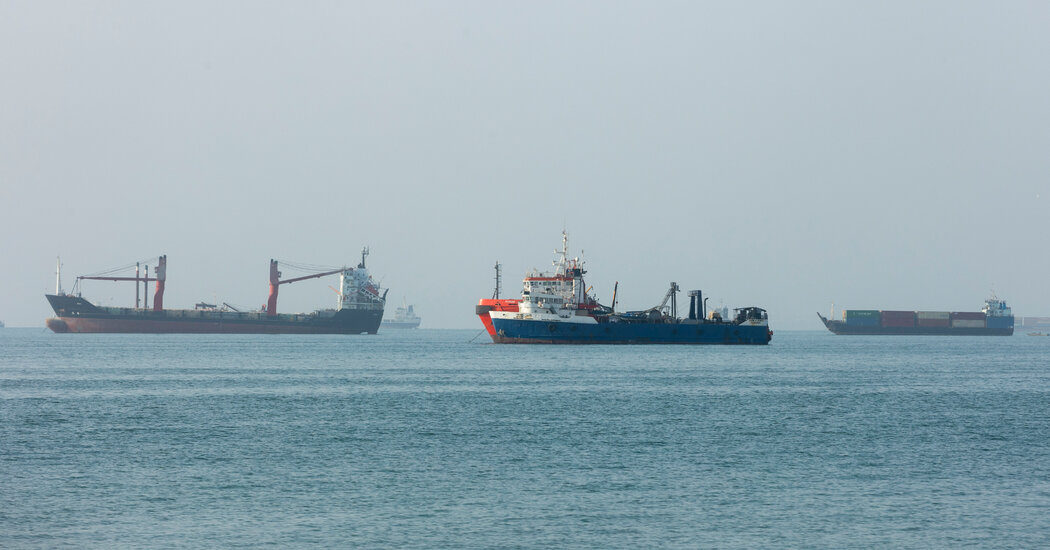
“The Hormuz Strait is OPEN, and will remain OPEN, with or without Iran,” President Trump insisted again Monday in a Truth Social post, announcing a reinstatement of the U.S. military blockade of Iranian ports and associated vessels.
“We are reinstating the THE IRANIAN BLOCKADE, so named because it is only stopping Iran’s ships or customers from entering or leaving. All other countries will have fair and open use of the Strait.”
Mr. Trump declared that the U.S. would henceforth be “known as ‘THE GUARDIAN OF THE HORMUZ STRAIT,’ but as such, and as a matter of FAIRNESS, will be reimbursed, at the rate of 20% on all cargo shipped, for any and all costs necessary to do the job of providing safety and security to this very volatile section of the World. The process and formation will begin immediately.”
The U.S. military’s Central Command said Monday that the latest attacks on Iran hit “a submarine and ship maintenance facility” at Bandar Abbas Naval Base on the country’s southwest coast in the Strait of Hormuz.

CENTCOM said in its social media post that the strikes were carried out using “three Corsair unmanned surface vessels … marking the first time American forces have employed sea drones in combat operations.”
“Last night’s strikes degraded Iran’s ability to continue attacking commercial shipping,” CENTCOM said.
The post was accompanied by black and white video, labeled “unclassified,” that showed a small watercraft approaching a raised dock structure holding what appeared to be a submarine before blowing up.
“Due to recent hostile actions by the US forces, passage through the Strait of Hormuz is currently unfeasible,” Iran’s Persian Gulf Strait Authority declared in a social media post Monday.
“As soon as stability and calm are restored, all applications will be reviewed in accordance with the scheduled timeline, and the permitting process will resume,” the PGSA added, reminding vessels that in Iran’s view, “the sole means of obtaining a passage permit” to transit the strait is through its website.
The PGSA was created by Iran during the war and Tehran insists that all commercial vessels wishing to transit the waterway seek permission via the agency and then use a northern route, close to Iran’s coast.


Iran does not recognize the legitimacy of a southern route through the strait, close to the Omani coast, that the U.S. insists is open and available. Iranian forces have attacked multiple vessels trying to use the route.
Iranian and U.S. authorities have argued publicly, via social media, for days about whether the strait is open or closed, with President Trump insisting it remains open via the Omani route, and declaring on Monday that the U.S. will “keep” control of the waterway “and we’ll probably run it.”
After condemning Iran for weeks over suggestions that it would charge commercial ships for passage, President Trump told Fox News on Monday that the U.S. was “going to get paid for guarding it, a lot of money.”


Discussion about this post