



Mbabane – The Central Statistical Office (CSO) has released Eswatini’s Gross Domestic Product (GDP) estimates for the second quarter of 2025, showing a 3.4 percent increase on a seasonally adjusted year-on-year basis. The figures reflect continued economic activity across key sectors and improved performance compared to the 0.6 percent growth recorded in Q2 2024.
The GDP estimates were compiled using the Production approach, which calculates the sum of Gross Value Added (GVA) across all industries at market prices. The quarterly data are seasonally adjusted to account for fluctuations caused by weather, holidays, and other seasonal factors. Annual GDP figures have been rebased from 2011 to 2019 to better reflect current economic conditions. The estimates follow the System of National Accounts (SNA 2008) and the International Standard Industrial Classification (ISIC Rev. 4).
Sectoral data reveal varied performance. The primary sector, contributing 8.1 percent to total GDP, fell by 6.1 percent year on year, largely due to declines in forestry (-9.4%) and mining and quarrying (-22.7%). The secondary sector, accounting for 31.9 percent of GDP, grew 6.7 percent, supported by manufacturing (6.1%), electricity supply (6.6%), water supply (4.1%), and construction (12%). The tertiary sector, the largest contributor at 52.6 percent, expanded 3.7 percent, with strong growth in information and communication (17.5%), professional services (15.1%), transport (3.1%), financial and insurance activities (4.1%), and wholesale and retail trade (2%).
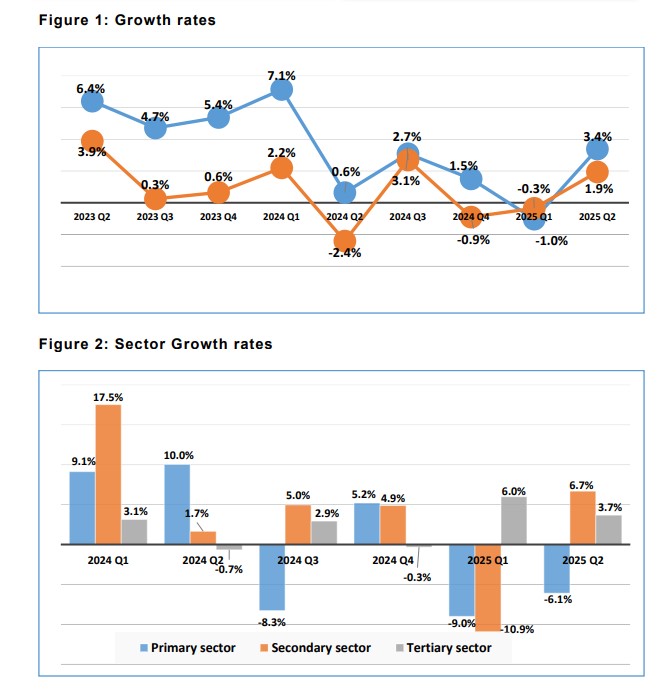
Quarter-to-quarter growth also improved, rising 1.9 percent in Q2 2025 following a -0.3 percent decline in Q1. The revisions in quarterly GDP reflect benchmarking against the recently published 2024 annual GDP figures to enhance accuracy. FISIM (financial intermediation services indirectly measured) is now allocated among industries rather than as a separate line item.


Tables in the report show detailed industry contributions in current and constant prices, with agriculture, forestry and fishing at E1,560 million, manufacturing at E5,689 million, and wholesale and retail trade at E3,189 million in Q2 2025. Sector shares to GDP indicate that the tertiary sector remains the dominant driver of economic activity, while the primary sector continues to face challenges.


The Ministry of Economic Planning and Development thanked all data providers for their contributions to compiling the estimates and encourages stakeholders to follow developments in the country’s economic performance.
To access the report, click on the link below.


Discussion about this post