



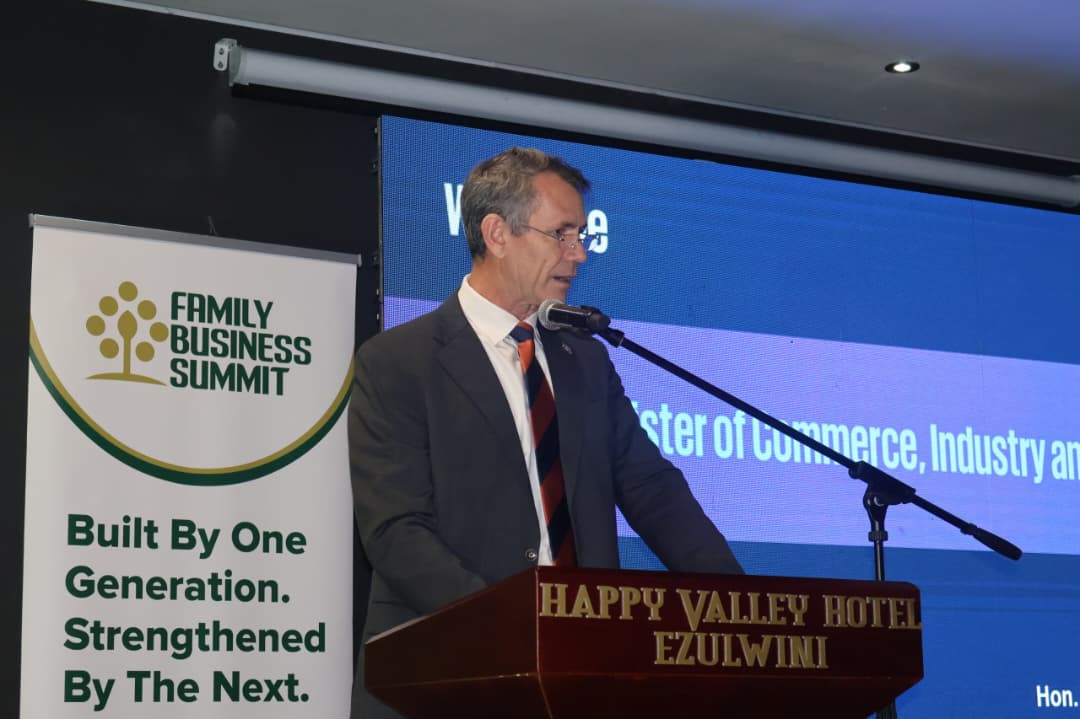
Ezulwini – The Minister for Finance has challenged Eswatini’s family-owned businesses to put succession and governance structures in place if they are to survive beyond the generation that established them and grow into major enterprises.
Rijkenberg said the failure of businesses to transition from their founders to the next generation remained a challenge for Eswatini, despite the significant contribution family enterprises make to the economy through employment, production and community development.
The legislator was speaking on Thursday when he officially opened the third Family Business Summit at Happy Valley Hotel on behalf of the Minister of Commerce, Industry and Trade, Senator Manqoba Khumalo.
He said family businesses had an advantage over companies driven primarily by short-term financial results because their owners could take a longer-term view of the enterprise.


“Unlike publicly traded corporations driven by quarterly results, family-owned enterprises often prioritise sustainability over immediate gains,” Rijkenberg said.
He said this long-term orientation could help family businesses withstand difficult economic periods, preserve jobs and build enterprises that could be transferred from one generation to another.
However, the Minister said this potential was often undermined when businesses lacked clear succession plans and governance arrangements.
He said some family enterprises had remained dependent on their founders and eventually collapsed after their deaths, depriving the country of businesses that could otherwise have continued contributing to the economy.
Rijkenberg said the challenge was therefore not simply to establish more businesses, but to ensure that existing family enterprises developed the structures needed to grow and survive.
He urged business owners attending the summit to use the discussions to strengthen governance, address internal conflicts and establish succession arrangements before they became necessary.
“We do not want to return to the era of pointing out dilapidated structures which are the skeletons of businesses that were once successful. Instead we want to celebrate businesses that have survived for generations,” he said.


The Minister said successful succession could also help family businesses move beyond the domestic market and develop into internationally competitive companies.
He pointed to global brands that had either remained family-owned or grown from family enterprises as examples of the scale that could potentially be achieved.
According to Rijkenberg, the government is prepared to support the development of locally owned enterprises through initiatives including the Citizens Economic Empowerment Act, the MSME National Policy and the Ingelo Certification Scheme.
Examplery, the Ingelo scheme, he said, was aimed at supporting local micro, small and medium enterprises producing goods with significant market potential.
He also called for the knowledge generated at the summit to reach businesses that could not attend the event, particularly MSMEs operating outside the country’s major commercial centres.
The summit, held under the theme “Building Resilient Legacies: Embracing a Multi-Generational Mindset,” brings together family businesses and other stakeholders to discuss governance, succession, resilience and strategies for creating wealth across generations.
Rijkenberg said the participation of local business owners alongside external experts was important because it allowed international experience to be considered within the realities of the Eswatini business environment.
The summit was organised with support from REDI, KPMG Private Enterprises, Standard Bank and Sothaba Enterprises Associates, with participants also drawn from neighbouring South Africa.

Discussion about this post