



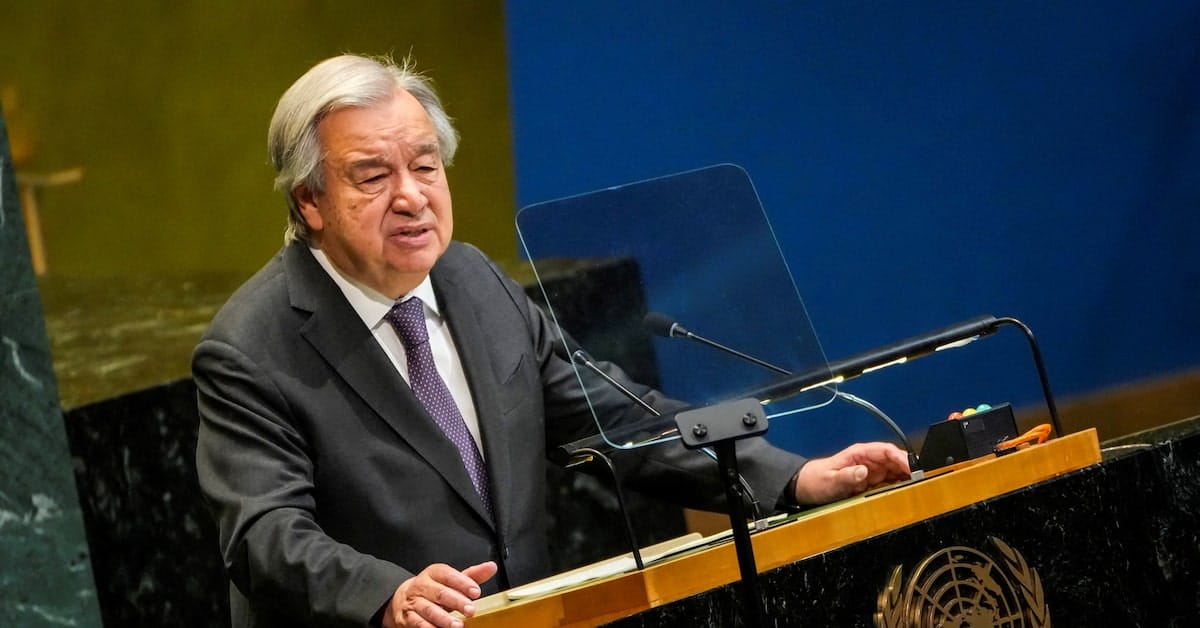
Mbabane – United Nations Secretary-General António Guterres has described Africa’s continued absence from permanent membership of the UN Security Council as “indefensible”, putting the continent’s long-running demand for a greater voice at the centre of the global reform debate.
Guterres made the remarks as world leaders gathered in New York on Tuesday for the opening of the 81st session of the United Nations General Assembly, attended by His Majesty King Mswati III, who was accompanied by Inkhosikati LaNgangaza. The high-level general debate is being held from September 22 to 26 and resumes on September 28.
The UN chief said the world was changing and international institutions had to change with it, arguing that updating global structures should not mean abandoning the principles of the UN Charter.
“This is 2026 – not 1946,” Guterres told African leaders earlier this year, describing the absence of permanent African seats on the Security Council as “indefensible”.

Africa’s position is anchored in the Ezulwini Consensus and the Sirte Declaration. The African Union is calling for no fewer than two permanent Security Council seats for Africa, with the same prerogatives as existing permanent members, including veto rights while the veto remains, as well as five additional non-permanent seats.
The demand has been repeatedly raised by African leaders over the years, including the late Zimbabwean President Robert Mugabe, who criticised the exclusion of Africa from permanent membership and backed the continent’s call for reform of the Council.
The issue continues to receive support beyond Africa. Russia has endorsed the African reform model and said increasing the representation of Africa and other Global South regions should be part of Security Council reform. However, Moscow has also made clear that it wants the existing veto system retained and has raised concerns about the size and composition of an expanded Council.
South Africa is also using the 81st General Assembly to push for permanent African representation. Its Permanent Representative to the UN, Ambassador Mxolisi Sizo Nkosi, said Security Council reform remains an important part of Pretoria’s agenda and that South Africa is seeking support for the African position contained in the Ezulwini Consensus.


The Security Council currently has 15 members, five of them permanent members with veto power and 10 elected members serving two-year terms. Africa currently has no permanent seat.
Guterres said reform was necessary because power was shifting and the world was changing, but warned that stronger institutions were needed rather than a weaker United Nations.
“The world does not need a weaker United Nations,” he said. “It needs a UN strong enough to face the world as it is – and determined enough to build the world as it should be.”
Beyond Security Council reform, the Secretary-General placed artificial intelligence among the major challenges requiring stronger international cooperation.
He warned that AI development was moving rapidly while understanding of its risks was still developing, calling on governments to take responsibility for protecting citizens and urging countries to establish international safeguards.
Guterres said AI did not stop at national borders and therefore required global coordination, warning against a “race to the bottom” on AI safety.
He called for the safe, secure and responsible development of AI, with stronger safeguards where increasingly powerful systems present greater risks.
The Secretary-General also addressed the conflicts in the Middle East and Ukraine, calling for de-escalation, diplomacy and dialogue and stressing the protection of civilians and access for humanitarian operations.
On Gaza, he called for full implementation of the peace plan and unrestricted humanitarian aid, while saying that lasting peace in the Middle East would require a two-State solution.
On Ukraine, Guterres called for an immediate ceasefire as a first step towards a just, lasting and comprehensive peace in line with the UN Charter, international law and relevant UN resolutions.
With roughly 100 days remaining in his term, Guterres said the world was facing deep uncertainty, shifting power and challenges that could not be addressed by countries acting alone.
He said the UN remained more than a platform for governments, describing it as a promise to uphold international law, protect human rights, invest in sustainable development and work for peace.
At the centre of that challenge is the question of whether global institutions can adapt to a changing world while ensuring that regions such as Africa have a permanent voice in decisions affecting international peace and security.

Discussion about this post