



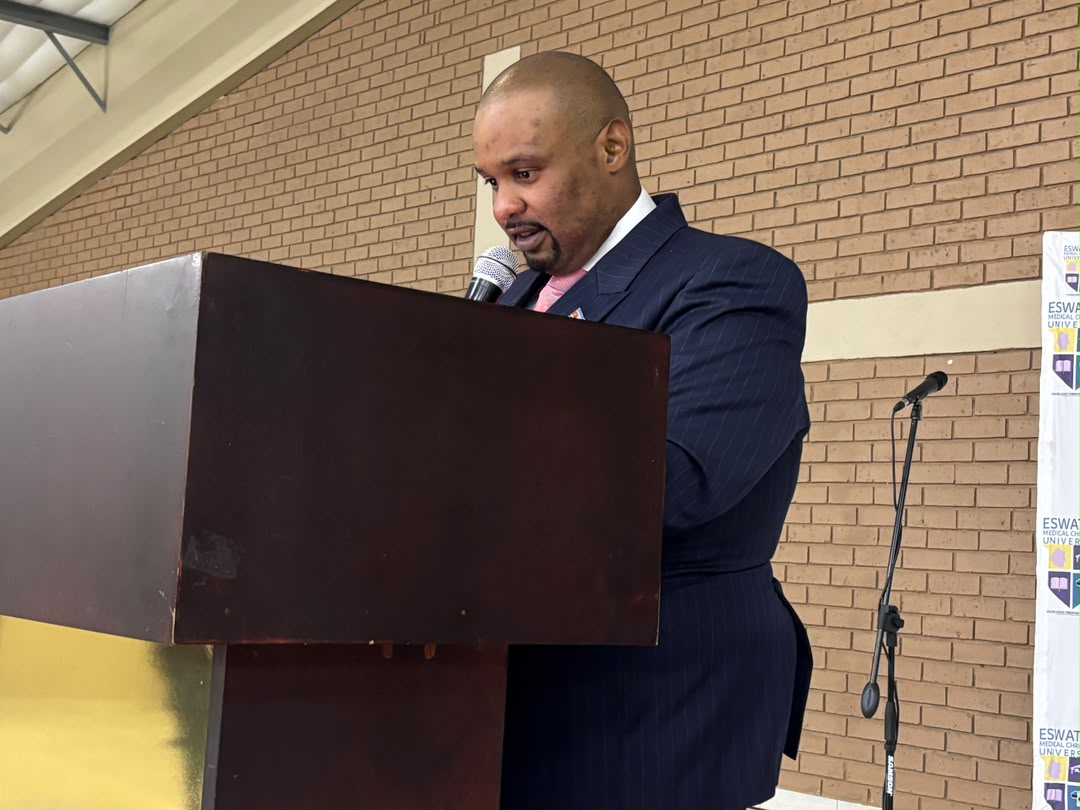
Mbabane – Senator Sphelele Mkhonta has told first-year students at the Eswatini Medical Christian University (EMCU) that their backgrounds should not determine how far they go in life, using his own journey from Pigg’s Peak to the Senate as proof that education can change a person’s circumstances.
Mkhonta was speaking during the university’s first-year orientation and registration programme on Monday, where he challenged the new students to take their education seriously and use it as a pathway to better opportunities.
“A young boy born of the dust streets of Pigg’s Peak stands before you today as a Senator, exactly 40 years into my life. I want to say to you students, it is possible, it is doable, it is achievable with the right attitude,” he said.
He told the students that among them could be future chief executive officers, Cabinet ministers and senators, but said achieving such positions would require commitment, determination and the right attitude.

“Amongst you sits a future CEO, a future Cabinet Minister, a Senator. As I leave here today, you now remain with the responsibility to identify who amongst you is one of the above-mentioned. Mine is to tell you, it is possible; yours is to push towards that direction,” Mkhonta said.
Education as the great equaliser
Mkhonta centred his address on the theme ‘Education: The Social Equaliser’, arguing that academic qualifications can help level the playing field between people from different social and economic backgrounds.
He said education gives young people the knowledge, skills and credentials needed to compete for opportunities regardless of where they come from.
“When you present your CV for a vacant position, they don’t ask about your background. The recipient of that document looks at the details in front of them. They don’t care if you were born of a rich or poor family; all that speaks to them is your relevant qualification for the advertised position,” he said.
According to Mkhonta, this is where education becomes a social equaliser because a person’s family background may no longer carry the same weight once qualifications and skills are placed before an employer.
He said education also creates an environment where talent and hard work can compete with social disadvantage.
“Education offers a shared classroom space where talent and hard work can outweigh a disadvantaged background,” he said.
Mkhonta further described education as a source of empowerment, particularly for people from communities that have historically had fewer opportunities.
He said education gives people the confidence and voice to participate in society and claim their social and civil rights.
“It is possible”
Drawing from his own experiences, Mkhonta reminded the students that he, too, had once been a first-year student sitting through an orientation programme.
He recalled being addressed during his own university orientation by Professor Tess, who presented a research paper titled ‘Education is a Social Equalizer’.
Years later, Mkhonta said, he was standing before the new generation of students as a senator.
He told them that his journey should serve as encouragement that their present circumstances do not have to determine their future.
He also quoted Ecclesiastes 9:11, which states that success does not always belong to the swift or the strong, but that “time and chance happen to them all.”
Mkhonta said the students should therefore remain focused on the goals they had set before leaving home for university.
“As you enter this new journey of your life, the set goals made while you left home are three or four years away from you. With the right attitude, determination and focus, it is possible,” he said.
Pledges support to students
Mkhonta also pledged his support to the students as a local resident while they pursued their studies and careers.
He encouraged them to view their admission to EMCU not simply as an academic opportunity, but as the beginning of a journey that could change their lives and those of their families.


The orientation programme brought together EMCU management, academics, staff, student representatives and the new students as they began their university studies.
Mkhonta said the students should leave university with more than certificates, but with the confidence and ability to contribute meaningfully to society.

Discussion about this post