



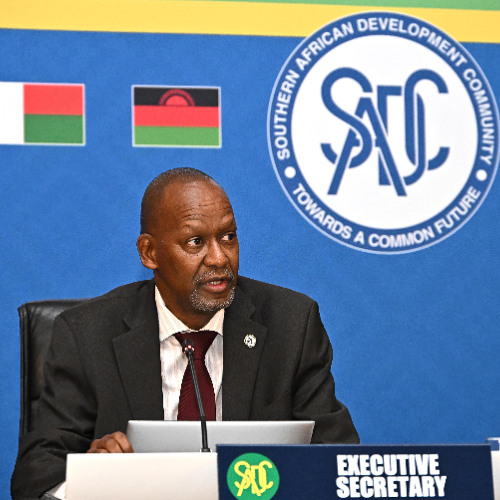
Southern African Development Community (SADC) Executive Secretary Elias M. Magosi has called for greater alignment among member states in diplomatic positions.
Magosi warned that the region risks remaining vulnerable to global shocks unless it speaks with one voice on key international issues.
Addressing the Retreat of SADC Ministers of Foreign Affairs at Skukuza in the Kruger National Park, Mpumalanga, South Africa, on Friday, Magosi said the changing global order demanded stronger regional solidarity, coordinated diplomacy, and accelerated economic integration.
He told ministers that diplomacy could no longer be limited to political engagement alone, but must become an instrument for economic transformation, strategic positioning, and regional integration. “Greater alignment is critical in our diplomatic positions, strategic partnerships, and participation in multilateral forums,” Magosi said.


He urged SADC member states to increasingly coordinate positions on trade, finance, climate change, energy, peace and security, and the reform of global governance institutions.
According to Magosi, speaking with greater coherence and consistency would significantly strengthen the region’s bargaining power in global affairs, particularly at a time when the international landscape was undergoing what he described as one of the most profound transformations in modern history.
He said the world was experiencing intensifying geopolitical competition, economic fragmentation, technological rivalry, and growing uncertainty in international cooperation and multilateralism. The SADC executive secretary said since 2020, the world had endured overlapping crises beginning with the COVID-19 pandemic, followed by the Russia-Ukraine conflict and more recently escalating tensions and war in the Middle East.
“These events have exposed our region’s existential vulnerabilities,” he said.
Magosi noted that the crises had disrupted global systems in unprecedented ways, affecting trade flows, investment patterns, energy markets, financial conditions, and geopolitical alignments with far-reaching consequences for the region’s development.
He warned that developing regions such as SADC remained particularly exposed due to structural weaknesses, including dependence on imported energy, fertilisers, machinery, and industrial inputs.
He said constrained fiscal space, rising debt burdens, and insufficient economic diversification had further amplified the impact of global shocks on regional economies, contributing to inflationary pressures, unemployment, and social instability.
The executive secretary also highlighted the fragility of global supply chains, saying disruptions to maritime routes and logistics systems had demonstrated how vulnerable developing economies were to external shocks originating beyond their borders.
According to Magosi, these disruptions were affecting the affordability and availability of food, fuel, fertilisers, medicines, and industrial inputs essential for economic activity.
He said the agricultural sector was facing severe pressure due to rising input costs, climate variability, fertiliser supply disruptions, and outbreaks of animal diseases such as Foot and Mouth Disease.
“These pressures threaten agricultural productivity, rural livelihoods, export competitiveness, and regional food security,” he said.
Magosi stressed the urgent need for stronger regional cooperation in veterinary surveillance, biosecurity systems, research, vaccine access, and cross-border coordination.Despite the challenges, Magosi said SADC remained one of the most strategically endowed regions globally, possessing vast reserves of oil and gas, abundant renewable energy resources, critical minerals needed for the global energy transition, extensive agricultural potential, and strategic transport corridors.
However, he lamented that African economies continued to occupy the lower end of global value chains.
“We largely export raw or minimally processed commodities while importing higher-value manufactured goods,” he said. “In other words, we continue to export jobs and import inflation.”
Magosi argued that the pattern perpetuated dependence, limited job creation, constrained technological advancement, and exposed the region to volatility in global commodity markets.He said this reality compelled SADC to place industrialisation, beneficiation, and value addition at the centre of its development agenda.
On energy security, Magosi called for increased investment in power generation, transmission infrastructure, renewable energy systems, and cross-border electricity trade.
He also advocated for strengthening petroleum and gas independence through regional refining capacity, strategic fuel reserves, domestic exploration, and integrated oil and gas pipeline networks.
According to Magosi, strengthening regional energy integration through mechanisms such as the Southern African Power Pool would reduce vulnerability to external energy shocks and support industrialisation and economic growth. He further stressed the importance of transport and logistics infrastructure, saying efficient ports, rail systems, road corridors, and border management systems were essential for reducing transaction costs, facilitating trade, and improving regional competitiveness.
Magosi also urged member states to strengthen domestic resource mobilisation and improve coordination on external financing and debt management. He warned that external financing arrangements were increasingly becoming linked to access to strategic resources, potentially limiting policy flexibility for developing economies. In this regard, he said the operationalisation of the Regional Development Fund (RDF) remained critical to regional integration.


According to Magosi, the RDF would provide SADC with an opportunity to mobilise resources for infrastructure and industrialisation programmes while reducing dependence on unsustainable external financing mechanisms. He said the retreat’s recommendations should ultimately contribute towards strengthening regional resilience, safeguarding stability, enhancing policy coherence, and accelerating implementation of the SADC regional integration and industrialisation agenda.
“The choices we make collectively will determine whether our region remains vulnerable to external shocks or emerges stronger, more resilient, and more self-sustaining,” Magosi said.
He urged member states to believe in their own capabilities and execute concrete interventions arising from the retreat.“We are adequate, we are capable, we are experienced, and we are talented enough to create a renewed, progressive, and truly integrated and resilient region,” he said.

Discussion about this post