



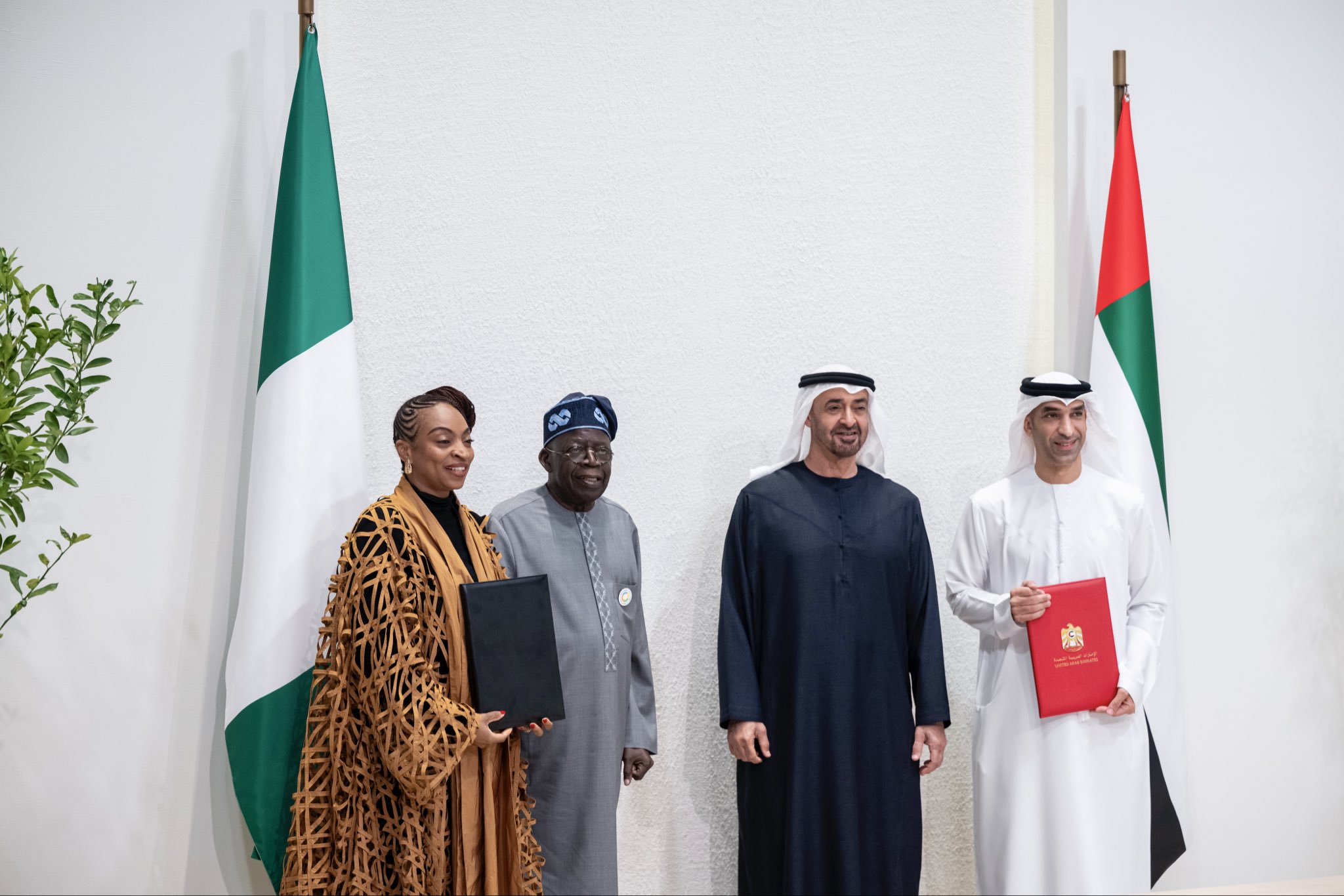
Abu Dhabi – The Federal Republic of Nigeria and the United Arab Emirates signed a Comprehensive Economic Partnership Agreement on 13 January 2026, creating a new framework for trade and investment between the two countries. Nigerian negotiations were led by Dr Jumoke Oduwole, Minister of Industry, Trade and Investment, with support from the Federal Ministry of Justice and the Nigeria Customs Service. UAE negotiator Dr Thani bin Ahmed Al Zeyoudi, Minister of Foreign Trade, signed on behalf of his country. The signing ceremony was witnessed by President Bola Ahmed Tinubu of Nigeria and President Sheikh Mohamed bin Zayed Al Nahyan of the UAE.
Dr Oduwole described the agreement as a strategic instrument for economic transformation, providing Nigerian businesses and professionals with open access to the UAE, the Middle East, and global markets. She noted the agreement removes tariffs on over 7,000 products and allows participation in 108 service sectors.

The CEPA establishes reciprocal tariff elimination on goods traded between the two countries. Nigeria immediately removes tariffs on 3,949 products from the UAE, with the remainder phased out over five years, while the UAE immediately eliminates tariffs on 2,805 Nigerian products and gradually on 3,042 others. Restricted items include pork, certain narcotics, asbestos, and used tyres. Nigerian exports to the UAE cover agricultural goods such as fish, cocoa, cereals, oil seeds, live animals, fruits, and nuts, as well as industrial products including pharmaceuticals, chemicals, machinery, vehicles, textiles, footwear, furniture, and cosmetics. UAE goods entering Nigeria include mineral fuels, machinery, vehicles, electrical equipment, iron and steel, plastics, pharmaceuticals, and consumer goods.
For services, Nigerian businesses can establish companies, branches, or representative offices in the UAE, and UAE service providers can operate in Nigeria under local regulations. Nigerian professionals can enter the UAE as business visitors for 90 days or as intra-corporate transferees for renewable three-year periods. Key sectors covered include tourism and hospitality, creative industries and media, professional services such as law, accounting, and architecture, financial services, healthcare, engineering, construction, distribution, cultural and recreational services, audiovisual and telecommunications services.



The agreement aligns with Nigeria’s commitments under the World Trade Organization, the African Continental Free Trade Area, and ECOWAS, while supporting the country’s non-oil export and economic diversification agenda. It also aims to remove barriers to foreign direct investment from the UAE, creating opportunities for job creation and industrial growth.
Authorities including the Federal Ministry of Industry, Trade and Investment, Nigeria Customs Service, Nigerian Export Promotion Council, and Nigerian Investment Promotion Commission will now coordinate to implement the agreement and facilitate trade and investment flows. Businesses seeking guidance on products, services, rules of origin, or export procedures can contact the Federal Ministry of Industry, Trade and Investment, the Nigerian Export Promotion Council, or the Nigeria Office for Trade Negotiations.


Discussion about this post