



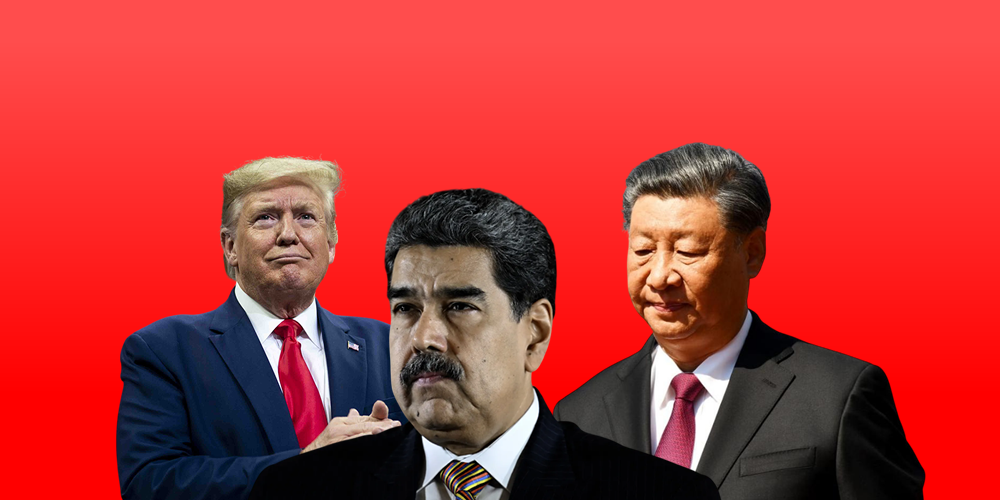
Washington DC – The United States has carried out a large scale military operation in Venezuela, capturing President Nicolas Maduro and his wife and removing them from the country, President Donald Trump announced on Saturday, 3 January 2025.
The operation follows months of escalating pressure between Washington and Caracas, officially framed by the US administration as part of its war on drugs but increasingly linked to a broader contest with China for influence in Latin America.
According to Trump, the strike took place in Venezuelan waters and territory after repeated US naval actions against vessels alleged to be linked to drug trafficking. The US president has long accused Maduro of running what he calls a narco state, claiming Venezuelan authorities facilitate cocaine trafficking, violence and human trafficking into the United States. Maduro has consistently rejected these claims, insisting Venezuela is not part of the drug trade and dismissing United Nations data cited by Washington.
The confrontation has unfolded mainly in the Caribbean and northern South America, where the US Navy has expanded its presence and carried out strikes on suspected drug boats. US troops have also been deployed for exercises near the Panama Canal, while intelligence operations intensified in Caracas over recent months.
Trump’s return to office in 2025 marked a sharper turn in US policy. His administration, led by Secretary of State Marco Rubio, adopted a hard line approach toward Latin America, viewing China’s expanding economic footprint as the main threat to US interests in the region. China has become the largest trading partner for several South American countries and has invested billions of dollars in infrastructure, ports, railways and mining projects through its Belt and Road Initiative.


Venezuela sits at the centre of this rivalry. It holds the world’s largest proven oil reserves and, despite years of US sanctions, continued selling crude to American refineries designed specifically to process Venezuelan oil. At the same time, Caracas deepened ties with Beijing after former president Hugo Chavez came to power in 1999, seeking economic support free from US political pressure. China later extended more than 60 billion dollars in loans to Venezuela, funding housing, transport and energy projects.
US officials argue that Beijing has used Venezuela as a strategic gateway into Latin America, while critics say Washington’s actions mirror a long history of intervention across the region. Over the past century, the US has sent troops or influenced political outcomes in countries including Panama, Cuba, Haiti, Chile, Argentina and Brazil, largely driven by strategic and energy interests.
In recent months, Maduro reportedly attempted to ease tensions by offering American companies dominant stakes in Venezuela’s oil, gold and mineral sectors and proposing to scale back exports to China. The offer was ultimately rejected by Washington, with Rubio arguing that removing Maduro could trigger political change in allied socialist governments such as Cuba and Nicaragua.
Following the breakdown of diplomatic communication on 6 October 2024, Maduro publicly appealed to Trump while also seeking military and technical support from China and Russia. Internal US documents suggest Caracas requested radar systems and deeper cooperation, though Beijing has so far avoided direct military involvement, continuing instead to receive oil payments to service outstanding debt.
The capture of Maduro raises fresh uncertainty across Latin America, where governments are watching closely amid fears of wider instability, economic fallout and new migration waves. Analysts warn that while the US move may weaken Chinese influence in Venezuela, it risks pushing the region further into geopolitical tension at a time when many countries are balancing relations between Washington and Beijing.


Discussion about this post