



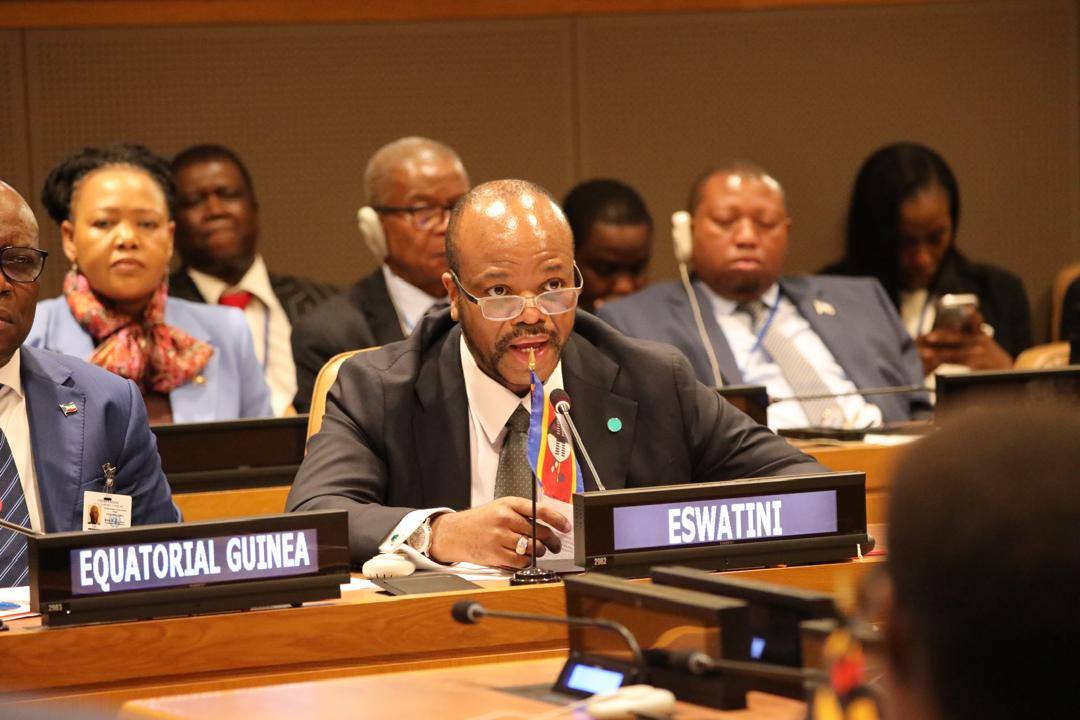
NEW YORK – His Majesty King Mswati III urged African leaders to reject coups and refuse to recognise governments installed through unconstitutional means during a special meeting of the African Union Peace and Security Council yesterday.
Speaking at the sidelines of the 80th United Nations General Assembly, the King said any attempt to overthrow a legitimate government must face consequences rather than acceptance. He told delegates that both the African Union and the United Nations have a responsibility to ensure that coups are never legitimised.
The gathering addressed key security challenges on the continent, including violent conflicts, unconstitutional power shifts, climate-induced instability, and transnational crime. King Mswati III drew on the AU’s 50th Anniversary Solemn Declaration and Agenda 2063, which commit to silencing the guns by 2030, as a framework for action.
Eswatini, now serving on the AU Peace and Security Council for the 2025-2028 term, will push for a reassessment of the council’s conflict resolution strategies. The King called for codifying successful interventions, creating a compliance unit under the General Assembly, and ensuring African solutions to African problems remain central. He also proposed fully operationalising the African Standby Force and increasing funding through the AU Peace Fund alongside innovative partnerships.

King Mswati III urged stronger coordination with regional and international partners, including Regional Economic Communities, the UN Security Council, the European Union, and the League of Arab States. He also supported reforms to the UN Security Council to secure Africa’s fair representation, in line with the Ezulwini Consensus.
The King called for swift implementation of AU-facilitated peace agreements and political transitions, warning that fragmented efforts have slowed progress. Guided by Eswatini’s principles of sovereignty, non-interference, and multilateral dialogue, he framed the address as a call for action rooted in African unity and determination.


The meeting included the AU Chairperson, the President of Angola, other heads of state, members of the AU Peace and Security Council, and the Chairperson of the African Union Commission.

Discussion about this post