



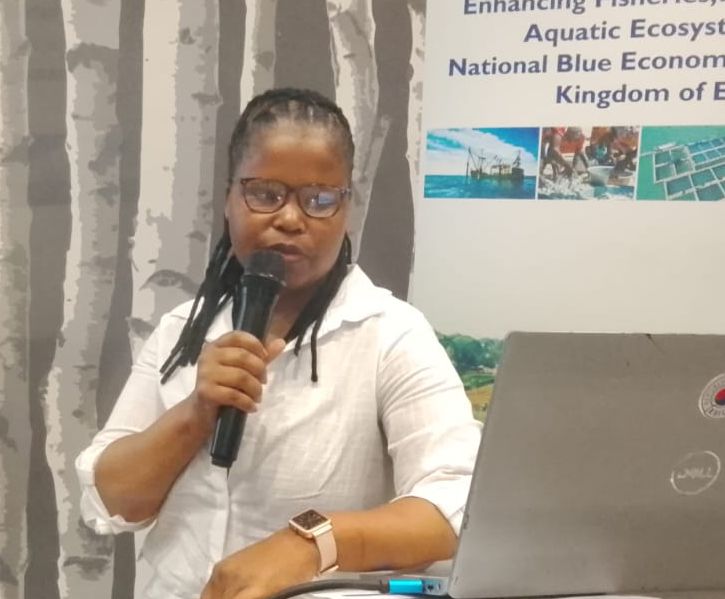
Mbabane – The University of Eswatini (UNESWA) lacks adequate facilities and equipment for practical aquaculture training and research, raising concerns about its capacity to produce skilled professionals who can help develop the country’s fish farming industry.
Dr Thabisile S. Sigwane, a Lecturer in the Department of Animal Science at UNESWA’s Luyengo campus, said this during the National Consultative Workshop on Enhancing Fisheries, Aquaculture and Aquatic Ecosystems in the National Blue Economy Strategy of the Kingdom of Eswatini.
She acknowledged UNESWA’s existing collaboration with the Aquaculture Research Centre, which provides access to laboratory facilities, a hatchery and an established fish farm. She said this partnership offered a foundation on which the university could build its research and training capacity.
Beyond the shortage of facilities, Sigwane highlighted the need for research that addresses the challenges experienced by fish farmers and communities.


She proposed investigating the social, technical, financial and institutional factors limiting the adoption, productivity and sustainability of small-scale fish farming in Eswatini.
The cost of fish feed was another area requiring attention. Sigwane said research should evaluate affordable, locally available feed ingredients and develop cost-effective formulations that support fish growth and health without unnecessarily increasing production costs.held at Hilton Garden Inn, Mbabane, from October 13 to 15, 2026.
Sigwane said the university had the potential to serve as a national centre for aquaculture innovation, fisheries management, aquatic ecosystem conservation and professional training. However, limited facilities and equipment were constraining its ability to strengthen practical teaching and applied research.
The university currently offers Principles of Aquaculture (ASC106) to Level 1 students and Aquaculture Production (ASC409) to Level 4 students. These courses provide foundational knowledge and practical skills relevant to aquaculture and fisheries in Eswatini.
Despite these academic programmes, Sigwane identified the need for investment in facilities and equipment to enable students to gain more practical experience and allow researchers to develop solutions to challenges affecting the sector.
She proposed establishing a modest aquaculture teaching and research unit equipped with experimental ponds or tanks to support practical classes, student projects and applied research.


The university would also benefit from basic water-quality monitoring equipment to measure dissolved oxygen, pH, temperature, conductivity, ammonia and nitrate. Such equipment would enable researchers to assess water conditions and identify potential risks to fish health.
Additional equipment for fish sampling, weighing, measuring and handling, as well as feed preparation and evaluation, would strengthen practical training and research into fish production.
The cost of fish feed was another area requiring attention. Sigwane said research should evaluate affordable, locally available feed ingredients and develop cost-effective formulations that support fish growth and health without unnecessarily increasing production costs.
Fish health problems also featured among the proposed research priorities, with the university seeking to investigate common diseases, strengthen farm-level biosecurity and improve the prevention, diagnosis and management of disease outbreaks and unexplained fish deaths.
She further identified the potential role of probiotics in improving water quality, fish health and production performance in aquaculture systems.
The impact of drought, seasonal changes and climate change on water availability and quality was another concern. Research into these challenges could help identify practical adaptation measures for fish farmers facing water shortages and changing environmental conditions.
Sigwane also proposed assessing the economic viability of small-scale aquaculture enterprises, including production costs, access to markets, profitability and opportunities for value addition.
Such research could help establish whether fish farming offers sustainable business opportunities for local producers and identify the challenges preventing enterprises from becoming profitable.
Meanwhile, Sigwane emphasised that expanding fish production should not come at the expense of the country’s freshwater ecosystems.
She said the development of aquaculture needed to be accompanied by measures to protect rivers, wetlands, native aquatic species and water quality.
Among the proposed interventions were baseline surveys of freshwater biodiversity and fish populations to provide information for conservation planning and sustainable fisheries management.
She also identified the need to monitor pollution, sedimentation, water abstraction and habitat degradation to determine which freshwater ecosystems required priority protection.
Responsible fish stocking practices, risk assessments and monitoring were proposed to prevent farmed fish from escaping into natural water bodies and to reduce the risk of introducing invasive and non-native species.
Sigwane further recommended environmental safeguards for fish farms, including appropriate effluent treatment, responsible chemical use and disease prevention to minimise the impact of aquaculture activities on surrounding water bodies.
She said climate-resilient aquaculture practices should promote efficient water use while taking into account competing domestic, agricultural, industrial and ecological needs.
To address these challenges, the university is proposing stronger collaboration among government, academia, industry and development partners.
Sigwane called for a national fisheries and aquaculture partnership network involving government departments, fish farmers, water authorities, environmental agencies, private-sector producers, regional universities, research institutions and development partners.
Such a network could support collaborative research, student placements and internships, technical training, shared use of facilities and equipment, joint funding applications and the exchange of knowledge.
It could also help generate research evidence and technical recommendations to guide government planning and policy development.
The proposals are aligned with the African Union’s Africa Blue Economy Strategy of 2019, which promotes sustainable resource use, wealth creation, stronger value chains, capacity development and the protection of aquatic ecosystems.
Under this framework, UNESWA could contribute through fisheries resource assessments, research into aquaculture production systems, freshwater conservation and the development of practical skills among students, extension personnel and prospective fish farmers.
The university could also support inclusive economic growth by promoting youth- and women-led fish enterprises, small-scale producers, entrepreneurship and value addition along the fish value chain.
The workshop, which runs from October 13 to 15, 2026, focuses on enhancing fisheries, aquaculture and aquatic ecosystem management within Eswatini’s National Blue Economy Strategy.
Sigwane’s proposals place emphasis on the need to strengthen the university’s research capacity, address the practical challenges facing fish farmers and ensure that the expansion of aquaculture is supported by environmental protection and sustainable resource management.
For Eswatini to realise the potential of its aquaculture sector, the proposed interventions point to the importance of equipping institutions responsible for training, research and innovation with the facilities and resources needed to support fish farmers and inform national policy.


Discussion about this post