



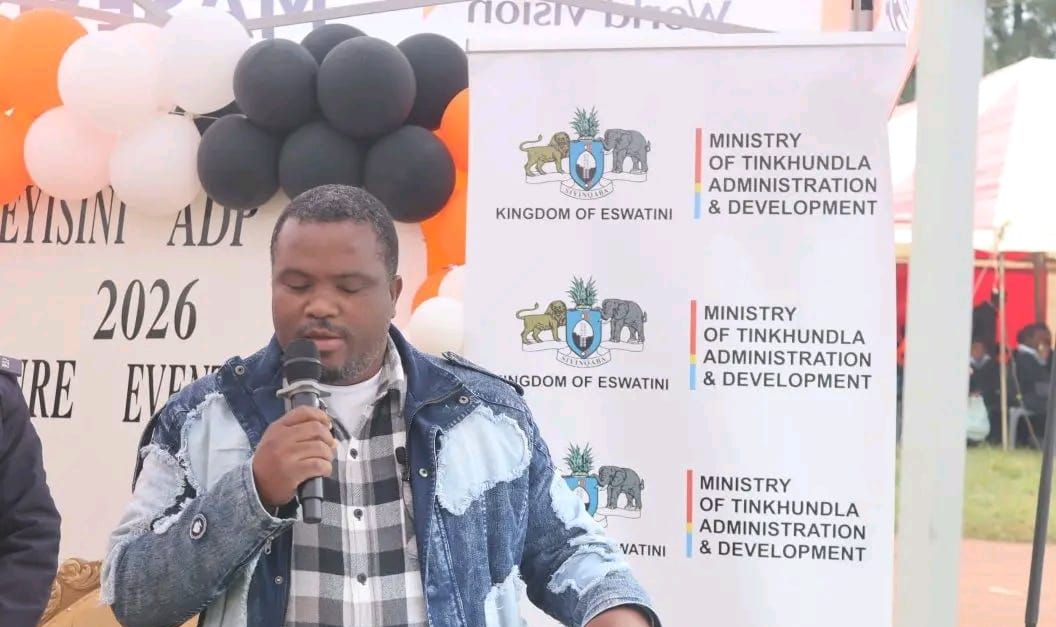
Mbabane- Minister of Tinkhundla Administration and Development Sikhumbuzo Dlamini has raised concern over the sustainability of rural water projects.
“ Millions of Emalangeni invested in providing communities with clean water could be wasted if adequate maintenance and accountability systems are not put in place” he said.
Dlamini said government and development partners had invested heavily in rural water infrastructure, but some communities were not sufficiently empowered to maintain and operate the systems once projects were completed.
He said the responsibility for such projects should increasingly be placed under government structures to allow proper monitoring of their operations and maintenance.


The Minister was speaking at the Maseyisini Area Development Programme handover event on September 30, 2026, where World Vision Eswatini marked the end of its direct programme presence in the area after nearly two decades of community development work.
He said the experience showed that providing infrastructure alone was not enough to guarantee sustainable access to water.
Dlamini cited Nkwene Inkhundla as an example, saying more than E90 million had been invested in rural water infrastructure in the area, yet residents had gone for about two weeks without water. He questioned the sustainability of projects where communities were expected to maintain infrastructure without adequate resources and institutional support.
The Minister also raised concerns about the management of community water committees, saying there were instances where committee members did not want to leave their positions even when community members wanted to elect new committees. He said there were also cases where there was no trace of how funds meant for the projects had been used, raising concerns about accountability and financial management.
Dlamini said such challenges made it difficult for communities to take full responsibility for water infrastructure, particularly where there were no funds available for maintenance. He said government needed to take a stronger role in overseeing the projects to ensure that their operations were monitored and that communities continued receiving water services.
His concerns come as Maseyisini celebrates significant gains in water access through the World Vision-supported programme. According to the Minister, approximately 4 000 households, benefiting more than 18 000 people, now have access to clean water through safely managed systems, solar-powered micro-schemes and reticulated water projects.
The partnership with the Eswatini Water Services Corporation connected 2 138 households, seven schools and two health facilities through a water network stretching about 145 kilometres, while Masibini reportedly reached approximately 90 per cent water coverage.
Dlamini said the government should learn from such investments by ensuring that communities are supported beyond the construction phase. He stressed that infrastructure must be accompanied by systems that ensure continued operation, maintenance and accountability.
The Minister’s comments came against a broader concern over the sustainability of rural water schemes, particularly where communities are expected to manage infrastructure without sufficient resources or oversight.
Dlamini said development projects should not simply be handed over to communities without ensuring that the structures responsible for their continued operation have the necessary capacity and resources.
He was addressing the Maseyisini community as World Vision concluded its direct programme presence after establishing the Area Development Programme in 2008 with support from World Vision US. The programme served approximately 28 800 people across six chiefdoms and implemented interventions covering water, sanitation, livelihoods, health, nutrition, education and child protection.


Dlamini said the end of World Vision’s direct presence should not mean the end of development in Maseyisini, but rather a transition towards greater community and government responsibility.
He urged government departments, community leadership structures and development committees to build on the gains made and address remaining gaps, particularly in water and sanitation.
“Let us continue expanding access to safe water and sanitation until every household is reached,” Dlamini said.
The Minister also encouraged communities to strengthen savings groups, agricultural initiatives and youth economic empowerment programmes while continuing to protect children and ensure access to essential services.
World Vision’s Maseyisini programme has also supported 26 schools with water, sanitation and hygiene interventions, while 14 schools received electrical and solar-powered boreholes. The programme further helped 3,600 households improve sanitation facilities and supported more than 1,500 farmers with climate-smart agriculture training.
Dlamini said the achievements demonstrated what could be accomplished when communities, government, traditional leaders, churches and development partners worked together, but stressed that sustainability would depend on what happens after external partners leave.
The Minister said the infrastructure and systems left behind should ultimately translate into lasting benefits for communities, particularly reliable access to clean water.


Discussion about this post