



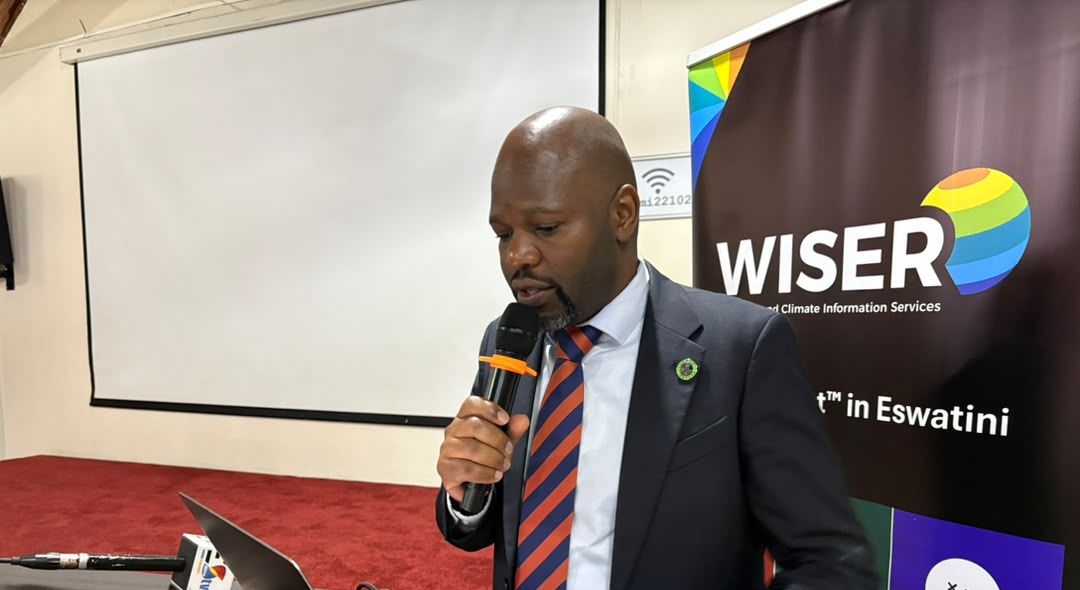
Ezulwini- The National Disaster Risk Management Authority (NDRMA) says weather warnings will have limited value if communities receive them too late, cannot understand them or are not told what action to take.
NDRMA Chief Executive Officer Victor Mahlalela said the country’s shift towards Impact-Based Forecasting (IBF) was intended to close this gap by changing how weather-related risks are communicated to the public.
Mahlalela was speaking during an Impact-Based Forecasting Media Engagement Workshop held at Sibane Sami Hotel in Ezulwini on Tuesday, where journalists were introduced to the approach being implemented by the NDRMA in collaboration with the Eswatini Meteorological Service (EMS).
Unlike traditional forecasting, which largely focuses on predicting weather conditions such as rainfall, wind speeds and temperatures, IBF seeks to explain what the forecast conditions could mean for people, infrastructure and livelihoods, including where the greatest risks could occur and what action should be taken.

Mahlalela said, for example, that telling communities that heavy rainfall was expected was not enough if the warning did not also communicate the possibility of flooding in low-lying areas, road disruptions, infrastructure damage or threats to human safety.
He said it was the connection between the forecast hazard, its potential impact and the action required that made early-warning information useful to communities.


The NDRMA CEO said the media had a critical role in this process because journalists were part of the country’s early-warning chain rather than merely recipients of technical information.
He said the words used by journalists, the questions they asked and the speed and platforms through which warnings were communicated could influence whether communities understood the risks and responded appropriately.
Mahlalela further warned that the rapid spread of information through social media made verification increasingly important during emergencies, as inaccurate or unverified information could circulate alongside official warnings.
He therefore called on media organizations to work closely with the NDRMA and EMS in verifying information and ensuring that authoritative warnings reached the public accurately and promptly.
The initiative is being implemented through the WISER Action First Co-Production Programme, with technical support from the World Meteorological Organization (WMO) and funding from the United Kingdom Government’s Foreign, Commonwealth & Development Office (FCDO).
Mahlalela said the implementation process had involved government ministries and departments, technical agencies, municipalities, humanitarian and development partners, communities and marginalized groups.
He also stressed that warnings needed to reach people who could face barriers in accessing information, including persons with disabilities, older people and young people.
According to Mahlalela, authorities would need to consider different languages, formats and communication platforms to ensure that warnings reached people in both urban and rural communities.
The broader objective, he said, was to strengthen a people-centred multi-hazard early-warning system in which scientific forecasts could be translated into practical decisions before hazards developed into disasters.
He said the country needed to move beyond simply forecasting hazards towards anticipating their impacts, communicating risk and enabling early action.
The media engagement formed part of efforts to strengthen collaboration between the NDRMA, EMS and media organizations in ensuring that early-warning messages are timely, accurate, accessible and actionable.


Discussion about this post